On this page
- Give each task a place on the calendar
- Follow water around the exterior
- Connect the roof visit to the right professional
- Prepare heating equipment before you depend on it
- Know the plumbing questions before a freeze
- Add the guest route to the maintenance list
- Review documents around the tasks you are doing
- Keep records that explain the work
- Use a small budget to prioritize the next appointment
- Close the month with the open items
- Sources and reference material
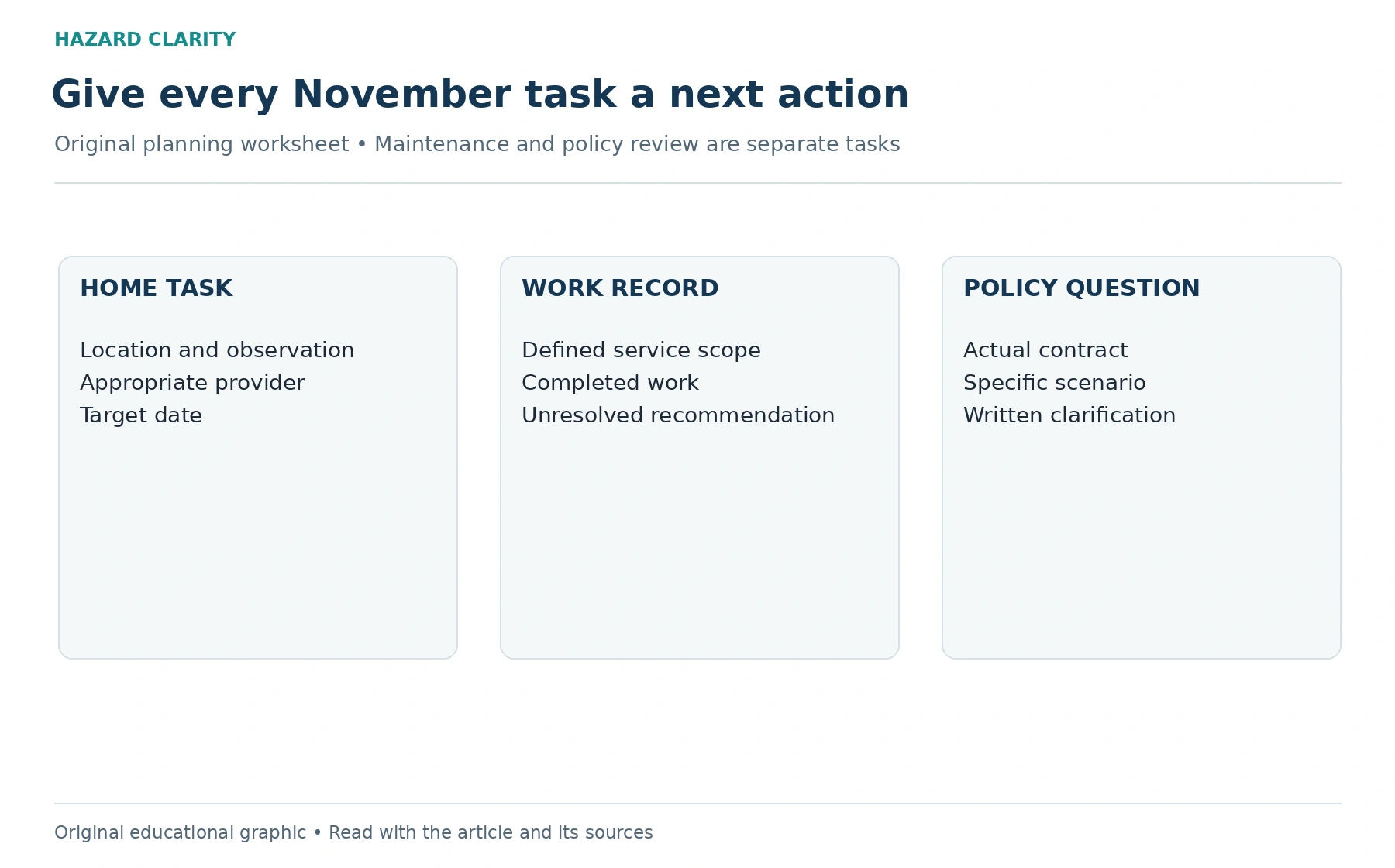
A November home checklist works best when every task has a clear reason. Cleaning a gutter is a maintenance job. Asking how a policy handles a particular kind of water damage is an insurance question. Recording the work helps you explain what changed, but it does not turn maintenance into guaranteed coverage. Keeping those purposes clear makes the whole month easier to manage.
This guide organizes fall tasks around the systems you depend on as weather changes and holiday plans get busier. Use it as a monthly planning sheet, then turn to the detailed articles for questions that deserve closer attention. Conditions vary by climate, building, and policy. Choose the checks that apply to your home instead of following a national list mechanically.
Give each task a place on the calendar
Start with the unresolved items you already know about. Read the last inspection, recent service invoices, and your own notes from rain or heating problems. Transfer the remaining questions into one list with a next action, an owner, and a target date. A known concern should not disappear simply because a new seasonal checklist arrives.
Organize that list around urgency and access. A suspected immediate hazard needs the appropriate emergency or professional response. A routine service visit needs an appointment. A question about an insurance endorsement needs a reply from the insurer or licensed agent. Those actions can happen in parallel, but they should not be confused with one another.
For each item, record what would count as completion. “Call the HVAC company” is a first step. “Service completed, report received, and recommended follow-up scheduled” describes a result. You can use that same method for roof work, drainage observations, plumbing reviews, or an insurance question. Keep the completion standard realistic and tied to the task.
Follow water around the exterior
Walk the exterior from a safe position and note where water is collected, carried, and discharged. Look for observations you can describe: gutter overflow during rain, a disconnected downspout, a low spot that stays wet, or water appearing near a basement entry. Avoid turning an observation into a cause before it has been evaluated.
Take photographs that show the location and surrounding area. Add dates and weather context. A close-up of a wet wall may be useful, but a wider photograph can help a professional see how the area relates to the rest of the home. Share both when asking for an evaluation.
The distinction among surface flooding, sewer backup, and groundwater matters when deciding what to investigate and what insurance questions to ask. HC’s Indiana water pathways article provides a detailed example of separating those mechanisms. The same habit of identifying the source is useful elsewhere, while local systems and policy terms still need their own review.
Connect the roof visit to the right professional
A homeowner’s exterior walkthrough should not become a roof inspection from a ladder. If you see staining, damaged components, or drainage that appears unusual, describe the observation and ask for the appropriate professional review. Identify whether the question concerns roofing, gutter installation, attic conditions, or another system.
Bring earlier invoices and any warranty information to the conversation. Ask the provider to explain the scope of the proposed visit and what it will not cover. If work is recommended, ask for the location, reason, and priority in writing. That makes it easier to compare proposals without treating every service visit as a complete evaluation of the house.
HC’s roof age and insurance guide can help organize questions for an insurer. Keep the roof’s actual condition and documented work separate from broad assumptions based on age. A repair receipt, a professional opinion, and a policy answer each have their own scope.
Prepare heating equipment before you depend on it
Locate the service records for the heating systems you use. Identify the equipment and the company that normally services it. Ask a qualified provider what work is appropriate before colder weather, including any unresolved concerns from the previous season. Tell the provider about rooms that do not heat consistently or changes in how the home is used.
Keep the completed service report and recommended follow-up together. If parts are ordered or another visit is needed, leave the task open. A paid invoice may document a visit without establishing that every issue was corrected. Ask for clarification when the record only says “checked” or “tuned up.”
Include alarm and household emergency planning in the same month, while recognizing that equipment service does not replace those checks. The USFA heating resource is an official starting point for fire safety guidance. Follow the appliance instructions and professional advice for your exact setup rather than copying an arrangement from a different home.
Know the plumbing questions before a freeze
Ask where the main water shutoff is and whether it is accessible. If you are unfamiliar with the system, have a plumber explain it during an appropriate visit. Identify areas that may need additional evaluation because they are exposed, rarely heated, or associated with earlier problems. Do not guess which valve controls the entire property.
Build a response plan for interrupted heat or a plumbing concern while you are away. The plan should identify who receives alerts, who can enter the home, and who can contact a qualified service provider. Avoid assigning a neighbor a repair task beyond that person’s ability or willingness.
HC’s plumbing and insurance explainer is a useful background resource. For your own policy, ask what conditions, exclusions, and duties apply to freeze-related damage. Record the actual answer rather than assuming that a general article establishes coverage for every circumstance.
Add the guest route to the maintenance list
Before holiday visitors arrive, walk from the parking area to the entrance. Look at lighting, steps, railings, walking surfaces, and anything that limits access. Repeat the observation when the route is normally used after dark. A walkway that looks straightforward at midday may be harder for a guest to understand in the evening.
Arrange repairs with the right provider and note any work that remains incomplete. Ask visitors about access needs before assigning sleeping arrangements or choosing an entrance. If the route is shared with a landlord, association, or another property owner, clarify the responsibility instead of assuming it belongs to someone else.
An insurance conversation can then focus on relevant liability questions. Ask how personal liability and medical payments differ under your policy and whether your planned activities merit a limits review. Fixing a loose railing remains a maintenance action; asking about coverage does not make it reasonable to leave the condition unresolved.
Review documents around the tasks you are doing
You do not need to repeat a full insurance shopping process every month. Bring a focused list to your licensed agent or insurer: new equipment, repairs, changed use, unresolved conditions, and questions raised by seasonal preparations. Ask whether any of those items needs reporting or supporting documentation.
The NAIC winter preparation resource encourages policy review alongside seasonal preparation. Your policy, endorsements, and insurer’s response still control the specific coverage discussion. Ask for explanations you can attach to the document you actually hold.
If someone suggests a mitigation credit, ask what qualifies, what proof is required, and when an approved change becomes effective. Avoid building your maintenance budget around a discount that has not been confirmed. A task may be useful for the home even if it has no effect on the premium.
Keep records that explain the work
Use one folder for this month’s tasks, with short filenames or labels that include the date and system. Keep before-and-after photographs, invoices, provider notes, and insurer replies together. Store a secure backup so the records remain available if the home itself becomes inaccessible.
For example, a gutter service record could include the areas cleaned, any defects observed, and any work left for another contractor. A heating record could identify the equipment serviced and recommendations not yet completed. An insurance reply could name the policy and question addressed. Each record should make the next conversation easier.
Avoid using photographs as proof of technical conclusions they do not establish. A clear image can identify a location or show a visible change. It may not prove the cause of damage, compliance with a code, or the quality of hidden work. Ask the relevant professional what evidence is needed for that question.
Use a small budget to prioritize the next appointment
Separate the cost of learning about a problem from the cost of the eventual repair. You may need a defined evaluation before comparing repair proposals. Ask the provider what the initial visit will establish and whether its fee is separate from any later work. This helps you plan without treating an estimate as a diagnosis.
List costs you can confirm, such as an agreed service visit, separately from amounts that remain unknown. Leave a place for additional evaluation or work recommended afterward. An insurer conversation may clarify payment responsibilities, but do not count on reimbursement or a credit that has not been confirmed.
If several tasks compete for attention, ask the appropriate providers about their priorities and timing. Give immediate hazards the appropriate response. For routine work, use the advice to set a realistic sequence rather than postponing every task until the full household budget is available. A defined next action can still move the home plan forward.
Close the month with the open items
Review the list before December. Move incomplete appointments forward with a new date, keep unanswered questions visible, and remove tasks only when the intended result is documented. Share the remaining list with anyone helping manage the home. That simple handoff is often more useful than starting another checklist from scratch.
November preparation should leave you with fewer unexplained conditions and better information for professionals. Use the calendar to choose the work, the service records to track its completion, and your insurance documents to ask precise questions. When location context would help, run a property report and follow its sources; when the question is about installed systems or coverage, take it to the qualified provider who can answer it.
Sources and reference material
NAIC Winter insurance preparation • Reviewed October 3 2026.
USFA Heating fire safety • Reviewed October 3 2026.
See this property’s own hazard picture.
Check an address