On this page
- Begin with the water pathway
- Surface flooding is a location and property question
- Sewer backup requires its own investigation
- Groundwater and seepage are different questions
- Plumbing leaks add another category
- A sump pump is equipment with a maintenance story
- Insurance follows causes and policy terms
- A flood zone cannot answer every basement question
- What to request when buying an Indiana home
- If water is present now
- Build a useful water review
- Sources and reference material
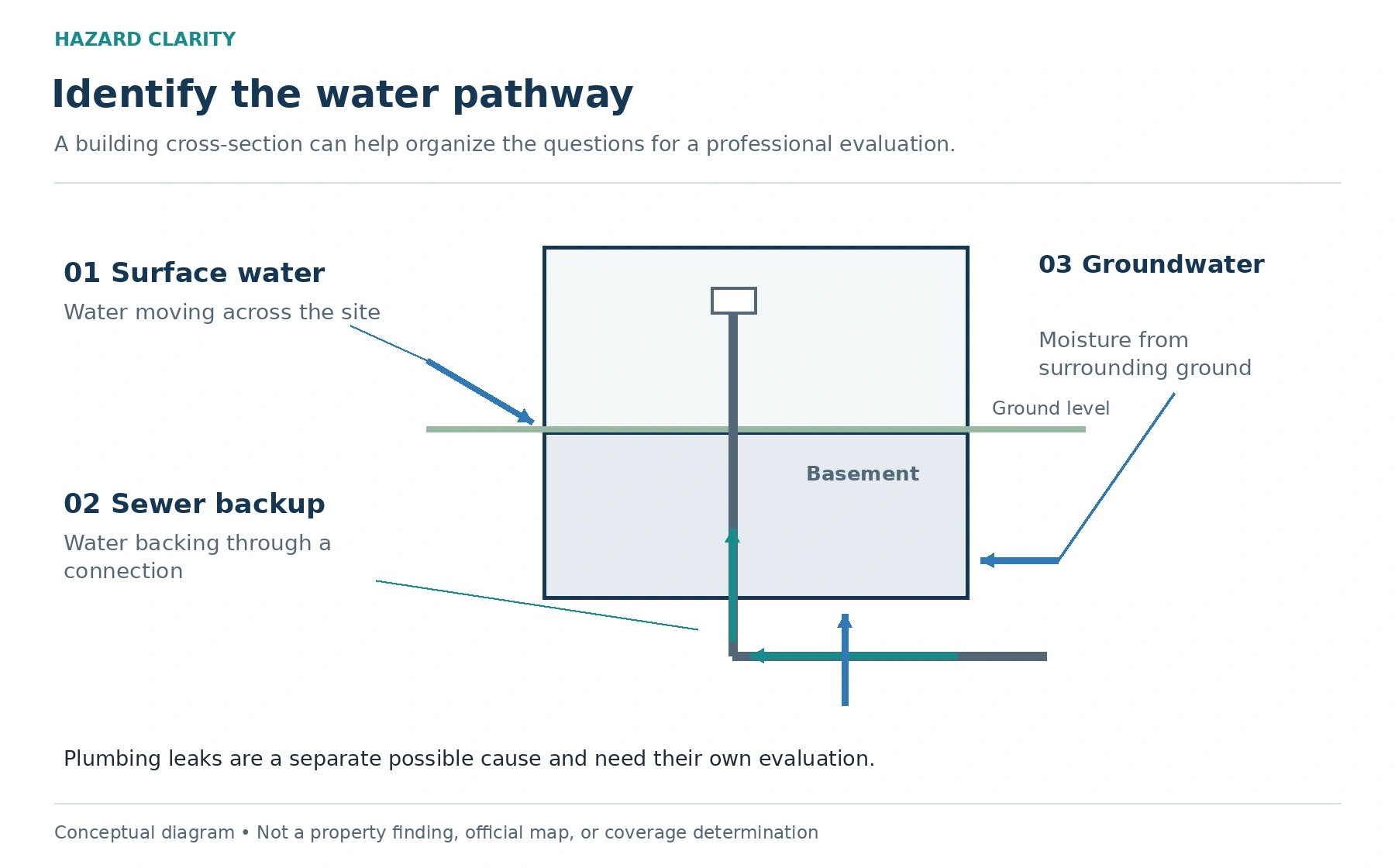
Water in a basement is a description of what you see, not a complete explanation of what happened. For an Indiana homeowner or buyer, the useful next question is where the water came from and how it reached the space. Surface flooding, sewer backup, groundwater seepage, and plumbing problems can require different evaluations and different insurance conversations.
You do not need to diagnose the cause yourself. You do need to avoid treating every wet basement as the same problem. A clear record of the circumstances helps an inspector, contractor, utility, or insurance professional focus on the right questions.
This guide explains how to organize that review. For broader local context, start with Hazard Clarity’s Indiana page and Indiana flood-readiness information. These resources support property research; they do not determine the cause of a particular water event or decide a claim.
Begin with the water pathway
Try to separate the source of the water from its entry point. Water observed at a floor drain may raise a different question from water entering through a window. Moisture along a wall after rainfall may require a different investigation from a leaking supply pipe. Several conditions can occur during the same event.
Record what you can observe without entering an unsafe space. Note the date, weather, location, approximate extent, and whether power or equipment operation was interrupted. Photographs from a safe location and existing maintenance records can help explain the sequence later.
Avoid turning an observation into a definitive cause. “Water was visible near the floor drain” is useful. “The city sewer definitely failed” is a conclusion that needs evidence. Clear descriptions leave room for the people qualified to investigate.
Surface flooding is a location and property question
Water can move across land toward a building during a flood event or intense rainfall. The relevant research may include nearby waterways, mapped floodplains, site drainage, and the relationship between the building and surrounding ground. A property can warrant questions even if the homeowner does not think of it as a riverfront home.
Indiana’s state flood-insurance resource directs residents to both FEMA information and the Indiana Floodplain Information Portal. These tools can help you identify what to ask about the location. They do not inspect basement walls or explain every drainage detail around a specific home.
If the map is unclear, ask the local floodplain administrator or Indiana DNR how to interpret the applicable information. A property’s street address and a map pin should not be treated as a substitute for a careful review of the building and relevant boundaries.
Sewer backup requires its own investigation
A sewer-backup concern may involve the home’s connection, a blockage, or conditions in the larger system. The location and circumstances matter. Fort Wayne’s official guidance notes that backups can occur in both combined and separate sewer systems, so the system’s general label does not resolve every case.
Ask the local utility how to report an issue and which records or evaluations may be appropriate. A qualified plumbing professional can explain whether a sewer-line inspection or another service would help answer the specific question. Do not assume the public utility and the homeowner have the same responsibility for every part of the connection.
If you are buying, request available documentation about previous backups, repairs, and installed prevention devices. Ask who installed the work and whether maintenance is required. A device’s presence is a starting point for review, not a guarantee that the home cannot experience another problem.
Groundwater and seepage are different questions
Moisture can appear around a foundation without looking like water flowing through the yard. A homeowner may describe it as seepage, groundwater, or pressure against the basement. Those descriptions need professional evaluation before you decide what remedy is appropriate.
Ask an inspector or qualified contractor to explain observable conditions and the scope of any further work. A proposal should identify the issue being addressed, the planned method, limitations, and maintenance expectations. Comparing bids is easier when the contractors are responding to the same documented concern.
Do not select a repair solely because a neighbor used it. Similar homes can have different conditions. An interior drainage system, exterior work, grading change, or other measure should be evaluated for the property and applicable requirements rather than assumed to be universally effective.
Plumbing leaks add another category
A leaking fixture, supply line, drain connection, or appliance can create water inside a home. That is not automatically the same thing as a flood or sewer backup. The cause, timing, maintenance history, and policy language can all become relevant to the discussion.
For a buyer, ask the inspector to explain visible signs of leakage and whether additional plumbing evaluation is warranted. For an owner facing an active problem, contact the appropriate professional promptly and follow the insurer’s reporting instructions if you may make a claim.
Keep invoices, photographs, and descriptions of the work. The purpose is to build an accurate record, not to decide coverage in advance. Your policy and the insurer’s investigation determine the claim response; a general article cannot establish it from a short description.
A sump pump is equipment with a maintenance story
A basement may have a sump pump, battery backup, alarm, or other water-management equipment. Ask what each component does, when it was installed, and how it is maintained. An inspection may provide observations, but it is not a promise that equipment will operate indefinitely or under every condition.
A hypothetical buyer might see a newer pump and assume the water question is resolved. A more useful review asks why it was installed, whether discharge is appropriate, and what records exist. The buyer can then discuss remaining uncertainty with the inspector and insurance professional.
Avoid operating equipment or changing connections without permission and qualified guidance. During a showing, your job is to gather questions. During ownership, a documented maintenance plan is more useful than relying on a device you have never had explained.
Insurance follows causes and policy terms
Homeowners insurance generally does not provide the same protection as a separate flood policy. Water-backup coverage may be available through an endorsement, but it is not interchangeable with flood insurance. The exact protection depends on the policy wording, limits, deductible, exclusions, and circumstances.
Read HC’s explanation of flood damage and homeowners insurance before your coverage conversation. Then ask the agent to explain the proposed policy using the water scenarios relevant to your home. Broad phrases such as “water coverage” are not specific enough.
Useful questions include whether the policy addresses sewer or drain backup, sump-related losses, groundwater or seepage, and flood. Ask how a finished basement and its contents are treated. Request the relevant documents rather than relying only on a summary or assumed coverage limit.
A flood zone cannot answer every basement question
A FEMA flood-zone designation describes mapped flood information. It does not tell you whether a plumbing connection leaks, a sewer line is blocked, or a downspout is discharging beside the foundation. Those are separate questions that may require separate professionals.
Likewise, an inspection finding does not replace a flood-map review. A dry basement on the inspection day does not document every past event or predict every future one. Keep the map, condition, equipment, and insurance discussions connected but distinct.
This approach avoids two common shortcuts: assuming a location outside a mapped high-risk zone has no water concerns, and assuming any sign of moisture proves a serious regional flood problem. Both jump farther than the evidence allows.
What to request when buying an Indiana home
Ask for available disclosures, prior water-event descriptions, repair invoices, contractor proposals, equipment records, and relevant drainage or sewer information. Ask the seller to clarify whether the reported issue involved surface water, a backup, seepage, or a plumbing leak, while recognizing that their explanation may need verification.
Discuss the inspection scope before the appointment. If you are concerned about a sewer line or recurring moisture, ask whether a separate service is needed. Give yourself time to receive and understand the results within the purchase agreement’s deadlines.
Your REALTOR can help coordinate requests and the contract process. Technical causes and repair design belong with qualified professionals. Insurance questions belong with a licensed agent or the insurer. Assigning each task clearly helps prevent the same issue from being passed around without an answer.
If water is present now
Prioritize safety before documenting property details. Stay out of flooded areas where electricity, contamination, structural damage, or other hazards may be present. Follow local emergency guidance and contact qualified help. Do not enter water to retrieve a photograph or test equipment.
When it is safe, keep a factual timeline and retain communications with the utility, contractor, and insurer. Follow the policy’s reporting and mitigation instructions. Ask before discarding materials when documentation may be needed, while following health and safety directions.
The immediate response and the later cause investigation are related but different tasks. An accurate record helps both. It also provides better information if you later sell the home or review the maintenance and coverage plan.
Build a useful water review
Create four headings in your notes: location, physical condition, equipment, and insurance. Under each, list the documents reviewed, answers received, and open questions. This is more useful than labeling the whole basement simply “wet” or “dry.”
A home with a documented past issue and an explained repair can present a different decision from a home with an unresolved concern. Your task is to understand the evidence, limitations, and ownership responsibilities rather than assume the history determines the outcome.
Run your Indiana address through Hazard Clarity for location context, then bring the specific water questions to the appropriate professionals. Knowing which question you are asking is the first step toward getting an answer you can use.
Sources and reference material
State of Indiana — Indiana Flood Insurance • Reviewed October 2, 2026
City of Fort Wayne — Sewer Backup • Reviewed October 2, 2026
FEMA and NFIP — Buy a flood insurance policy • Reviewed October 2, 2026
Sources support the article’s factual foundations; the research workflow, worksheets, and hypothetical examples are original editorial guidance. Confirm current requirements and policy terms for the actual property before relying on a transaction-specific conclusion.
See this property’s own hazard picture.
Check an address