On this page
- Identify the installed system before choosing an upgrade
- Ask the provider to explain the full functional path
- Define what the backup is intended to do
- Treat alerts as a response workflow
- Keep a dated service and testing record
- Prepare for an outage without improvising around water
- Ask the insurer about the specific equipment and water scenarios
- Review the whole file before a purchase or seasonal handoff
- Sources and reference material
A sump pump that ran during a showing leaves an important question unanswered: what happens when the electricity is out, the primary pump stops, or another part of the drainage path is not working? A useful ownership review looks at the system’s dependencies and the records for each component rather than treating one observed cycle as proof of reliable protection.
This is a different question from identifying whether water came from flooding, sewer backup, or groundwater. The water source still matters, especially for investigation and insurance, but the focus here is the equipment and response plan around a home that already has a sump system. Owners need to know what they have, how it is maintained, and which provider can explain its limitations.
The goal is a practical sump-pump file and outage plan. It includes professional evaluation, backup questions, alarms, discharge responsibility, and actual policy terms. It does not provide electrical instructions, pump-sizing calculations, or a guarantee that equipment can prevent every kind of basement water event.
Identify the installed system before choosing an upgrade
Gather the pump model, installation information, manuals, service records, and any documentation for backup equipment. Ask the seller or current owner which components exist and what they know about earlier failures or water events. Label unverified recollections as such until the documents or professional evaluation establish more.
North Dakota State University Extension encourages owners to check sump pumps and advises new owners unfamiliar with the equipment to contact a licensed plumber. Its guidance also describes battery-powered backup pumps used when the primary pump fails or power is lost. This is useful background for asking about your system, while the actual configuration needs its own review.
Do not assume that a second device is a working backup simply because it is present near the sump. Ask the provider to identify its function, power source, condition, and testing requirements. The equipment could have missing documentation or need service. A clear inventory of components is the foundation for deciding whether maintenance, replacement, or another evaluation is appropriate.
Ask the provider to explain the full functional path
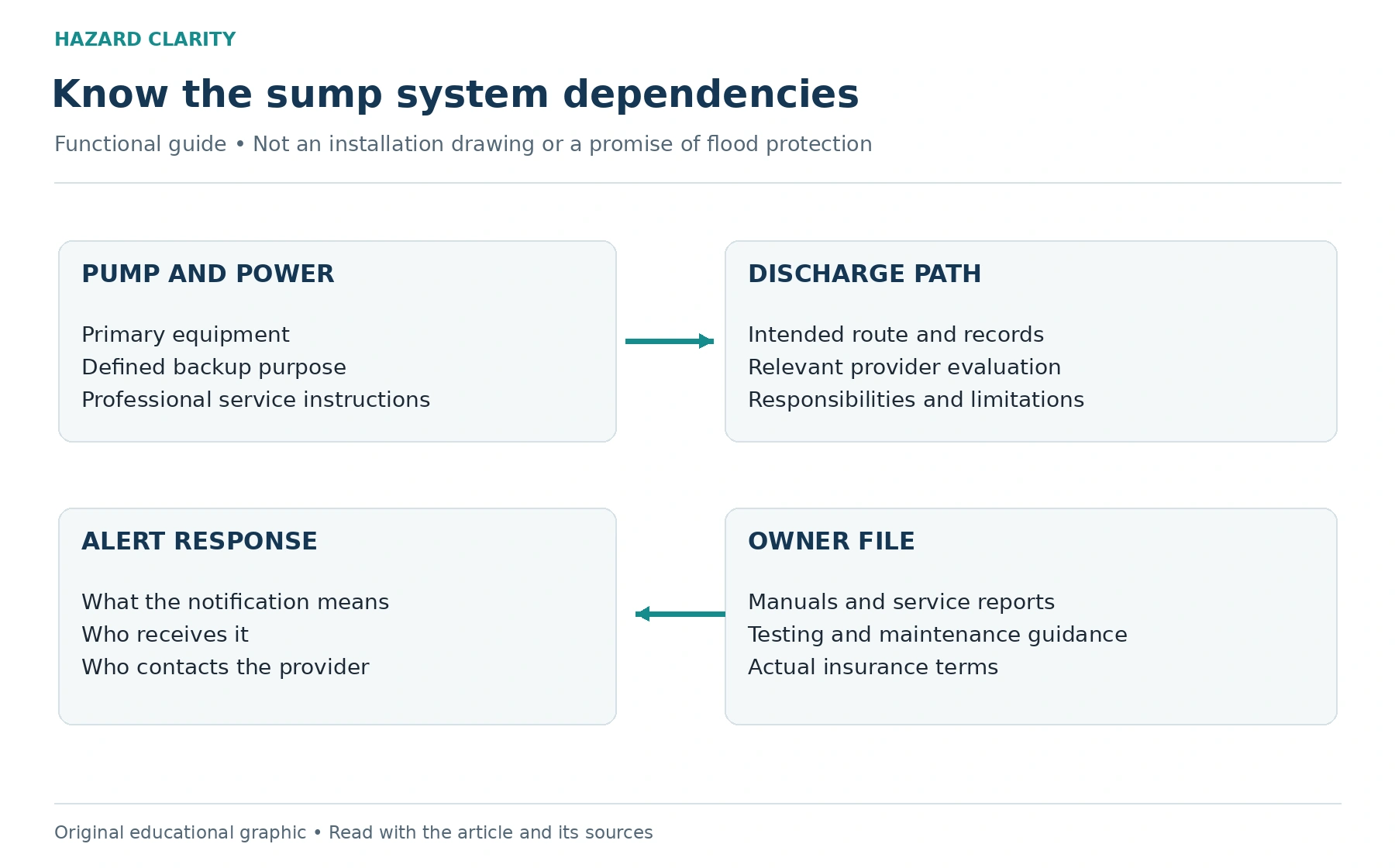
A useful discussion includes water entering the sump, the pump’s operation, the power arrangement, and the discharge route. Ask the plumber which parts the service will evaluate and which require another provider or local approval. The educational diagram in this article shows dependencies; it is not a plumbing design or a representation of your particular installation.
Ask where the discharge goes and which records explain its intended arrangement. If the route is unclear or involves a shared feature, request appropriate clarification rather than assuming it can be changed freely. A backup power source does not, by itself, verify the suitability or condition of the discharge path. Each part should have its own answer.
Provide earlier water-event records to the professional when relevant. Ask whether the reported circumstances fit the system’s intended function or require a broader drainage evaluation. A pump file is more useful when it identifies limits. An owner should not treat equipment service as proof that every exterior or interior water pathway has been investigated.
Define what the backup is intended to do
Ask whether the proposed backup addresses loss of electrical power, failure of the primary pump, or another defined situation. Those purposes can overlap, but they are not automatically identical. Request an explanation of how the actual equipment operates, what conditions it depends on, and what routine service or testing its manufacturer specifies.
If a provider discusses battery backup, ask about the installed battery and charger, replacement guidance, and the basis for any run-time estimate. Do not use a generic number of hours as a promise for your house. Ask what assumptions the estimate uses and how the provider will document the equipment and instructions you receive.
For a purchase, ask whether the seller can demonstrate the system through an appropriate professional service rather than an improvised showing test. Request the resulting written findings and note which components were included. If no evaluation is available, keep that limitation visible when deciding what follow-up to commission.
Compare proposals by function and scope rather than only price. A useful written proposal identifies included components, required electrical or plumbing coordination, testing, instructions, and exclusions. If other work is necessary, ask who handles it and how it will be approved. The buyer or owner needs to understand what the completed project will establish and what remains outside it.
Treat alerts as a response workflow
Ask which alarms or notifications are installed and what each one indicates. A local audible alarm, an app notification, and a monitored service can involve different dependencies and responsibilities. Request the relevant manuals and ask the provider how to test the arrangement appropriately. Do not assume the word smart means somebody will respond when the owner is away.
Identify who receives an alert, what information they need, and whom they should contact. If internet connectivity or another service is involved, ask what happens when that dependency is unavailable. The point is to understand the actual system and avoid relying on an assumed notification path. Keep the instructions accessible without requiring access to the affected basement.
Test your organizational handoff with a simple scenario: the designated contact is away when a notification arrives. Is another authorized person available, and do they have the correct provider information? This is a planning exercise, not an equipment test. It helps expose a communication gap that even properly functioning hardware cannot resolve by itself.
Keep a dated service and testing record
Follow the manufacturer’s instructions and the qualified provider’s guidance for inspection, testing, and maintenance. Ask the provider to specify what the owner can appropriately do and which tasks require professional service. A generic article should not direct electrical manipulation or disassembly around water. If the instructions are unclear, ask for clarification before attempting the task.
Record the service date, provider, components reviewed, findings, and work completed. Add any replacement parts and the resulting instructions. If a test identifies an issue, track the repair and its completion evidence rather than leaving only a note that something failed. The file should show how an observation led to a response.
Ask whether equipment warranties or service arrangements require registration or particular records. Keep those documents alongside the manual while retaining the difference between a warranty and insurance. A warranty’s coverage for equipment is not a promise that damage to the basement or belongings will be paid, and an insurance endorsement is not an equipment maintenance plan.
Prepare for an outage without improvising around water
An outage plan should identify safe contacts, the known backup arrangement, and the circumstances that require professional or emergency response. Do not enter standing water to handle electrical equipment or investigate a pump. Ready.gov’s flood guidance notes the danger of electrically charged water, supporting a safety boundary that takes priority over collecting photos or trying a quick fix.
If a generator is part of the professionally planned arrangement, follow the relevant manufacturer and official safety instructions. Ready.gov directs that gasoline-powered generators be used only outdoors and away from windows. Do not improvise indoor operation or an electrical connection because the basement is taking water. Ask qualified providers to explain the appropriate system before an emergency occurs.
Keep essential documents, contact numbers, and any equipment instructions available away from the basement. The ownership plan should remain usable when power, internet service, or access is limited. A secure offline copy of the contact sheet can be more practical than depending entirely on an app that requires the same services affected by the event.
Ask the insurer about the specific equipment and water scenarios
Tell the insurance professional what system and backup you have, then ask how the actual policy addresses water backup, sump overflow, equipment failure, or other relevant circumstances. Request the provisions, limits, exclusions, and deductibles that apply to the coverage being discussed. Do not assume a battery backup creates insurance coverage or that an endorsement covers every basement water event.
HC’s flood-damage coverage explainer can help keep flood coverage distinct from other water questions. The specific cause and policy wording still matter. If the professional needs more information about the system or earlier damage, provide the documented facts rather than a general statement that the basement is protected.
Retain the answer with the policy documents and the equipment file. If an insurer requests proof of installation or service, ask what evidence is acceptable and when it is needed. Confirm any resulting coverage through the insurance process. A contractor’s successful installation test and an insurer’s confirmation answer different questions, and both should remain understandable in the owner’s records.
Review the whole file before a purchase or seasonal handoff
For a buyer, request the equipment records before the inspection and ask what evaluation the inspection includes. If the pump or backup is outside the general scope, commission the appropriate follow-up. Use HC’s inspection and hazard-report comparison to explain why location information does not verify the installed system’s condition or performance.
For an owner, choose review timing based on the equipment instructions, provider recommendations, and the property’s circumstances. Do not invent a universal maintenance interval from this article. The calendar entry should point to the actual instruction and the responsible person. That makes the routine repeatable without silently replacing professional guidance with a convenient date.
An illustrative handoff might include a pump manual, backup equipment details, a dated service report, a discharge explanation, alert instructions, and insurance correspondence. If one item is missing, mark the question and assign follow-up. The value is the complete functional story, not the size of the folder. A useful outage plan tells you what the system depends on and what to do when a dependency changes.
Sources and reference material
North Dakota State University Extension Now Is the Time to Check Your Sump Pump • Professional assistance and battery backup background; March 2023 guidance. Reviewed October 3 2026.
Ready.gov Floods • Electrical water hazard and outdoor generator safety; not an installation guide. Reviewed October 3 2026.
See this property’s own hazard picture.
Check an address