On this page
- Start with the question you need answered
- What a home hazard report can contribute
- What the inspection contributes
- Neither replaces an insurance conversation
- A practical example of using both
- Use the report before the inspection when practical
- Read limitations as part of the answer
- Prepare a short follow-up worksheet
- Compare the complete picture
- Questions worth asking before you finish
- A clearer starting point for the property
- Sources and reference material
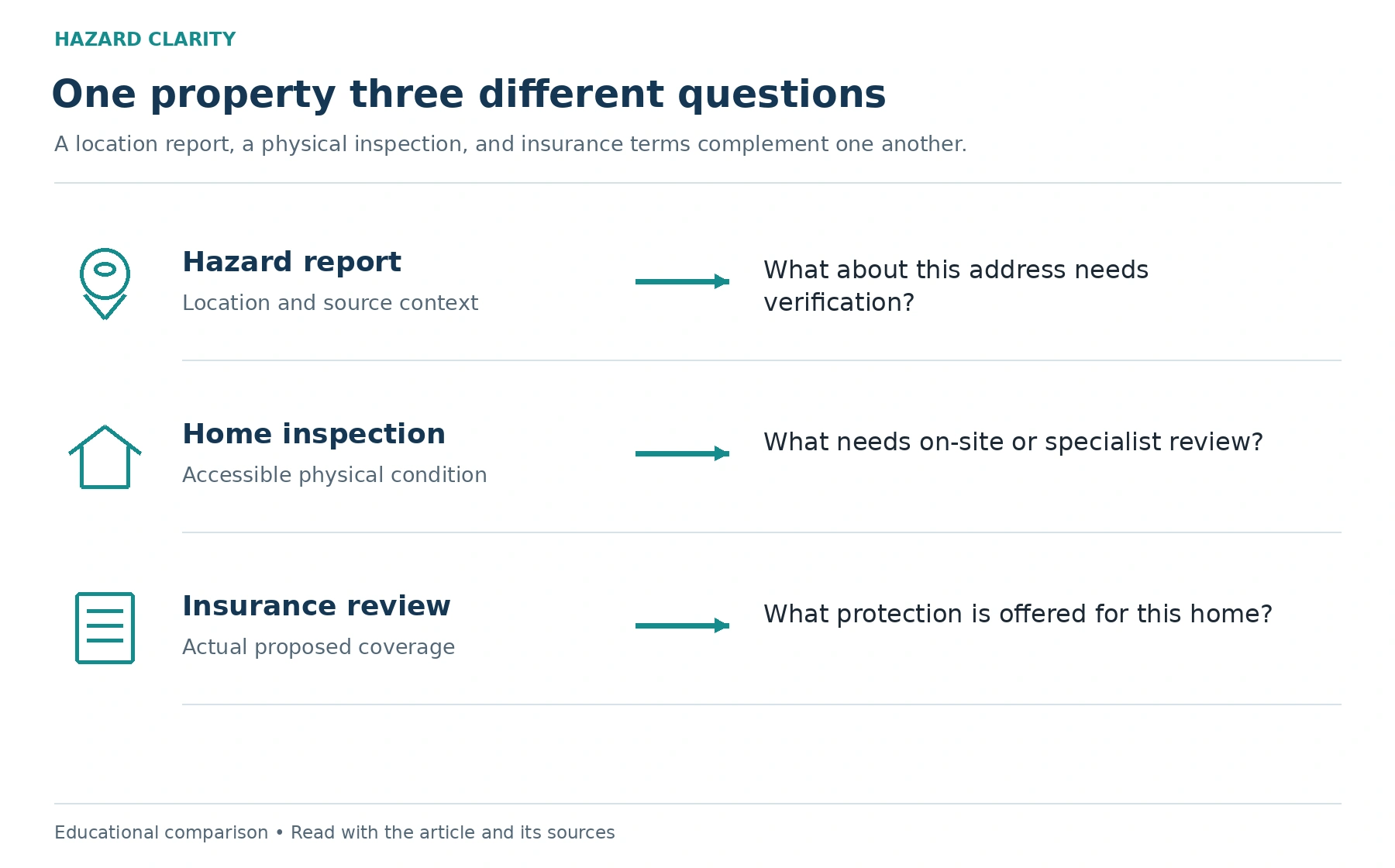
A home hazard report and a home inspection answer different questions about the same property. A hazard report organizes information about the location and conditions that may deserve attention. A home inspection examines the accessible physical condition of the home within the inspector’s agreed scope. Together, they can help you prepare more useful questions before you commit to a purchase.
The distinction matters because a property can look well maintained while still requiring a closer look at its setting. It can also sit in an area with familiar weather exposure while having a roof, drainage system, or electrical issue that deserves professional evaluation. Understanding both layers gives you a clearer picture without asking either tool to do a job it was not designed to perform.
If you are starting your research, review how Hazard Clarity works. Then use this guide to decide where a report fits alongside the inspection, insurance conversation, and other parts of your due diligence.
Start with the question you need answered
Consider two questions: “What should I understand about this address?” and “What condition is this home in today?” They overlap, but they are not interchangeable. The first points toward property information, public maps, historical records, and location context. The second points toward an on-site evaluation of observable systems and components.
For example, you may want to know whether a home is close to a mapped floodplain. That is a location question. You may also want to know whether the basement shows signs of moisture and whether the sump pump operates during the inspection. Those are physical-condition questions. Answering one does not automatically answer the other.
Before ordering services, write down what remains uncertain. A specific list makes it easier to choose the right professional and prevents a general report from being mistaken for a complete evaluation.
What a home hazard report can contribute
An address-based hazard report can bring together information that would otherwise require several research stops. Depending on the provider and available inputs, it may organize flood, wildfire, severe-weather, earthquake, or other relevant property context. The useful part is not simply seeing a category; it is understanding the source, geography, and question behind it.
A report may help you notice a condition you would not have thought to investigate. It may also help you compare homes consistently. Instead of remembering that one listing felt “close to water,” you can keep a record of which source you reviewed, what it showed, and what still needs confirmation.
The report should be read as an information layer. It is not a guarantee that a hazard will occur, a prediction of a specific claim, or a declaration that a home is suitable for you. The interpretation becomes more useful when you connect it with the actual building and your plans for ownership.
What the inspection contributes
A home inspection gives you an opportunity to understand the property’s observable condition and ask questions about findings. The Consumer Financial Protection Bureau encourages buyers to arrange an independent inspection promptly and attend when possible. The inspector’s written agreement explains what is included, what is excluded, and which limitations apply.
Do not assume every inspection includes the same services. Ask about the roof, foundation, basement or crawlspace, electrical system, plumbing, heating and cooling, and accessible exterior features. Ask separately about additional testing or evaluations that may be relevant, such as radon, sewer lines, wells, septic systems, or structural concerns.
The inspection report can help you identify follow-up needs. It may recommend a qualified contractor or specialist for a particular finding. That recommendation is useful precisely because the general inspection has boundaries. A short visual observation is not the same thing as opening a concealed assembly or completing an engineering analysis.
Neither replaces an insurance conversation
Insurance introduces another set of questions: what coverage is available, what the policy includes, what it excludes, and what you would pay. A hazard report cannot bind coverage. An inspection report cannot guarantee a carrier’s acceptance. An attractive premium alone does not explain how a policy would respond to every type of loss.
If you need a starting point, read HC’s insurance questions to ask before buying a house. Use your property information and inspection findings to make those questions more specific. For example, ask how the roof information, basement use, or documented mitigation features affect the proposed coverage.
An insurer may request its own inspection or documentation. That process has a different purpose from a buyer’s inspection. HC’s explanation of home insurance inspections can help you keep those roles separate.
A practical example of using both
Imagine a hypothetical buyer comparing two homes with similar layouts. The first has a finished basement and sits near a creek. The second has an unfinished lower level farther from that creek. An address review raises flood-related questions for the first property, but it does not tell the buyer whether water has entered the basement.
The buyer asks the inspector to explain observable moisture signs and drainage features within the inspection scope. The seller is asked for available water-event and repair records. An insurance professional is asked to explain flood and water-backup options, limits, and exclusions. A local official or qualified specialist may help resolve a map or drainage question.
There is no single automatic verdict in this example. The benefit is a better sequence of investigation. The buyer can compare documented answers rather than relying on appearance, vague reassurance, or a category label alone.
Use the report before the inspection when practical
Reviewing location information early gives you time to prepare questions. If you already know that drainage, wildfire exposure, or another condition deserves attention, you can discuss it before the inspection appointment. The inspector can explain which parts of that concern fall within the service and which require another professional.
Early review also helps you manage transaction deadlines. The purchase agreement determines the timing and options available to you. Your REALTOR or attorney can explain the applicable process; a hazard report does not change the contract or extend a deadline.
Avoid waiting until the final walkthrough to begin a completely new research thread. Some questions need records, appointments, or written coverage information. Start with the issues most likely to affect your decision and leave time for the people responsible for answering them.
Read limitations as part of the answer
A useful report tells you more than a result. It helps you understand how that result was produced. Check the address, source date, map layer, and geographic scope. If information is modeled, understand that it is an estimate built from assumptions rather than a record of a specific future event.
Inspection limitations deserve the same attention. An inaccessible attic, concealed foundation area, disconnected utility, or weather condition may limit an evaluation. Ask what could not be observed and whether that limitation creates a follow-up task.
Missing information is not automatically favorable information. “Not available” should remain an open question until you decide whether additional research is appropriate. Treat uncertainty as something to organize, not something to erase with a reassuring guess.
Prepare a short follow-up worksheet
For each issue, record the finding, its source, the person who can clarify it, and your next step. A flood-map question may go to the local floodplain administrator or a qualified survey professional. A physical repair question may go to a contractor. A policy question goes to a licensed insurance professional.
Add the date you need the answer and a place to store the response. Keeping everything in one worksheet prevents a verbal explanation from becoming detached from the document it describes. It also helps you see whether two professionals are answering the same question or addressing different parts of it.
You do not need a complicated scoring system. “Answered,” “follow-up requested,” and “still uncertain” are useful working categories. They describe your research progress without pretending to rank the home scientifically.
Compare the complete picture
A property decision includes more than hazard exposure or condition. Budget, location, layout, accessibility, maintenance capacity, and insurance preferences all matter. The purpose of additional information is to help you weigh those factors with fewer unanswered questions.
One buyer may be comfortable maintaining a drainage system after obtaining clear professional guidance. Another may prefer a home with a simpler maintenance routine. Those are personal ownership decisions. A report should support your judgment rather than substitute an unexplained score for it.
When comparing properties, use the same questions for each. A thorough review of one home and a quick glance at another can create a misleading comparison. Consistent research gives you a fairer basis for deciding which follow-ups matter.
Questions worth asking before you finish
Ask your inspector what the service covers and whether the property suggests a need for separate testing. Ask which observations require specialist review. Ask your insurance professional what documents are needed, whether the proposed policy addresses the types of loss you are concerned about, and when coverage would begin.
Ask your REALTOR how the transaction timeline affects the opportunity to investigate and respond. If documents conflict, keep both and request clarification from the appropriate source. Do not resolve a technical disagreement by choosing the answer that feels most convenient.
Finally, make sure the address in each report is correct. Similar street names, parcel boundaries, and map pins can create confusion. Confirming the basics is a small step that protects the usefulness of everything that follows.
A clearer starting point for the property
A hazard report helps you organize the setting. An inspection helps you understand observable condition. Insurance and specialist conversations help answer questions within their own professional scopes. You get the most value when those pieces work together.
Run the property address through Hazard Clarity and use the information to prepare your next questions. Keep the report alongside your inspection and supporting documents, then follow up on the findings that matter to your purchase and ownership plans.
Sources and reference material
Consumer Financial Protection Bureau — Schedule a home inspection • Reviewed October 2, 2026
Consumer Financial Protection Bureau — Shop for homeowners insurance • Reviewed October 2, 2026
Sources support the article’s factual foundations; the research workflow, worksheets, and hypothetical examples are original editorial guidance. Confirm current requirements and policy terms for the actual property before relying on a transaction-specific conclusion.
See this property’s own hazard picture.
Check an address