On this page
- Start with the state program and definition
- Match the home to the official mapping resource
- Gather condition and repair records for the property
- Commission follow up with a defined purpose
- Review the state policy separately from homeowners insurance
- Verify ownership and effective date details
- Use an illustrative example to organize the decision
- Maintain a file that remains useful after the purchase
- Sources and reference material
A Pennsylvania home purchase can include an underground question that is easy to miss during a conventional showing. Past coal or clay mining may be relevant to property research even when the buyer sees no visible problem. The useful response is to connect official mining information, the home’s condition records, and the actual insurance options rather than treating a map result as a structural diagnosis.
Mine subsidence also deserves a separate place in the insurance discussion. A buyer who has obtained an ordinary homeowners quote may still need to ask whether that policy addresses damage associated with collapse of underground mines. Completing one insurance application does not automatically answer every earth-movement question about the property.
Pennsylvania’s Department of Environmental Protection provides a Mine Subsidence Insurance program and an interactive risk resource. This guide explains how a buyer or owner can use those official starting points while keeping their scope clear. The goal is a documented property review, not a prediction that a house will experience damage or a determination that existing cracks have a mining-related cause.
Start with the state program and definition
Pennsylvania DEP describes mine subsidence as ground-surface movement associated with collapse of underground coal or clay mines. The state explains that its insurance program addresses damage from that mechanism because homeowners insurance usually does not include it. Those facts establish a reason to investigate the separate program; they do not establish eligibility, a covered loss, or the terms for a particular building.
Avoid grouping every ground concern under the same label. Settlement, a drainage issue, another geologic process, or a construction defect may require different investigation and policy analysis. If a property has visible damage or an existing engineering report, describe the evidence accurately and let the relevant professionals evaluate the cause. A nearby mining reference should not replace that process.
Keep the state’s current program information with your other research sources. Use it to identify the appropriate application, contact, and policy documents. Do not rely on an old premium example or a neighbor’s coverage description when choosing your own limit. Prices, terms, building details, and the amount appropriate for a property need their own current review.
Match the home to the official mapping resource
DEP directs users to its MSI Risk interactive mapping application to check mining conditions and the program’s recommendation for a site. Enter the property location carefully and verify that the result is for the intended building or parcel. Save the map context and the result with the date, source, and identifying details needed to find it again.
Read the displayed explanation before translating a color or label into a conclusion. If the location is uncertain or the result conflicts with another record, contact the program for clarification. Record the exact question you asked and the response. An official mapping tool is more useful when the owner can explain what was checked than when the file contains only an uncaptioned screenshot.
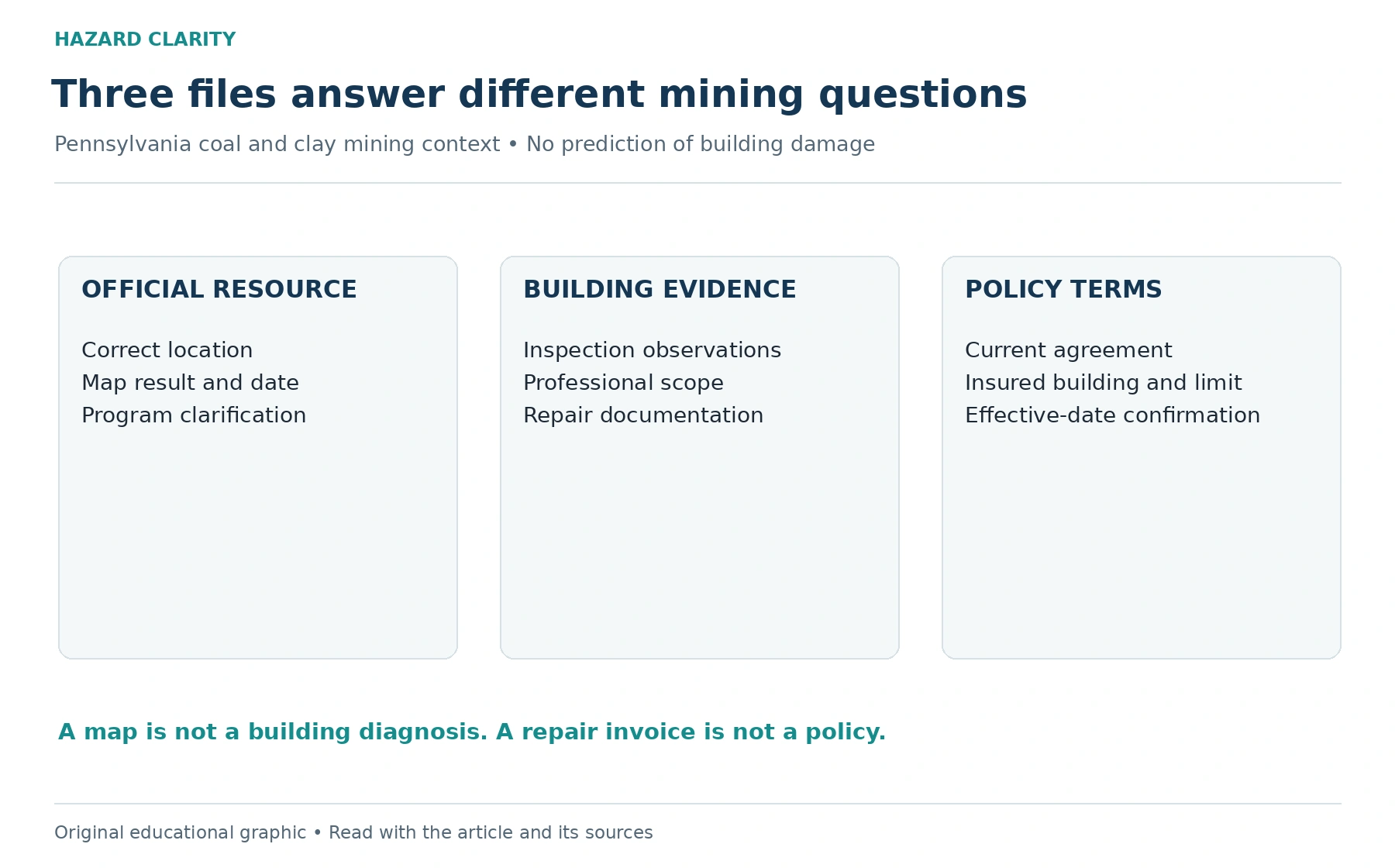
Treat this step as research about mining conditions, not an evaluation of the building. A map cannot inspect a foundation, determine the cause of a crack, or certify earlier structural work. Conversely, a general home inspection may not address historic underground mining. HC’s hazard report and inspection comparison helps keep those evidence sources distinct.
Gather condition and repair records for the property
Ask for available inspection reports, engineering evaluations, repair scopes, permits, and dated photographs related to structural or ground concerns. Request the records even if the seller reports that earlier work resolved the issue. The useful details are what prompted the evaluation, which location it covered, what conclusion it reached, and what work followed.
Read a contractor receipt for its actual scope. A foundation repair invoice may not explain the origin of movement, and an engineering report may not document whether recommended work was completed. Put them in sequence and identify the gap between recommendation and completion. This method avoids both dismissing genuine repair evidence and overstating what one document establishes.
If records are missing, ask where additional information may be obtained and whether further evaluation is appropriate. A missing record is an information limitation, not proof of a defect. Give the inspector or specialist the available documents and ask what can reasonably be concluded within the proposed service. Keep the answer attached to the original uncertainty.
Commission follow up with a defined purpose
If an inspection identifies concerns requiring a specialist, ask what question the specialist needs to answer. The scope might concern a visible condition, a prior repair, or the information necessary to plan further work. It should not be reduced to a request that someone declare the whole home safe from subsidence based on a short visit.
Before commissioning a service, confirm the provider’s relevant qualifications, deliverable, access requirements, and timing. Share the map reference and property records without presenting them as a conclusion. Ask the provider to distinguish observations, assumptions, limitations, and recommended follow-up. Those distinctions help a buyer understand whether the evaluation answered the purchase question or opened a new one.
When a professional recommends more investigation, assign that item to a person and date. An unresolved recommendation should remain visible during the contract review. Ask your real estate or legal professional how the purchase agreement handles evaluation and response timing. This article’s workflow does not establish a buyer’s contractual deadlines or replace advice about the agreement.
Review the state policy separately from homeowners insurance
Use the program’s current insuring agreement and application materials to understand the coverage being considered. Ask which building details, values, and other information are required, what the coverage limit represents, and when coverage would begin. Obtain answers through the official program or an appropriately authorized insurance professional rather than assuming that filing an application completes the process.
Keep your ordinary homeowners policy in a separate section. Ask the insurance professional to identify how its earth-movement exclusions and other relevant terms interact with the specific questions you have raised. HC’s homeowners coverage overview provides background language, while the actual policy determines the applicable terms.
Do not treat separate coverage as a guarantee that every structural problem will be paid. Ask about the insured cause, covered property, limits, exclusions, and the information needed when damage is reported. If you do not understand a provision, write down the question and request clarification before making a decision. A record of that discussion makes later review easier.
Verify ownership and effective date details
For a purchase, confirm whose application or policy is being discussed and how the ownership transition will be handled. Do not assume that a seller’s policy remains in force for the buyer or automatically transfers. Request the appropriate process, identifying details, and proof of coverage for the new owner when coverage is obtained.
If an existing policy is offered as part of the property records, verify the building address, insured owner, dates, limit, and status with the appropriate source. A copy of a past document is evidence of what that document said, not independent proof of current coverage. Preserve it as history while keeping the buyer’s current coverage confirmation separate.
Include any lender requirements in the closing checklist without allowing them to substitute for your own review. Ask the lender which documents it needs and by what date. The borrower, insurer, program, and lender each have different roles. Assigning a responsible contact to each deliverable helps prevent a policy question from being mistaken for a completed financing item.
Use an illustrative example to organize the decision
Imagine a buyer reviewing a Pennsylvania home with a basement crack, an old repair receipt, and a state mapping result recommending consideration of mine subsidence insurance. The three items answer different questions. The crack is an observation, the receipt describes work, and the map result provides program research context. None alone establishes that the crack was caused by an underground mine.
The buyer can ask the inspector what specialist evaluation is needed, provide the repair record to that provider, and separately review the state insurance program. If the provider requests more records or investigation, the buyer can discuss the timing and implications with the real estate or legal professional. This creates an evidence-based decision process without forcing unrelated documents into a single conclusion.
The same structure helps an existing owner. A new observation belongs in the property condition file with its date and location. Coverage questions go to the insurer or program, and technical questions go to the appropriate evaluator. The owner should follow relevant reporting instructions rather than waiting for a definitive cause before contacting the responsible parties about an actual event.
Maintain a file that remains useful after the purchase
Store the map result, agency correspondence, policy documents, evaluations, and repair records with a short index. Identify the building and the question addressed by each document. If the property has multiple structures, make those distinctions clear so a record for one building is not casually used to answer a question about another.
Review the insurance file when ownership, building details, or the coverage need changes, using current program instructions. Keep evidence of completed work and any professional maintenance recommendations with the condition file. A good record should show both what has been resolved and what remains outside the earlier review, rather than becoming a folder of reassuring statements without supporting details.
For broader location research, begin with HC’s Pennsylvania resources. Then use the state’s mining tools, the property’s records, qualified evaluation, and the actual policy documents for the underground question. Keeping those four parts connected gives the buyer a clearer decision and the owner a more usable foundation for future maintenance and insurance conversations.
Sources and reference material
Pennsylvania DEP Mine Subsidence Insurance • Program mechanism, MSI Risk mapping, and ordinary homeowners coverage distinction; no price or limit recommendation. Reviewed October 3 2026.
See this property’s own hazard picture.
Check an address