On this page
- Write down the rental you actually intend to offer
- Ask the insurer before relying on the existing policy
- Use Texas guidance for Texas property questions
- Keep the Texas insurance review apart from local permission
- Read the platform documents by their actual names
- Separate property records from guest communications
- Assign the response role before the first arrival
- Record belongings and the space offered to guests
- Revisit the review when the offering changes
- Finish with a decision you can explain
- Sources and reference material
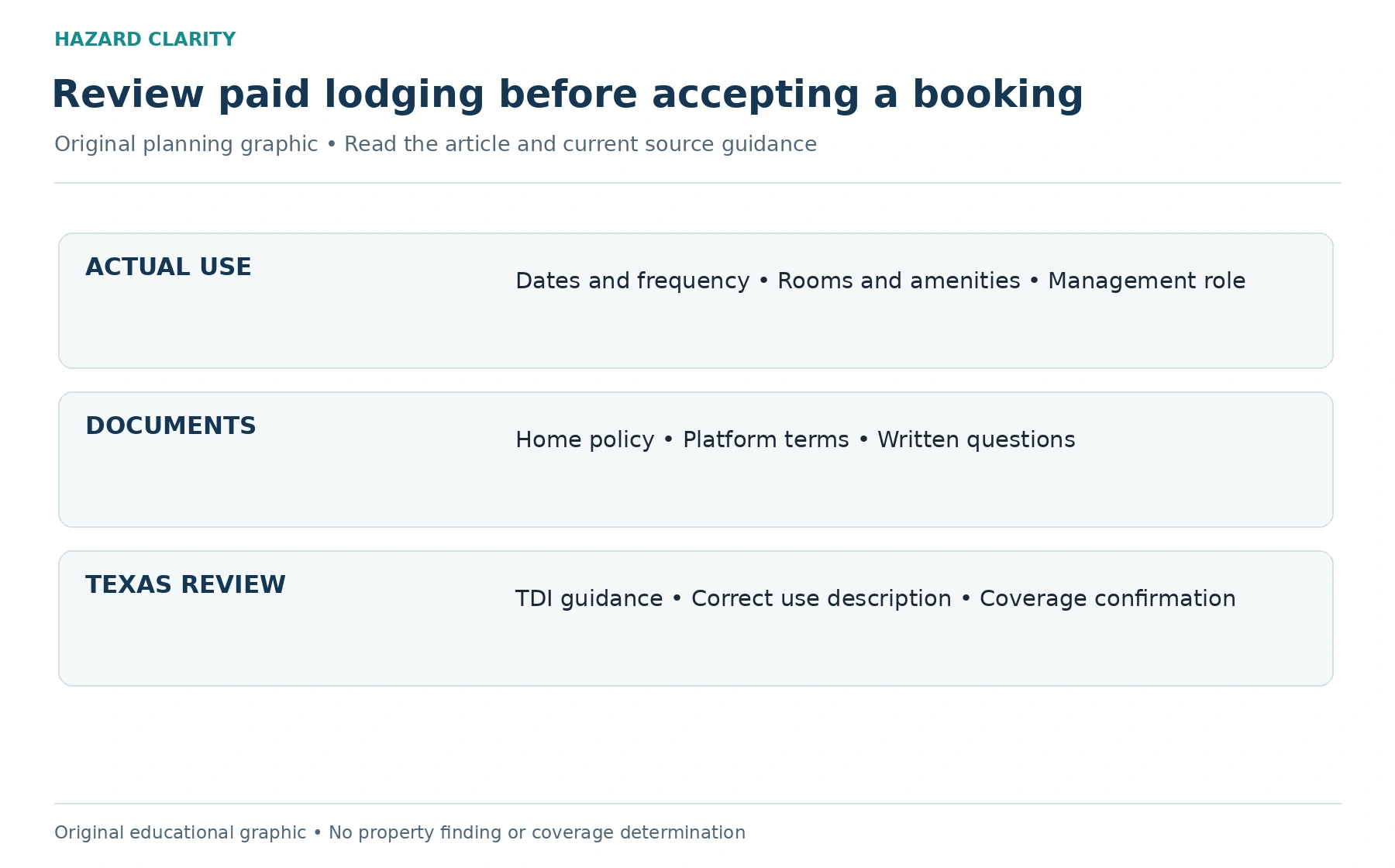
Accepting paying holiday guests changes the questions you need to ask about your home. Before posting a listing or confirming a booking, describe the rental arrangement to your insurance company, review the platform's current documents, and check the requirements that apply at the property. A room prepared for family is only one part of a paid lodging plan.
This holiday home rental insurance guide covers the review workflow and includes Texas-specific guidance. It does not determine whether your rental is permitted or which policy will cover an incident. Those answers depend on the actual use, contracts, and jurisdiction. Start early enough to resolve questions before guests arrive; a booking confirmation does not establish that the insurance arrangements fit.
Write down the rental you actually intend to offer
Describe whether you will rent a room, a separate unit, or the whole home. Include the dates, expected frequency, number of guests, and whether you will remain on site. If the listing offers access to a pool, detached structure, or other amenity, include that information in the review.
Be specific about services and activities. A basic overnight stay, an event booking, and a property managed by another business can raise different questions. Do not assume the phrase occasional rental communicates all of the details an insurer or local office needs.
Create a short property-use summary you can send consistently to the relevant people. Keep the version and date, particularly if the plan changes. For example, moving from one holiday weekend to recurring bookings is a material change in your own operating plan. Ask whether it also changes the requirements previously discussed, rather than treating an earlier answer as permanent approval for every future use.
Ask the insurer before relying on the existing policy
The NAIC home-sharing insurance resource advises reviewing both the homeowners policy and the home-sharing company's coverage before listing. Short-term rental use can fall outside the arrangements a homeowners policy was designed for. Ask about your proposed activity directly.
Provide the property-use summary and the policy number. Ask which coverage, exclusion, endorsement, or separate policy question the company needs to address. Include the building, belongings, guest injuries, and any activities you plan to offer without assuming that one answer applies to every category.
Request a response you can retain with the actual policy documents. If additional coverage is proposed, ask how it becomes effective and what information is required. A quote or general conversation is not the same as a completed policy change. Confirm the arrangement through the insurer's established process before relying on it for a booking.
Use Texas guidance for Texas property questions
The Texas Department of Insurance home-sharing guidance cautions that homeowners coverage may exclude or limit rental-related losses. It also explains that landlord insurance intended for traditional leases may not fit short-term rentals. The useful next step is a conversation about the specific arrangement with your agent or company.
For a Texas property, describe the actual address, proposed rental dates, and access offered to guests. Ask whether the present insurance documents reflect the way you plan to use the home. Avoid assuming that a product labeled landlord insurance resolves the question without reviewing its terms.
If you intend to rent only an amenity or storage space, make that distinction explicit. The same state resource identifies separate coverage questions for those arrangements. Keep the company's answer connected to the use you described. A response about renting a bedroom does not necessarily address renting a pool for an afternoon or a shed for storage.
Keep the Texas insurance review apart from local permission
A Texas insurance discussion does not establish whether a particular city, county, association, or lease allows your rental. Identify the authority responsible for the property and ask what requirements apply to the proposed use. Use current official instructions rather than a neighbor's experience or an old listing nearby.
Retain relevant responses, permits, registrations, or written restrictions where applicable. Match them to the correct property and operating plan. If you are a tenant, review the actual lease and obtain whatever authorization is required before assuming you may offer the space to others.
These are separate checks with separate decision makers. The insurance company addresses coverage; the responsible local office or governing agreement addresses permission and operating requirements. If the answers appear inconsistent or the documents are unclear, seek qualified advice before accepting the booking. A calendar full of guests should follow the completed review, rather than drive a rushed interpretation of the rules.
Read the platform documents by their actual names
Find the platform's current insurance, protection, reimbursement, and host agreement documents. These labels can describe different arrangements. Record the issuing entity, effective terms, covered activity, exclusions, limits, and reporting process rather than relying on a promotional headline.
Ask how the platform arrangement relates to your own policy. Does it require particular documentation? Who handles a report? What happens if a guest contacts you directly instead of using the platform? Bring unresolved questions to the platform and your licensed insurance professional rather than combining partial answers into a coverage assumption.
Save the version used for the booking. A web page may change after your review, and an informal summary may omit important conditions. Keep the listing, confirmation, and applicable documents together. That gives you a usable record of what you offered and which agreement you reviewed, without pretending that storing the documents settles a future claim.
Separate property records from guest communications
Maintain a host file for maintenance, insurance, permissions, and the booking arrangement. Give guests the information they need for arrival and use of the home. The welcome instructions should be understandable without exposing policy numbers, private records, or sensitive access details beyond the guest's role.
Describe equipment limitations and areas guests may use. If a system needs professional service, resolve the concern or adjust the offering appropriately. A disclaimer in a welcome note should not become a substitute for addressing a known maintenance problem.
HC's report and inspection comparison helps distinguish location-based property context from physical evaluation. Use a hazard report to organize broader questions, while qualified providers assess the installed systems and actual spaces. Neither a report nor a guest's acknowledgment establishes compliance with local lodging requirements or confirms the property's condition for your intended rental.
Assign the response role before the first arrival
Decide who will receive guest messages and who can contact qualified service providers. If you will be away, confirm the local person's availability, access permissions, and authorization limits. A phone number in the listing is useful only if someone is prepared to answer it.
Keep emergency instructions distinct from routine troubleshooting. Guests should know how to seek immediate assistance when needed without waiting for a host to approve a repair request. The person coordinating the property should understand where their role ends and where emergency or qualified professional help begins.
Review how an incident is documented and reported under each relevant agreement. Do not instruct guests to investigate dangerous conditions for photographs. Once the situation is safe, preserve the facts and follow the appropriate reporting processes. Confirm who communicates with the insurer or platform, particularly if a manager is involved and more than one agreement could require notice.
Record belongings and the space offered to guests
Keep an inventory of items supplied with the rental and a dated record of the space before the stay. Describe the actual condition rather than using a blanket statement that everything is perfect. Include unresolved service items in the host file and address their effect on the offering before arrival.
Record purchase and model information for equipment where useful. If damage is reported, an existing record can help identify the item and earlier condition. It cannot prove the cause of every change or determine who is legally responsible.
HC's replacement cost and actual cash value guide provides background on settlement terminology. Ask the applicable company how the actual agreement treats furnished items. Keep inventory values, guest charges, platform reimbursement questions, and insurance settlement terms separate so that one number is not mistaken for every possible payment outcome.
Revisit the review when the offering changes
Update the property-use summary when you add recurring dates, increase guest capacity, change amenities, hire a manager, or move bookings to another platform. Ask the relevant companies and offices whether the new facts require another review. An answer about one holiday weekend may have been limited to that arrangement.
Keep a simple change log with the date, revised use, person contacted, and confirmed next step. If a requirement is still unresolved, leave it marked open. A planned application or coverage quote should not be recorded as complete merely because you hope to start hosting next week.
The same approach helps when you stop renting and return to personal use. Ask what records or policy updates are needed, and preserve the history. Insurance, maintenance, and local permission records should describe the property's actual use through each stage rather than staying frozen at the first booking.
Finish with a decision you can explain
Before confirming paid guests, check that the rental description is accurate, coverage questions have been answered, applicable permission requirements have been reviewed, and the response arrangements are workable. Identify any remaining issue and who can resolve it. Choose a different plan if essential questions remain open.
Keep the final review with the booking records and share the relevant instructions with the person managing the property. Our November 21 overnight guest article supports the room and arrival walkthrough, while this review addresses the paid use and its agreements. The two preparations belong together without becoming interchangeable.
If you want broader property context, run an HC address report and use it to frame questions for the appropriate sources. Professional help remains optional and should match the question you need answered. A useful holiday rental plan begins with the actual offering and ends with documents and responsibilities you understand before anyone checks in.
Sources and reference material
NAIC Insurance coverage for home-sharing rentals • Reviewed October 3 2026.
Texas Department of Insurance Home-sharing insurance • Reviewed October 3 2026.
See this property’s own hazard picture.
Check an address