On this page
- Start by describing the heating history you know
- Use official New Jersey homeowner resources
- Distinguish a removal receipt from a complete case file
- Verify a No Further Action letter in context
- Choose a professional scope before requesting a price
- Coordinate the purchase timeline around the unresolved question
- Ask insurance questions using the documented facts
- Test the paper trail with an illustrative example
- Sources and reference material
An older New Jersey home may have used heating oil even if its current heating system runs on another fuel. That history can leave a records question about a tank, its location, earlier removal or closure, and any investigation of a discharge. A newer furnace or a seller’s statement that the house no longer uses oil does not, by itself, explain the complete tank history.
The right starting point is a paper trail, followed by qualified evaluation where the records leave uncertainty. Buyers should avoid turning a photograph of a pipe, an old invoice, or a map result into a conclusion about contamination. Each piece of evidence needs its location, date, scope, and relationship to the property identified.
New Jersey DEP provides homeowner guidance and resources for its Unregulated Heating Oil Tank program. The word unregulated in the program name should not be interpreted as an absence of procedures or responsibilities. This guide helps you organize questions for the state, local officials, environmental professionals, and your transaction team without trying to prescribe tank work or make a legal determination about a specific site.
Start by describing the heating history you know
Ask the seller what fuels and equipment the property has used, which tanks existed, and what records are available. Separate confirmed facts from recollections. A statement that oil service ended years ago is useful history, but it should remain a statement until documents establish the equipment involved and what happened to it.
Request installation, service, removal, closure, and investigation records where they exist. Also ask for photographs, permits, contractor reports, laboratory documents, and correspondence with officials. A tank history may span several owners and different professionals. Organizing the records chronologically can reveal whether an apparent gap is an omitted document or a genuinely unanswered question.
Do not assume the current heating equipment resolves the history. A conversion invoice may establish new equipment while leaving earlier tank work outside its scope. Read the document for the tasks it actually lists. Ask a qualified professional what further information is appropriate rather than treating fuel conversion and tank closure as interchangeable events.
Use official New Jersey homeowner resources
New Jersey DEP’s homeowner guidance explains that older heating-oil tanks can deteriorate and leak, potentially affecting soil or groundwater. The guidance directs owners toward official information about tank and remediation processes. That background gives a reason to review the records; it does not establish that any particular tank has leaked.
The state’s UHOT resources describe professional investigation and remediation pathways for relevant discharges. Use the current pages to identify the appropriate contacts and guidance for your situation. Avoid relying on a neighbor’s process or an old contractor advertisement as a statement of current requirements. Aboveground and underground equipment, site conditions, and the work proposed may involve different questions.
Keep the official resource links and access date in your file. When you contact an official, describe the tank type if known, the address, and the question the available records leave open. Ask which additional documents or professional credentials are relevant. A focused inquiry is more likely to produce usable direction than a request for a blanket assurance that the property has no environmental issues.
Distinguish a removal receipt from a complete case file
A receipt may show that a contractor removed a tank on a particular date. It may not explain the condition of surrounding soil, whether sampling occurred, or whether a separate remediation process followed. Ask what other reports belong with the receipt. Do not fill those gaps with assumptions simply because the document is labeled complete.
If sampling or investigation records are provided, ask the appropriate environmental professional to interpret their scope. Identify the locations, methods, dates, and conclusions described in the report without trying to evaluate laboratory results yourself. A report for one area should not be generalized to every part of the parcel, and a selected page should not replace the complete report and attachments.
Where the history includes an agency case, ask for identifying numbers and the associated correspondence. This allows the records to be matched to the correct property and matter. A street address alone may not explain which tank, discharge, or portion of a larger site the document covers. Preserve the full records rather than keeping only a seller’s brief summary.
Verify a No Further Action letter in context
New Jersey DEP provides guidance for checking whether a No Further Action letter has been issued, including use of its Data Miner resources. If a seller supplies such a letter, match the property and case identifiers and ask the appropriate professional to explain its scope, attachments, and any conditions. The title of the letter is not a substitute for reading it.
Confirm that the letter relates to the tank matter being discussed rather than another site issue. Ask whether all referenced material is included and what the record says about the areas evaluated. If the transaction raises a legal question about the effect of the letter, involve the appropriate attorney. A buyer’s document checklist should not assign legal significance beyond the actual record.
If the seller says a letter exists but cannot provide it, request the official retrieval or verification route. Keep the item open until the relevant document or authoritative response is available. Conversely, do not describe a missing copy as evidence that cleanup failed. The task is to verify the case status and obtain enough information for the right professionals to advise you.
Choose a professional scope before requesting a price
Tell the environmental professional what the records show and what you need answered. A records review, a site investigation, and a tank closure service are different scopes. Ask which service is appropriate, what it can establish, what it excludes, and whether other work could become necessary after the initial evaluation. Confirm the written deliverable and timing.
New Jersey DEP’s UHOT FAQs discuss contractor certification for underground tank closure and how to verify relevant categories. Use the official guidance to check credentials appropriate to the proposed work. Do not assume that a company offering general heating services has every qualification required for the task you are considering. Ask the provider and the state when the relevant category is uncertain.
Request a written proposal describing work locations, access, assumptions, handling of additional findings, and the responsibilities for any required submissions. Ask how completed work and findings will be documented. A quote consisting only of a total price can make it difficult to compare providers or understand what evidence you will receive at the end of the service.
Coordinate the purchase timeline around the unresolved question
Bring the records gap and proposed evaluation to your real estate and legal professionals early. Ask how the purchase agreement handles access, testing, findings, and response deadlines. This guide does not establish a right to enter, excavate, test, or extend a contractual period. Those questions belong to the agreement and the professionals advising the parties.
If work is proposed before closing, document who authorizes it, who pays, what deliverable is expected, and how findings will be shared. If work remains for the buyer after closing, ask your advisors to explain the implications rather than assuming a cost estimate resolves every responsibility. The decision should reflect the uncertainty as well as the quoted initial scope.
HC’s hazard report versus inspection guide can help you explain why a specialized tank question remains outside a general location report. A conventional inspection may also have exclusions affecting this issue. Read the actual scope instead of assuming that any completed inspection includes an environmental investigation of past heating equipment.
Ask insurance questions using the documented facts
Provide the insurance professional with the accurate property description and relevant history requested for the application. Ask how the proposed policy treats the specific concerns you are discussing, including applicable exclusions or separate coverage options. Do not assume ordinary homeowners insurance pays for every tank-related investigation, cleanup, or third-party issue.
Use HC’s insurance questions before buying to organize the discussion, then request references to the actual proposed documents. A contractor estimate and a policy answer serve different purposes. Keep the written insurance response separate from the technical report so neither becomes an assumed substitute for the other.
If an actual suspected release or urgent condition is identified, follow current official guidance and the qualified professional’s direction for reporting and response. Do not delay because the sale is pending or the paperwork is incomplete. The transaction file should support appropriate action while your advisors address how the issue affects the purchase and the parties’ responsibilities.
Test the paper trail with an illustrative example
Imagine a buyer who receives a furnace-conversion invoice and a tank-removal receipt. The seller says the property was cleared, but the file has no investigation report or agency letter. The useful next question is which records accompany the removal and whether an official case or further evaluation is relevant. The buyer should not call the property contaminated or fully cleared from those two receipts alone.
The buyer can request additional records, verify any case through official resources, and commission the appropriate professional review. The resulting advice can then be discussed with the transaction and insurance professionals. If the missing information cannot be obtained in time, the uncertainty should remain explicit in the decision rather than being hidden behind an informal assurance.
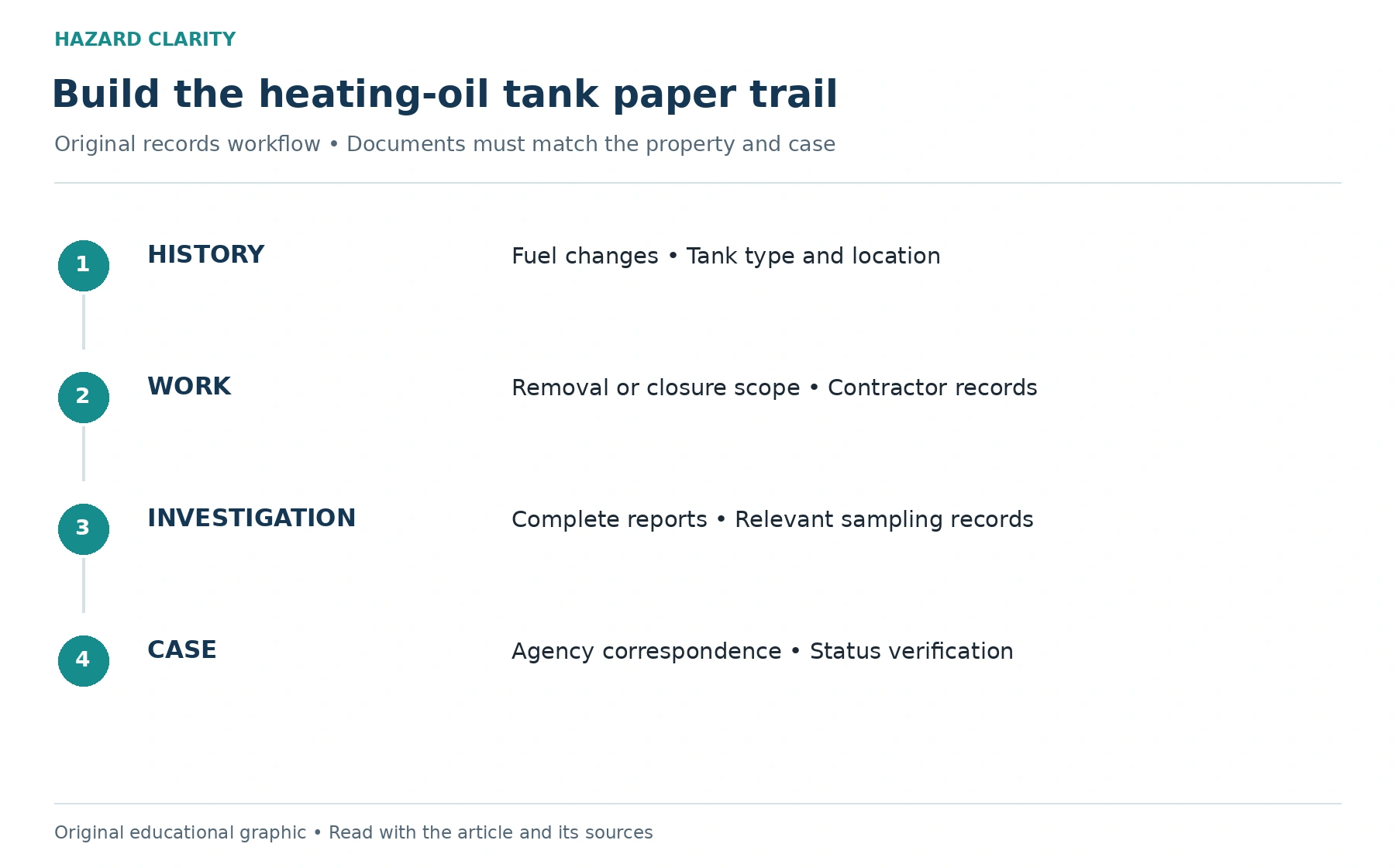
For broader location context, start with HC’s New Jersey resources. Keep the tank paper trail as a separate property file: heating history, contractor scope, investigation records, agency correspondence, and open questions. That structure gives a buyer a clearer foundation and leaves a future owner with records that explain what was actually evaluated and completed.
Sources and reference material
New Jersey DEP Homeowner Resources • Historic heating tanks and official homeowner guidance. Reviewed October 3 2026.
New Jersey DEP UHOT Frequently Asked Questions • Tank-closure certification guidance. Reviewed October 3 2026.
New Jersey DEP No Further Action Letter • Official case-status verification guidance; indexed page reviewed, direct retrieval blocked. Reviewed October 3 2026.
See this property’s own hazard picture.
Check an address