On this page
- List the household needs that depend on power
- Use Indiana guidance as the safety starting point
- Identify an alternate place before you need it
- Make communication work when the usual route fails
- Know what your heating provider can explain
- Review alarms as a separate preparation task
- Include drainage and remote alerts in the plan
- Ask insurance questions using a defined scenario
- Keep an outage record that distinguishes sources
- Practice the communication plan without creating a failure
- Sources and reference material
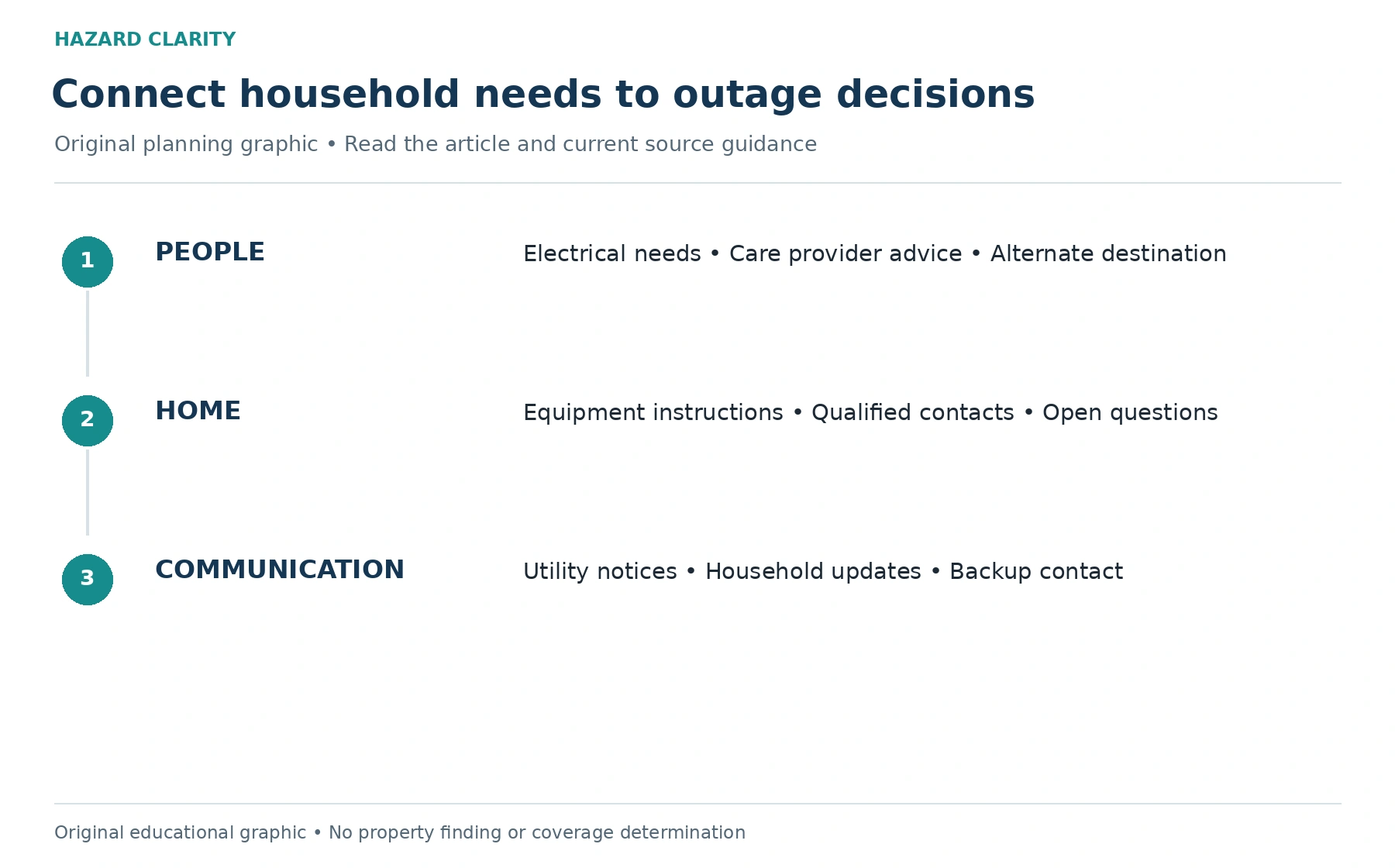
A winter power outage affects more than the lights. It can interrupt heating, communication, household routines, and equipment that depends on electricity. For Indiana homeowners, the useful preparation starts before an outage: know the household’s needs, identify a place to go if necessary, and decide who will contact the right people when plans change.
This is a heat and communication planning guide, not an electrical installation manual. It uses Indiana emergency guidance and practical household records to make the next decisions easier. Actual alerts, equipment instructions, medical needs, and conditions should guide your response. No checklist can predict how long an outage will last or establish that a particular home remains safe to occupy.
List the household needs that depend on power
Start with people rather than appliances. Does someone use equipment requiring electricity? Does a household member need a particular indoor environment or refrigerated medication? Discuss relevant backup and continuity needs with the medical or equipment provider. A general home article cannot tell you what arrangement is appropriate for that person.
Then identify the home systems you rely on: heating controls, pumps, well equipment where present, communication devices, powered access, or remote alerts. Write down what you know and what still requires a provider’s explanation. Fuel-burning heating equipment can still depend on electrical components, so do not assume the fuel source settles outage operation.
Ask each provider which questions it handles. A heating company can explain its installed equipment; a utility can address service information; a medical provider can advise on personal care needs. Keep those contacts beside the relevant item so the household does not have to reconstruct the responsibility list during an interruption.
Use Indiana guidance as the safety starting point
The Indiana Department of Homeland Security power outage resource recommends a communications plan, supplies, and planning for personal electrical needs. It also advises identifying somewhere to go during an extended outage. Use the official page to review your preparation and the current instructions that apply when an outage occurs.
The agency’s generator guidance calls for outdoor use at least 20 feet from windows, doors, or vents. Never operate a generator indoors. That warning is only one part of safe use; follow the equipment instructions and qualified installation advice as well. This guide does not provide connection, wiring, or fuel-handling procedures.
Make the official resource available to another household member. A saved link or printed reference can help when your usual connection is unavailable. Keep its guidance distinct from informal suggestions circulating online. A neighbor’s improvised setup is not evidence that the same arrangement is appropriate for your equipment or building.
Identify an alternate place before you need it
Think through where your household could go if staying home becomes unsuitable. Discuss availability with the person hosting you or review practical accommodation options before an urgent situation. Consider household size, transportation, access needs, pets, and any care requirements. An option that works for one adult may not work for your full household.
Write down what would need to travel with you: essential documents, medications, communication devices, and information for dependent household members. Keep that planning flexible. The appropriate timing for departure depends on actual conditions and official guidance, not a fixed number of hours invented for a general checklist.
Ask how you will confirm the destination is available when needed. A friend may also lose power or be out of town. Identify an alternative contact or location. Having two realistic possibilities is more useful than assuming a single household can accommodate you during every interruption.
Make communication work when the usual route fails
Agree on the first person to contact and the backup method if calls or data service are unreliable. Keep essential numbers somewhere you can reach without signing into a cloud account. A printed contact sheet and an accessible digital copy can support each other. Include local utility information and the providers relevant to the home.
For separated household members, decide who will share updates and where information will be recorded. One person can relay the utility’s current notice while another checks the agreed accommodation arrangement. Avoid turning every group message into a different version of the plan. Identify which source supplied each operational update.
Keep devices charged when an official forecast or notice gives you reason to prepare. Ask equipment providers about suitable backup arrangements where needed. Do not assume a small phone power bank can support other devices or that a product’s advertised capacity fits your household needs without checking its intended use.
Know what your heating provider can explain
Gather the heating system’s model information, service contact, and recent report. Ask the provider what operation depends on electrical service, what instructions apply after an interruption, and which signs require professional evaluation. Keep the answer specific to the equipment rather than collecting generic reset advice.
If the home has separate heating arrangements, distinguish them in the record. A detached office or finished addition may need its own provider instructions. Ask how to handle concerns in those areas without assuming the main furnace’s guidance covers every appliance. Make access to equipment information simple for another adult.
HC’s report and inspection comparison explains why property context and physical equipment evaluation serve different purposes. A location-based report cannot establish the condition or outage capability of your heating system. Use it to organize broader questions while qualified providers address the installed components.
Review alarms as a separate preparation task
Keep smoke and carbon monoxide alarm instructions with the household safety file. Review power supply, testing, and replacement information for the actual models. Do not assume an alarm will keep operating during an outage without checking the manufacturer’s documentation and the unit’s configuration.
The USFA heating fire safety resource is useful when considering household heating plans. Keep unfamiliar backup-heating ideas with qualified providers and official guidance. An interruption is a poor time to experiment with a device or arrangement whose operating requirements you do not understand.
If an alarm sounds or an immediate hazard is suspected, follow the appropriate emergency instructions. Do not delay that response to gather photographs or decide whether the problem could qualify for insurance. Maintenance and policy records become useful after people are safe and the appropriate response is underway.
Include drainage and remote alerts in the plan
If the home has a pump or monitoring device, ask what happens when its power or communication connection is unavailable. A backup component may have its own maintenance needs. Get the relevant provider’s explanation of the installed arrangement and keep the service records rather than assuming the word backup guarantees uninterrupted operation.
Remote alerts need a recipient who can act. Confirm who will receive a message, whether that person can access the home, and how qualified assistance will be contacted. If you are traveling, provide the helper with the information and permissions appropriate to the agreed role. Do not assign hazardous troubleshooting through a contact sheet.
Record any gaps. For example, the alert may depend on the home’s internet connection, or the only recipient may be unavailable during work hours. Those observations create questions for the provider and household. They are reasons to improve the response arrangement, not proof that equipment will fail.
Ask insurance questions using a defined scenario
An outage and a covered property loss are not automatically the same event. Ask your licensed agent or insurer how the policy addresses the situation you are concerned about: damaged equipment, resulting water damage, or temporary accommodation after covered damage, for example. Identify the cause and facts when they are known.
The NAIC winter preparation resource provides background for reviewing winter-related coverage questions. Use your actual contract to ask about limits, deductibles, exclusions, and any applicable duties. Do not assume that discomfort or a utility interruption alone triggers loss-of-use benefits.
Store the response with the policy and claim contact details. If damage occurs, ask how to report it and what records the company needs. Keep temporary accommodation receipts where relevant, but do not treat having a receipt as confirmation that the expense will be reimbursed. The insurer must address the contract and facts.
Keep an outage record that distinguishes sources
During an interruption, retain the relevant utility notice and the time you observed the home’s condition, when safe. An estimate from the utility and your own observation answer different questions. Label them separately rather than turning a projected restoration time into a confirmed event.
After service returns, use the equipment provider’s instructions for any follow-up and record concerns that still need evaluation. Keep appointment information, receipts, and communication with the insurer where relevant. A clear sequence can help explain what happened without claiming that the outage caused every condition noticed afterward. Assign remaining work before closing the household record.
Practice the communication plan without creating a failure
Use a short conversation exercise: the power is out, the household cannot reach its regular heating provider, and one person is away. Who checks the utility notice? Who confirms the alternate destination? Where is the contact sheet? Does the person at home know which concerns call for emergency assistance?
Change one detail and repeat the discussion. Perhaps the nearest helper is unavailable or the destination is affected too. Update the plan where a missing contact or unclear responsibility becomes obvious. There is no need to disconnect equipment or simulate a hazardous condition to learn whether the household understands its roles.
Finish with one next action, such as clarifying a provider instruction or confirming an alternate contact. Save the completed plan beside the home’s service records. Indiana’s official guidance supplies the safety foundation; your own household details make it usable. The result should be a clear route to information, assistance, and a practical change of location when conditions require it.
Sources and reference material
Indiana DHS Power outages • Reviewed October 3 2026.
USFA Heating fire safety • Reviewed October 3 2026.
NAIC Winter insurance preparation • Reviewed October 3 2026.
See this property’s own hazard picture.
Check an address