On this page
- What a radon test answers
- Begin with an Indiana qualified professional
- Put the test on the inspection calendar
- Follow the testing instructions carefully
- Read the number with the guidance
- An existing system needs its own records
- Turn a recommended repair into a defined scope
- Keep negotiation and technical interpretation separate
- Keep a useful ownership file
- Build the buyer checklist before you book
- Sources and reference material
Radon testing belongs on an Indiana homebuyer’s inspection plan because a neighborhood map, a clean basement, and a recent renovation cannot tell you the radon level inside the home. The useful next step is a properly conducted test for the actual property, followed by a clear plan for interpreting the result and completing any recommended work.
That does not need to derail the purchase. It does require enough time to obtain a reliable measurement, ask questions, and document the response before contractual deadlines. Start with the testing process rather than trying to guess from the home’s appearance. A finished basement, a crawlspace, or an existing mitigation pipe should lead to specific questions, not an automatic conclusion.
Use Hazard Clarity’s Indiana property information for broader location context. Then keep radon testing in its own lane. An address-based hazard report and an indoor measurement answer different questions, and the stronger purchase review uses both where they are relevant.
What a radon test answers
Radon is a naturally occurring radioactive gas. You cannot evaluate its indoor concentration by looking at a room or noticing a smell. CDC guidance explains that testing is the way to find out whether indoor levels are elevated. That makes radon different from a visible broken railing or a leaking faucet: the absence of a visible problem tells you very little.
A test result describes a measurement obtained during a particular period under particular conditions. Ask for the property address, location of the device, testing dates, result, units, and explanation of the method. Those details make the number usable. A text message saying the house “passed radon” leaves too much unanswered.
The objective is to understand the actual report and the next step recommended by a qualified professional. Keep the original file rather than copying only its headline number into your notes. You may need the full record when arranging follow-up, discussing work, or deciding when to test again.
Begin with an Indiana qualified professional
Indiana’s Department of Health maintains information about certified radon testers and mitigators. Its contractor guidance states that professionals providing residential radon testing, analysis, and mitigation in Indiana must hold the required state certification. Homeowners testing their own homes are treated differently under that guidance.
For a purchase, check the current state directory and ask who will conduct the measurement, who will analyze it, and what report you will receive. A company name alone is less helpful than the identity and qualifications of the person performing the service. Confirm the scope before booking so you know whether interpretation and follow-up questions are included.
Ask about availability early. Your purchase agreement may give you a limited inspection period, and the test itself needs the conditions and duration required by the applicable method. Your REALTOR can help coordinate the transaction timeline; the radon professional should direct the measurement procedure. Put both schedules in the same calendar.
Put the test on the inspection calendar
When scheduling the general home inspection, say explicitly that you want radon testing considered. Do not assume it is part of every inspection package. Request a written description of the services, timing, fees, and result delivery. If testing is performed by another provider, identify who coordinates access and retrieval of the equipment.
Ask when the test can begin and when the complete report will arrive. Build in time to review an unclear result or obtain a mitigation proposal if appropriate. A report delivered after your response deadline may still be useful for ownership, but it can complicate transaction decisions. Contract deadlines and extension options belong with your REALTOR or attorney.
For a hypothetical buyer with an inspection response due on Friday, scheduling the device late on Thursday could leave little room for discussion. Work backward from the deadline instead. The calendar should reflect the professional’s testing protocol, not force the protocol to fit an unrealistic deadline.
Follow the testing instructions carefully
Ask the tester for clear instructions about the home’s conditions during the measurement. The relevant procedure may address windows, exterior doors, heating and cooling, device placement, and other factors. Give those instructions to the person controlling the property so everyone understands the same requirements.
Do not move the device, change its setup, or attempt to improve the number during testing. If something unusual happens, tell the tester. A window left open, interrupted power, or unexpected access issue is information the professional needs when evaluating validity. The useful response is accurate disclosure rather than an informal adjustment to the result.
Keep a record of when the device was placed and removed and who had access. You do not need to supervise every minute, but you should know whom to contact with a question. If the report identifies an invalid or incomplete measurement, ask what needs to happen next instead of treating it as a completed test.
Read the number with the guidance
EPA recommends fixing homes with radon levels of 4 picocuries per liter, written pCi/L, or higher. EPA also recommends considering reduction work for levels between 2 and 4 pCi/L because there is no known safe level of radon exposure. These are public-health recommendations, not a universal real-estate pass or fail rule.
Ask the tester to explain how the method and result relate to current EPA guidance and applicable professional standards. A number close to a decision threshold deserves careful interpretation, including whether follow-up testing is recommended. Do not round a result to make a transaction decision easier or substitute a neighbor’s result for the home’s measurement.
Avoid trying to make a medical prediction for the people who will live there. This is a property research task: obtain the measurement, understand the recommended response, and plan the work. Personal health questions belong with a qualified healthcare professional. The buyer’s contract choices belong with the appropriate transaction adviser.
An existing system needs its own records
A mitigation pipe and fan can be useful evidence that someone addressed radon previously. They do not establish the current indoor concentration or show that the installation has been maintained. Request the installation record, contractor information, operating instructions, and any post-installation or later test reports.
Ask a qualified radon professional to explain the system’s apparent configuration and what inspection or testing is appropriate. The presence of a gauge is not the same thing as a new indoor radon measurement. Do not disconnect equipment, adjust components, or treat a photograph as proof of performance.
If the seller says the system was installed years ago, record the date as unverified until you receive documentation. Ask whether the fan has been replaced and whether the building has changed since the last test. A finished lower level or other renovation is a reason to discuss retesting, not a basis for guessing how the number changed.
Turn a recommended repair into a defined scope
If reduction work is recommended, request a written proposal from an appropriately certified Indiana provider. The proposal should identify the property, proposed work, exclusions, timing, and the plan for confirming the outcome. Ask what access is needed and whether the work affects finished areas, electrical service, or other building components.
Compare proposals by scope rather than price alone. Two estimates may assume different routes, materials, restoration work, or follow-up testing. Ask the provider to explain those differences in plain language. A low price without a clear completion standard leaves the buyer with another unanswered question.
Avoid inserting a generic cost estimate into negotiations as if it were a bid for the actual home. Obtain the property-specific proposal first. Then discuss how the agreement should describe who arranges the work, when it will be completed, what documents will be delivered, and how any required follow-up will fit the closing timeline.
Keep negotiation and technical interpretation separate
The radon professional explains the measurement and reduction work. Your REALTOR helps you communicate within the purchase agreement. An attorney can address legal wording and obligations where needed. Those roles work together, but a REALTOR’s reassurance cannot replace a valid measurement or a defined installation scope.
For example, a hypothetical seller may offer a credit while the buyer prefers completed work. Neither approach is automatically better in every transaction. Consider contractor availability, access, funding, follow-up testing, and the buyer’s ability to manage work after closing. Use actual proposals and contractual advice to evaluate the options.
Record the agreement in the required transaction documents. An informal promise to “take care of radon” can leave timing and proof unclear. Specific records are more useful: the installer’s invoice, work description, operating instructions, and the relevant test report. Keep personal impressions out of the technical file so later readers can distinguish evidence from conversation.
Keep a useful ownership file
After closing, store the testing and mitigation records with the home’s maintenance documents. Give the adults responsible for the property access to the operating instructions and provider contact details. If there is a system, ask the provider how to recognize an operating concern and what routine follow-up is appropriate.
CDC advises testing again after major renovations because changes to the home can affect indoor radon levels. Discuss retesting when you change the building or how you use its lower level. An older report remains part of the history, but it should not become a permanent substitute for current guidance.
Set a reminder to review the records when planning substantial work or preparing to sell. This is not about keeping a perfect binder. It is about making the next question easy to answer: what was measured, what was done, and what still needs verification? That history helps the next owner and the professionals assisting you.
Build the buyer checklist before you book
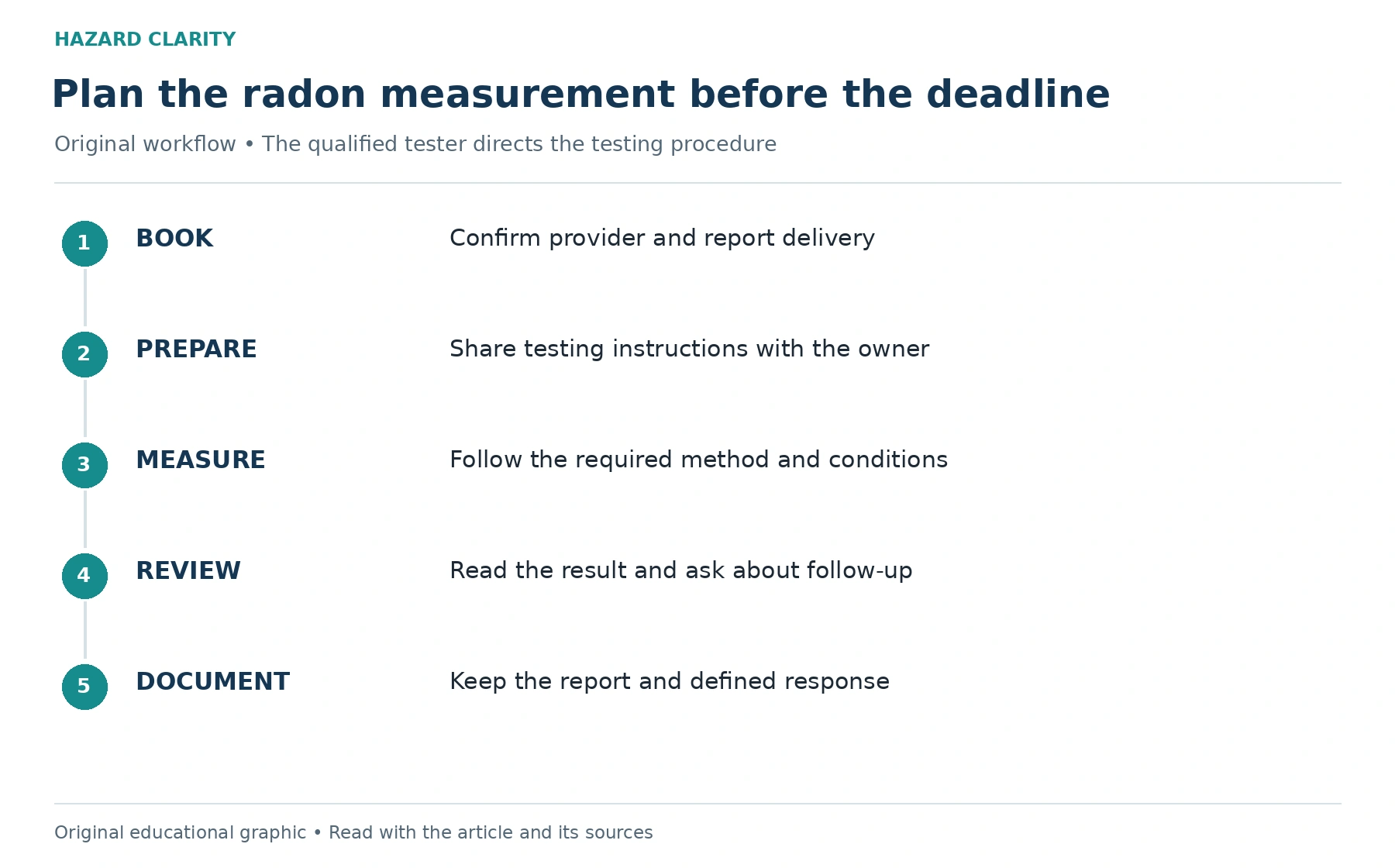
A workable checklist begins with five practical items: select a qualified tester, confirm the method and home instructions, fit the testing period into your inspection calendar, obtain the complete report, and document the recommended response. Add a responsible person and a due date to each item so an unanswered question does not disappear between appointments.
If the property already has a mitigation system, add its records and an appropriate current evaluation. If new work is proposed, add the written scope and outcome-verification plan. Keep estimated work and completed work separate. Mark missing documents as unresolved rather than assuming they do not exist.
For the broader purchase review, read how a home hazard report differs from a home inspection. Then start with the property address at Hazard Clarity to organize location questions alongside your inspection plan. A clear radon process adds a useful measurement to that plan and gives you concrete decisions to make.
Sources and reference material
CDC Testing Your Home for Radon • Testing and retesting guidance; updated August 26 2026. Accessed October 2 2026.
Indiana Department of Health Indiana Certified Radon Testers and Mitigators • Indiana residential professional certification. Accessed October 2 2026.
EPA Radon Resources for Real Estate Community • Links to the March 2024 buyer and seller guide; page updated September 16 2026. Accessed October 2 2026.
EPA Radon Action Level • 4 pCi/L action recommendation and consideration between 2 and 4; updated November 12 2025. Accessed October 2 2026.
See this property’s own hazard picture.
Check an address