On this page
- Start with priorities that come from the evidence
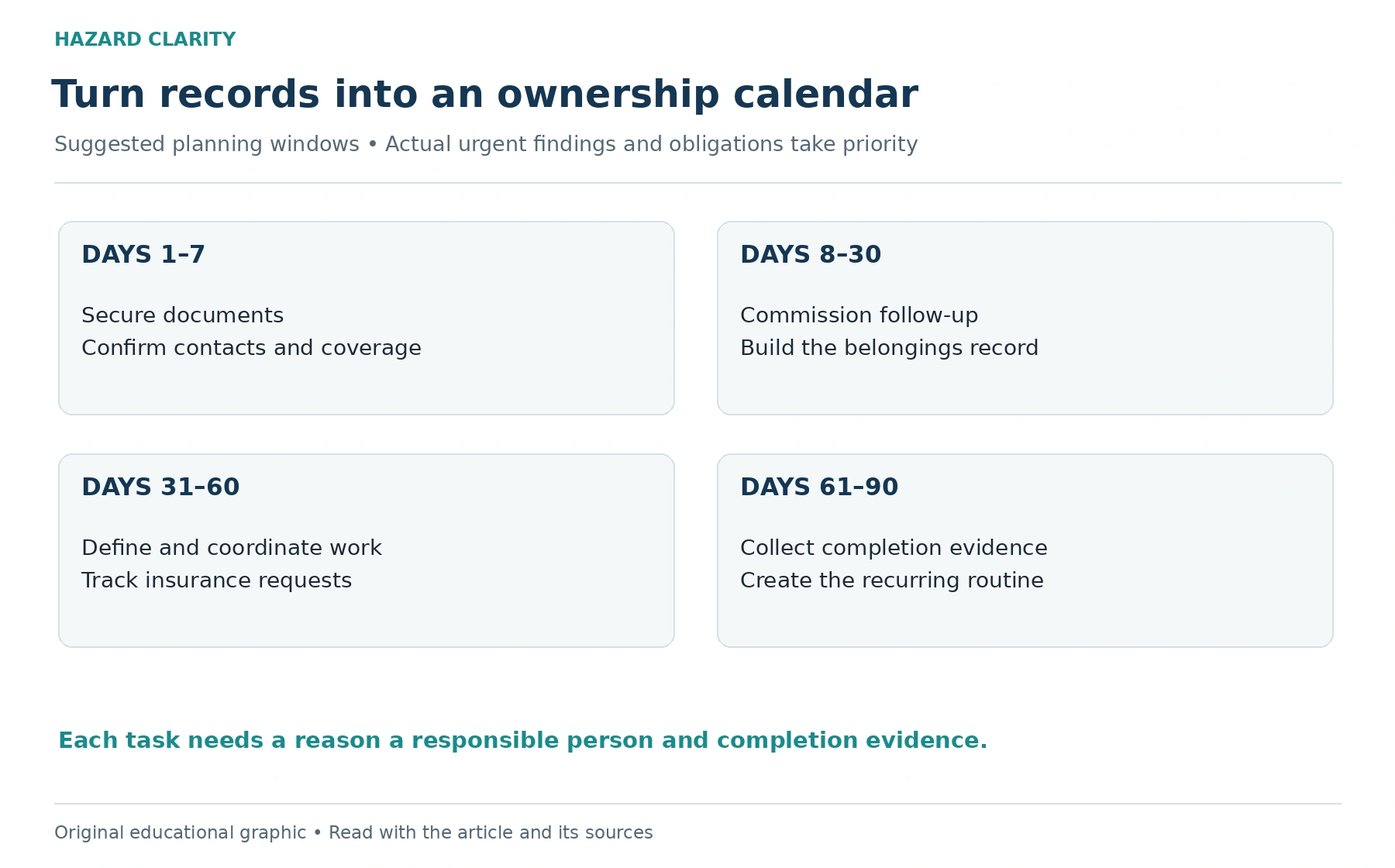
- Days one through seven secure the records and contacts
- Separate property research from physical evaluation
- Days eight through thirty commission the right evaluations
- Create a belongings record while rooms are being organized
- Days thirty one through sixty turn recommendations into defined work
- Keep insurance requests on their own calendar
- Days sixty one through ninety close the evidence loop
- Use the first ninety days to establish a durable routine
- Sources and reference material
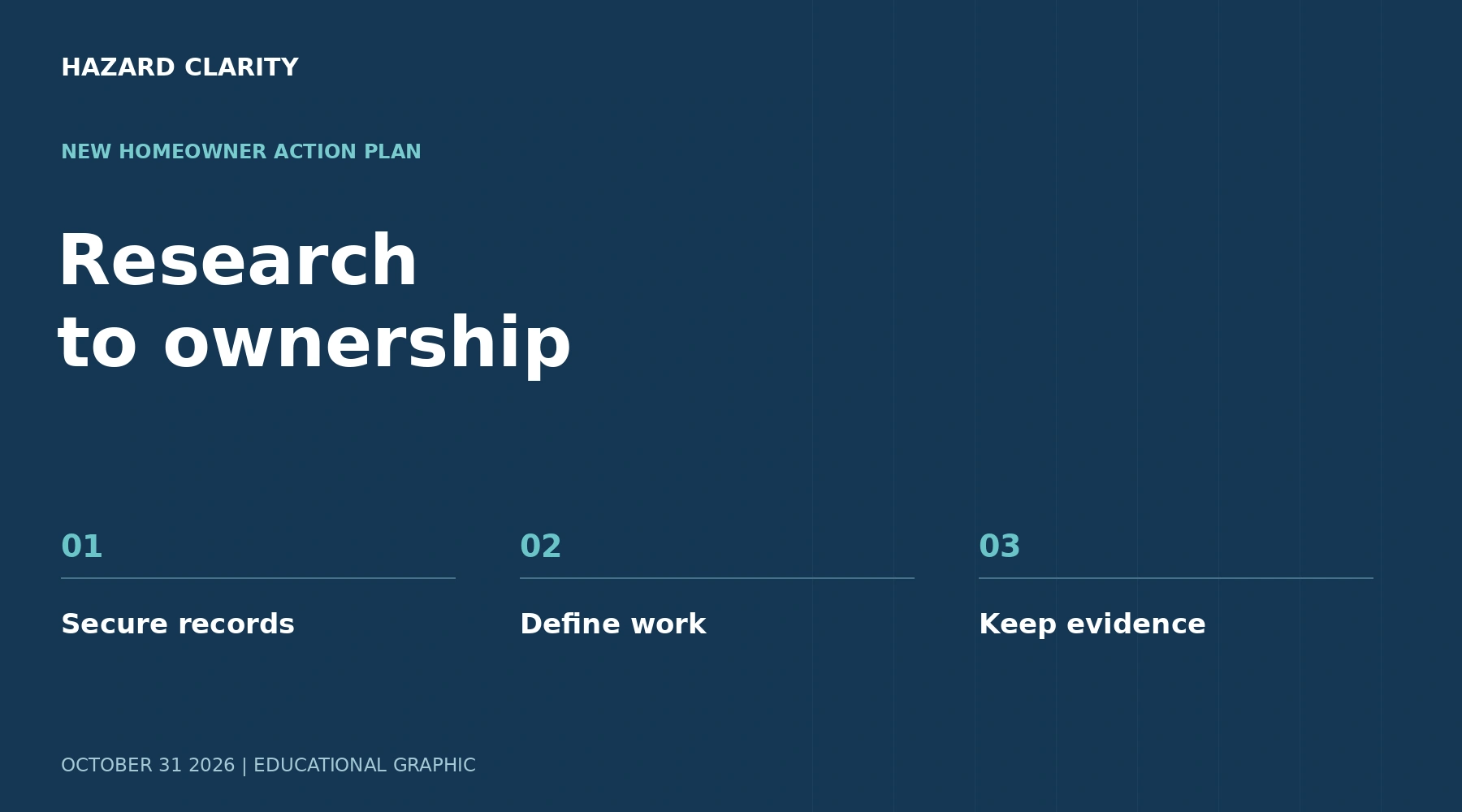
A new homeowner can leave closing with a large folder and still have no clear plan for the first weeks of ownership. The inspection report, insurance documents, contractor estimates, and seller’s records may each contain useful information, but they rarely arrive as one prioritized calendar. Turning them into assigned tasks is a practical way to make the research useful after the keys change hands.
The first ninety days are a helpful planning window, not a universal deadline. Some concerns require immediate action, while other work depends on professional advice, weather, access, or the owner’s budget. The sequence below is an original organizational framework that you can adapt to the actual documents and instructions for your home.
The aim is to finish this period with a usable property file, the right professional follow-up, documented work, and a repeatable maintenance routine. The plan connects location research, physical condition, and insurance without treating one as proof of the others. A completed folder should make it easier to see what is known, what was done, and what remains unresolved.
Start with priorities that come from the evidence
Before assigning dates, review the documents for urgent findings, contractual commitments, insurer requests, and provider instructions. Identify the source of each task. A professional recommendation, an insurance condition, and a personal improvement idea may all deserve attention, but they do not carry the same basis or timing. Keep those distinctions visible when prioritizing the work.
If there is an immediate safety problem, follow the relevant emergency guidance and professional direction rather than waiting for the calendar phase that seems to fit. This plan is for organizing ownership, not delaying response. Likewise, actual policy dates, permit requirements, and other stated obligations should take precedence over the illustrative day ranges below.
For every task, record the location, reason, responsible person, next step, timing source, and evidence that would show completion. A line that says fix drainage is too broad to manage. A line that identifies the documented concern and the appropriate evaluation is more useful, because the owner can act without inventing the technical conclusion or prescribing an unsupported repair.
Days one through seven secure the records and contacts
Collect the closing documents, inspection reports, hazard research, current insurance records, equipment manuals, warranties, and available seller maintenance history. Create a short index so each document can be found by subject. Keep a secure backup away from the home and make the contact sheet accessible when internet service or access to the main folder is unavailable.
Confirm the insurance property description, effective dates, payment arrangement, and any outstanding requests with the insurance professional. A closing file may contain an earlier quote or temporary confirmation, so ask which current documents you should retain. HC’s insurance timing guide provides background, while your actual policy and ownership facts establish the relevant dates.
Build a contact list for the insurer, utility providers, appropriate maintenance professionals, and local emergency information. Ask qualified providers to explain the home’s systems and any appropriate owner procedures. Do not assume that a label on equipment tells you how to operate or shut down an unfamiliar system safely. Record the instructions and where the relevant manuals are stored.
Separate property research from physical evaluation
Review what the location information actually covers and which sources or dates need follow-up. A hazard report can help identify questions about water, wildfire, seismic conditions, or other location factors. It does not confirm the condition of the roof, the function of a pump, or the completion of earlier work. Give each question the evidence appropriate to its scope.
HC’s hazard report and inspection comparison is a useful reference for this separation. Keep the inspection’s access limitations and specialist recommendations visible. A section that was not evaluated should remain an open question, rather than disappearing because the report contains no specific finding for that area.
If you did not receive a relevant record at closing, ask where it may be obtained and whether further professional review is appropriate. Prioritize the gap according to the actual concern and instructions. Missing paperwork is not automatically proof of a problem, but a documented unresolved recommendation deserves a specific next step rather than a place in a miscellaneous folder.
Days eight through thirty commission the right evaluations
Use the inspection and ownership records to define each follow-up scope. Ask the provider what the service will address, which documents or access are needed, and what written deliverable you will receive. A roof review, a drainage evaluation, and an energy assessment answer different questions. Confirm the relevant scope before assuming one appointment will cover everything.
The Department of Energy describes professional home energy assessments as a way to identify improvement opportunities and understand the home’s energy performance. If energy work is part of your plan, use the assessment to inform the sequence rather than selecting equipment or insulation solely from a general article. Keep its recommendations distinct from other technical or insurance instructions.
Share earlier repair records with the relevant evaluator. Ask the provider to distinguish observations, assumptions, limitations, and proposed follow-up. When the report arrives, update the task list with the actual recommendations and their timing. If further investigation is needed, leave the item open and identify the next responsible professional instead of marking the entire subject complete because a visit occurred.
Create a belongings record while rooms are being organized
Moving and unpacking provide a practical opportunity to document belongings. The NAIC recommends a home inventory as a useful record for insurance purposes. Photograph rooms and items, record identifying details, and retain receipts or other ownership information where available. Organize the files so the record can be found and understood later rather than becoming a large collection of unlabeled images.
Keep the inventory secure and backed up outside the home. Test that you can open the files and identify which version is current. Add major purchases and changes as they occur. The inventory documents what you own; it does not establish how a particular policy values or covers every item. Those questions belong in the separate insurance review.
Ask the insurance professional whether special items or changes in belongings warrant further coverage discussion. HC’s homeowners coverage overview can help organize terminology, while the actual policy sets the terms. Record any resulting changes with their effective dates and documents so the inventory and coverage files stay connected without being confused.
Days thirty one through sixty turn recommendations into defined work
Review the findings and request proposals that identify locations, tasks, assumptions, exclusions, and applicable permit responsibilities. Compare scopes before comparing totals. A lower price may reflect different work, and a short quote may leave the original concern unanswered. Ask each provider what evidence will document completion and whether another professional must evaluate the result.
Sequence the work around dependencies identified by the qualified providers. For example, a finish repair may need to follow resolution of the underlying moisture question. That is a reason to request coordination, not to diagnose the cause yourself. Ask who is responsible for the handoff between providers and retain their instructions with the project file.
If work reveals additional conditions, document the revised findings, scope, authorization, and cost before treating the original plan as complete. Keep change records with the initial proposal so the sequence remains understandable. A future owner should be able to see why the work changed and which recommendation each completed task addressed.
Keep insurance requests on their own calendar
If the insurer requests photographs, records, or property work, track the exact request, deadline, and acceptable proof. Ask for clarification when the requirement is unclear. A contractor’s invoice may be useful without being the evidence the insurer requested. Confirm receipt and any remaining action through the insurance professional rather than assuming that sending one document closes the item.
Tell the insurer about relevant changes in the home’s use or condition using accurate facts. A delayed move-in, renovation, rental plan, or completed improvement can raise questions separate from routine maintenance. Ask how the actual policy applies and retain the response. HC’s insurance questions before buying remains useful for organizing these discussions after the purchase as well.
Maintain payment and renewal reminders using the actual policy dates. If the lender is involved in payment or document handling, confirm its process separately. The owner should know who receives notices and who acts on them. A repeatable coverage routine depends on assigned responsibility, not simply on an assumption that someone else in the transaction is still following up.
Days sixty one through ninety close the evidence loop
Gather completion records for the work performed: the agreed scope, invoices, photographs, permits or approvals where applicable, and professional follow-up. Compare them with the original recommendation. Ask whether the relevant provider needs to review the completed work or supply additional instructions. A paid invoice establishes payment and described work, but it may not answer every question raised by the initial evaluation.
Create a maintenance calendar from manufacturers’ instructions, professional recommendations, and actual ownership responsibilities. Use the source for each interval rather than assigning universal dates. Include equipment service, recurring site tasks, and document reviews as appropriate to the home. Identify who performs the task and where the resulting evidence will be stored.
Review the unresolved list at the end of the period. An item may need more information, a future appointment, or a deliberate decision informed by professional advice. Keep that status explicit. The goal is not to force every project into ninety days; it is to leave the owner with an accurate picture of completed work and a credible next step for what remains.
Use the first ninety days to establish a durable routine
An illustrative owner might begin with an inspection referral for a roof concern, incomplete sump-pump records, and a policy request for updated photographs. The roof evaluation, equipment review, and insurance submission become three distinct tasks. Each has its own responsible contact, deliverable, and completion evidence, even if the owner coordinates them during the same month.
As those tasks finish, the owner retains the professional findings and turns any recurring instructions into calendar entries. New information updates the plan rather than disappearing into the folder. This method makes the property file useful for later work, an insurance review, and a future sale because it explains how questions were addressed.
Begin broader research with Hazard Clarity and connect that context to your own home’s evidence. A practical ownership plan grows from the property records, qualified advice, and actual policy terms. The first ninety days are an opportunity to establish that habit, giving you a clearer way to manage the home long after the initial purchase checklist is complete.
Sources and reference material
Department of Energy Consumer Guide to Home Energy Assessments • Assessment as improvement-planning input; no savings or incentive promise. Reviewed October 3 2026.
NAIC Home Inventory • Belongings documentation; the 90-day sequence is original editorial planning, not an official deadline. Reviewed October 3 2026.
See this property’s own hazard picture.
Check an address