On this page
- Start with the alarms you actually have
- Give the walkthrough a clear record
- Check whether everyone can receive the warning
- Walk the exits with the people who live there
- Keep carbon monoxide checks in the same visit
- Ask the insurance question after the home question
- Make the reminder fit your household
- Use the record when household arrangements change
- Finish with a short handoff
- Sources and reference material
Turning the clocks back is a useful reminder to check the parts of a home that are easy to overlook: alarms, escape routes, and the information someone would need in an emergency. You do not need to turn the day into a renovation project. Start with a careful walkthrough, identify anything that needs professional attention, and set reminders for the work that continues throughout the year.
For 2026, daylight saving time ends November 1 in places that observe it. NIST explains the clock change. Your household checks are still useful if your location does not change clocks. The date is an organizing prompt, not a substitute for the testing schedule in a device’s instructions.
Start with the alarms you actually have
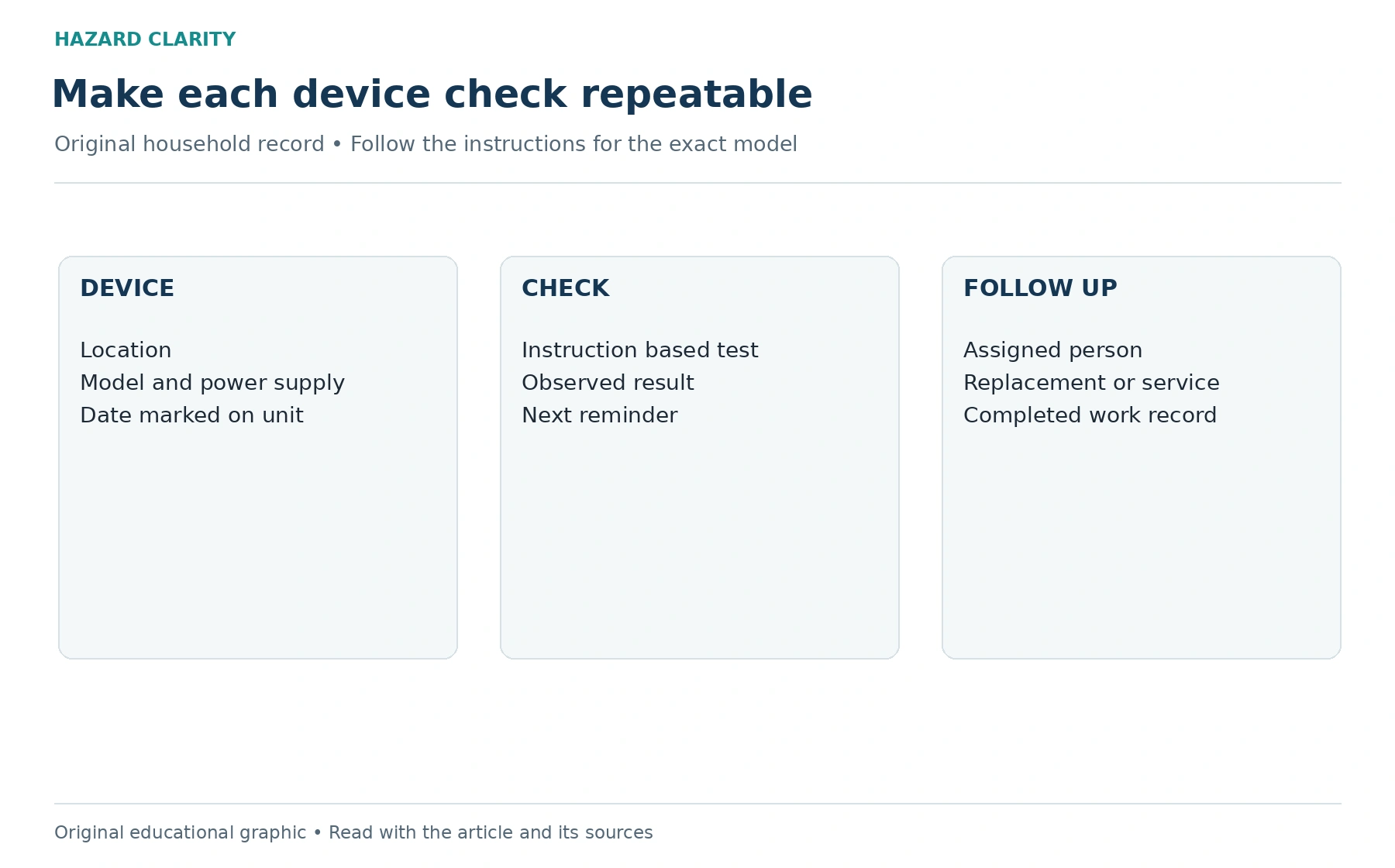
Walk through the home and make a simple list of smoke alarms and carbon monoxide alarms. Record the room or area, the manufacturer, the model if readable, and the date marked on the device. A combination unit may perform both functions, but confirm that from its label rather than assuming it does. A device that looks like an alarm could serve a different purpose.
Use the instructions for the exact model to understand its power supply, testing procedure, maintenance needs, and replacement date. Battery arrangements differ. Some devices have replaceable batteries; others use a sealed battery and require replacement of the entire unit at the appropriate time. Hardwired equipment can still have maintenance needs. If you cannot identify a device, place that on the follow-up list rather than improvising.
The U.S. Fire Administration’s smoke alarm guidance recommends monthly testing and identifies age as a reason to replace smoke alarms. Keep manufacturer instructions with your home records so you can follow the correct requirements for each model.
Give the walkthrough a clear record
A useful alarm record is short enough to update. For each device, write its location, date checked, observed result, and any follow-up action. “Hallway unit tested according to instructions on November 1” is more useful than “alarms done.” If a unit did not respond as expected, record that accurately and arrange the appropriate correction. Do not mark it complete simply because you bought a battery or scheduled a visit.
Separate the testing record from the replacement record. A test date does not establish the manufacture date, and a purchase receipt does not establish that the unit was installed correctly. If a professional installs or replaces equipment, keep the invoice and installation information together. Ask how to test the completed arrangement and what reminders you should set.
Take a readable photograph of the label when that can be done safely. It can save time when ordering a suitable replacement or asking a question later. Avoid climbing, dismantling unfamiliar equipment, or touching wiring just to improve your filing system. Ask for help when reaching or identifying a device would create a problem.
Check whether everyone can receive the warning
A working device is only part of a household plan. Consider who sleeps in each area, whether doors are usually closed, and whether someone has difficulty hearing an ordinary alarm. USFA describes accessible alarm options for people with hearing loss. A qualified installer or local fire department can help you understand appropriate equipment and placement for the household.
This is particularly useful before family visits. A guest may use a room that is normally an office, or a child may sleep in a different part of the home. Review the arrangement before the visit rather than assuming the everyday plan covers it. Ask for help with unfamiliar layouts, interconnected equipment, or placement questions.
A phone notification is not the same thing as a warning that reaches someone inside the home. If you use a monitored or connected system, understand what happens locally, what reaches your phone, and what the monitoring service actually does. A marketing description is not enough to establish the response. Read the service terms and ask the provider to explain the sequence.
Walk the exits with the people who live there
Follow the ordinary route out of each sleeping area and consider an alternative route with guidance appropriate to the home. Note furniture, storage, locked doors, or household arrangements that could interfere with leaving. The purpose is to identify practical obstacles before an urgent situation, not to certify that a route is adequate under a building code.
Talk through who may need help, where household members will meet outside, and how visitors will learn the plan. Use the USFA home escape planning resource for safety guidance. If a person’s mobility, vision, hearing, or age changes the plan, include that person’s needs directly rather than relying on a generic checklist.
Keep the conversation concrete. “The back door key is here, and this is our meeting place” is useful. “Everybody knows what to do” leaves too much unanswered. A new caregiver, visiting relative, or older child may need the same information in a different form. Review it together while the home is calm.
Keep carbon monoxide checks in the same visit
Use the same walkthrough to identify carbon monoxide equipment and its instructions. The USFA carbon monoxide resource includes monthly alarm testing guidance. Keep the record distinct from smoke alarm testing when the devices or procedures differ.
Do not use a maintenance checklist to decide whether a possible emergency can wait. Follow official emergency guidance if an alarm sounds or you suspect a hazardous condition. Leave professional evaluation of fuel-burning equipment to qualified people. A device test does not inspect a furnace, fireplace, water heater, or appliance installation.
If recent work changed your heating equipment or room use, ask whether the alarm arrangement needs review. Bring the equipment records and existing device information to that discussion. It is more productive than buying a new device without understanding where it belongs or how it should operate. Keep the alarm review and the appliance service record connected, while preserving their separate purposes.
Ask the insurance question after the home question
A protection device can be worth installing or maintaining regardless of whether an insurer offers a program for it. If you want to ask about a discount, be specific: identify the device, whether it is monitored, how it was installed, and what evidence the company requires. Ask whether the program is available under your policy and when any change would take effect.
Do not assume a receipt or a successful device test guarantees a credit. Different companies can use different eligibility rules, and a program may require verification beyond ownership. Keep the written response with the policy records. If the company requests an inspection or installation certificate, record who will provide it and when.
HC’s insurance inspection explainer helps frame insurer review questions. A home’s alarms, a carrier’s inspection, and a professional safety evaluation are different sources of information. Ask each provider what its work establishes before relying on it for another purpose.
Make the reminder fit your household
Choose a repeatable place for device instructions and monthly reminders. One household member can own the record, while another knows how to find it. If you use a calendar, create reminders for actual tasks rather than a single annual event labeled “home safety.” Separate testing, replacement follow-up, and professional service appointments.
Make unresolved items visible. A missing date label, a device you cannot reach, or a question about a guest room should have a next action. Give that action to someone who can complete it. A list becomes useful when the reader can tell whether the issue was resolved, scheduled, or still waiting for an answer.
For broader property context, HC’s report and home inspection comparison explains why a data report does not replace a physical inspection. Use a property report for relevant location questions and qualified people for the condition of installed systems. Keep your household plan grounded in what is actually present in the home.
Use the record when household arrangements change
Revisit the alarm and escape record when a room becomes a sleeping area, a guest stays regularly, or a caregiver joins the household routine. Give the person responsible for the change access to the relevant instructions. A monthly reminder is helpful, but it cannot anticipate every change in how the building is used.
For a rental or shared building, ask the landlord or property manager which devices and areas it maintains and how to report a concern. Keep that answer alongside the household record. Do not assume the responsible party can act on a problem that has never been reported, or that reporting it means the correction is already complete.
When work is finished, update the location list and the device information rather than leaving an older version as the only reference. Share the new record with the people who use it. That small step keeps the fall walkthrough useful after the date on the calendar has passed.
Finish with a short handoff
At the end of the walkthrough, share the findings with another adult or responsible household member. Explain which checks were completed, which devices need attention, and where the instructions are stored. Include anyone who regularly stays in the home or helps manage it. A record that only one person understands is harder to use when that person is away.
For example, an upstairs alarm with an unreadable manufacture date can become a defined task: identify the model, ask the manufacturer or installer how to confirm its age, and replace it when appropriate. A guest room arrangement can become a placement review with a qualified provider. These are actionable questions, rather than broad concerns that remain on a list indefinitely.
The fall clock change works best as the start of an ongoing routine. Check the devices according to their instructions, practice the household plan, and follow through on unresolved items. The result should be a home record your family can use throughout the year, with a clear route to professional help whenever the checklist reaches its limits.
Sources and reference material
USFA Smoke alarms • Reviewed October 3 2026.
USFA Carbon monoxide • Reviewed October 3 2026.
USFA Escape plans • Reviewed October 3 2026.
NIST Daylight saving time • Reviewed October 3 2026.
See this property’s own hazard picture.
Check an address