On this page
- Understand the mechanism before choosing a repair
- Build the winter history from specific records
- Ask what the inspection could actually observe
- Keep roof work and energy work connected
- Make a separate insurance inquiry
- Prepare for the first winter without climbing the roof
- Use an example to test the file
- Leave the review with three clear answers
- Sources and reference material
A Colorado home can look straightforward during an October showing and still leave you with unanswered winter roof questions. Fresh shingles, a clean gutter, and a recently painted ceiling are useful observations, but they do not tell you how the roof and attic performed during earlier snow events. Before your first winter, the better question is what the property records explain about heat loss, roof drainage, past moisture, and the work already completed.
Ice dams deserve their own review because a roof covering is only one part of the story. A buyer can collect a roof invoice and still have no documentation about an attic investigation or the cause of an old ceiling stain. A homeowner can replace damaged finishes and still need to understand why water entered. Building that connection early gives the next professional a clearer starting point.
This checklist is designed for Colorado buyers and new owners organizing a winter roof file. It combines general building-science background with local property questions and a practical handoff process. It does not assume that every Colorado home has the same snow conditions, roof design, or maintenance needs. The goal is a useful review of this home, rather than a diagnosis based on the state name.
Understand the mechanism before choosing a repair
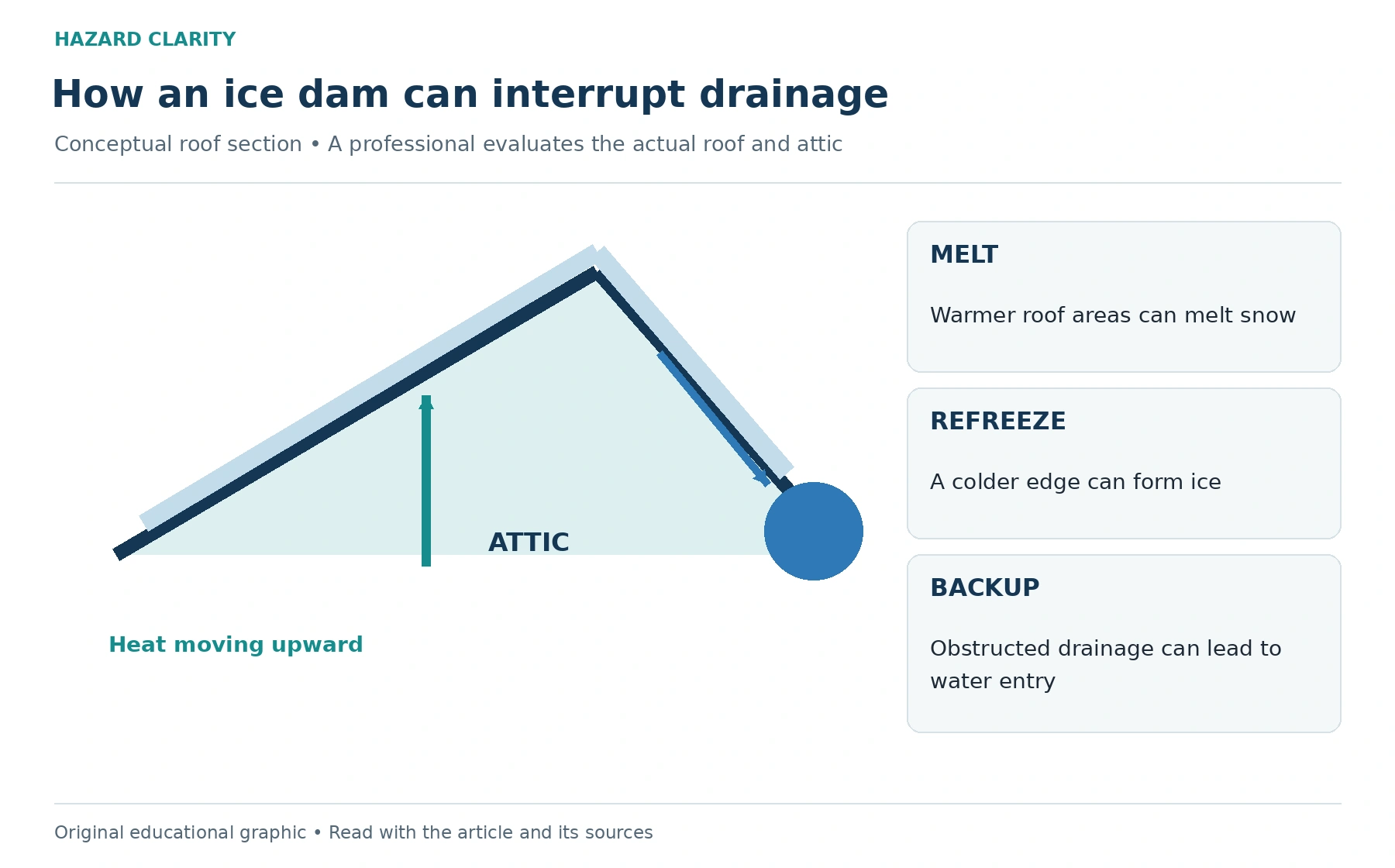
University of Minnesota Extension explains that an ice dam is a ridge at a roof edge that can obstruct drainage of melting snow. Differences in roof-surface temperatures can allow melting higher on the roof and refreezing near the colder edge. Water held behind that obstruction can enter the building. This is why the attic and heat-loss questions belong beside the roof questions.
That explanation does not establish what caused a particular stain. A roof penetration, flashing issue, plumbing leak, or another moisture pathway may require a different response. Ask the inspector to describe the evidence and the limits of the inspection. If the concern needs a roofer or building-performance professional, request a written referral question that identifies the affected location instead of simply saying the home has winter problems.
Colorado State University Extension’s heating guidance discusses household heat loss, offering useful local background for the conversation. Applying that background to a home still requires attention to its construction and condition. Do not choose insulation thickness, ventilation changes, or a roof treatment from a generic illustration. The educational graphic here explains a mechanism; it is not an installation drawing.
Build the winter history from specific records
Start with the seller’s account of past winter moisture and any records they can share. Ask which rooms were affected, when the events occurred, what work followed, and who performed it. A statement that the issue was fixed becomes more useful when it has an invoice, scope, photographs, and a description of the conditions that prompted the work.
Request roof installation and repair records separately from attic or energy work. A roof replacement receipt may establish the contractor and date without documenting air leakage or an earlier moisture investigation. An insulation receipt may establish added material without explaining whether the roof assembly was evaluated. Keeping the records separate avoids making either document answer questions outside its scope.
Organize photographs by location and date. An old close-up of damaged drywall is hard to interpret without the room, wall orientation, and broader context. A simple floor-plan reference, such as upstairs bedroom on the north side, can help a provider connect the record to the inspection. Keep original files where available and label your own annotations as annotations.
Ask what the inspection could actually observe
An inspection performed before winter may identify roof or attic concerns but cannot reproduce every snow and thaw condition. Ask which areas were accessible, what prevented observation, and whether the inspection addressed attic moisture or merely noted visible surfaces. A report that states an access limitation is giving you an important boundary, not an assurance that the hidden area is sound.
Use HC’s explanation of hazard reports and home inspections to separate location context from physical evaluation. A location report can help organize research; it cannot verify that a roof drains properly or that earlier repairs corrected a building problem. The property inspection and any specialist evaluation need their own scope and dated findings.
When you request follow-up, name the uncertainty. For example, ask whether the provider can evaluate the relationship between documented winter leakage, the roof edge, and attic heat loss. That request is more actionable than asking for a guarantee against ice dams. Confirm the deliverable, access requirements, fee, and expected report date before relying on the appointment in a purchase timeline.
Keep roof work and energy work connected
A roof concern can lead to more than one professional. One provider may evaluate coverings and flashing while another examines heat movement through the upper building enclosure. Ask whether the proposed work depends on findings from the other evaluation. This coordination matters when a contractor recommends a repair before the underlying moisture history has been reviewed.
Request estimates that describe the location, scope, exclusions, and assumptions. A quote for roof repairs should tell you what the provider intends to address and what remains outside the work. If additional conditions may be found after opening an area, ask how those findings will be documented and approved. Avoid treating a short estimate as a complete investigation report.
Changes to insulation, air sealing, or ventilation should be planned by qualified providers with the building’s systems in mind. Extension guidance notes the importance of safe operation of ventilation and combustion equipment when a home is tightened. As the owner, your useful task is to request that coordination and keep the resulting documentation, rather than attempting to prescribe the assembly yourself.
Make a separate insurance inquiry
Tell the insurance professional what is known: the property’s roof age if documented, the recorded moisture event, completed work, and unresolved evaluation. Ask how the proposed policy treats water damage in the circumstances described, including exclusions, deductibles, and any maintenance or condition questions. Do not assume that a roof invoice creates coverage or that a cause described casually by a seller controls a claim decision.
Keep the discussion attached to the actual policy and property. HC’s homeowners coverage overview is a starting point for terminology, while the professional should identify the applicable provisions in the documents offered to you. Record which documents were reviewed, the date of the conversation, and any requested follow-up evidence.
If the insurer asks for work before or after coverage begins, clarify the scope, proof, and timing in writing. An insurance condition and a contractor recommendation may overlap, but they are different instructions from different sources. Track both so that completing one task does not cause you to overlook the other. Confirm coverage status through the insurance workflow rather than through a repair promise.
Prepare for the first winter without climbing the roof
A useful readiness file identifies who to call if roof-edge ice or interior moisture appears. Keep contact information for the roofer, the relevant building-performance provider, and the insurer accessible away from the home. Discuss in advance how professionals handle winter access and temporary measures. A response plan is easier to use when you are not selecting providers during an active problem.
Do not climb onto a snowy roof or chip away ice to investigate. University extension guidance directs owners to professionals for winter roof work because of injury and property-damage risks. Observe from a safe location and avoid areas where ice or snow may fall. Your documentation should support a qualified response, rather than create a new exposure while collecting a photograph.
If you notice water inside, describe the room, time, weather context, and visible changes without declaring the cause. Photographs from a safe position can establish a sequence. Follow the appropriate provider’s instructions for response and documentation, and contact emergency services when an immediate safety problem warrants it. Do not wait for a content checklist to authorize action during an unsafe condition.
Use an example to test the file
Consider an illustrative buyer who receives a roof replacement invoice and photographs of an upstairs ceiling repair. The invoice identifies the roof work but says nothing about why the ceiling was wet. The buyer’s open question is whether the winter moisture source was investigated and addressed. That question remains open even if both documents are genuine and the room looks good at the showing.
A productive next step is to provide the documents to the inspector and ask which specialist scope is needed. The buyer can then compare the evaluation findings with the repair invoice, request missing records, and discuss unresolved condition questions with the insurance professional. The process creates a documented basis for a decision without labeling the home defective from a photograph.
For an existing owner, the same example becomes a maintenance handoff. Record what was evaluated, what work was completed, and what observations would justify contacting the provider again. If the response is to monitor a location, define who is doing that and how observations will be retained. Monitoring is a task with evidence, not a substitute for an unresolved professional recommendation.
Leave the review with three clear answers
At the end of the review, you should know what winter history is documented, what the professionals evaluated, and what remains unresolved. Those answers are more useful than a broad statement that the roof is winter ready. They let a buyer weigh the purchase and an owner schedule work with a realistic understanding of the evidence.
Store the roof records, attic findings, photographs, insurance correspondence, and contractor scopes together with a short index. Add new documents as work occurs and retain earlier versions so the sequence stays understandable. A future buyer or provider should be able to see why the work was performed and which question it answered.
Begin broader location research with Hazard Clarity’s Colorado resources, then move from regional context to the home’s own records. A sound winter plan connects location, building evaluation, and ownership responsibilities. That connection is what turns a seasonal concern into a practical set of next steps before the first snow changes access and visibility.
Sources and reference material
University of Minnesota Extension Dealing with and preventing ice dams • Mechanism, professional winter-roof work, and building-system coordination. Reviewed October 3 2026.
Colorado State University Extension Heating Colorado Homes • Local whole-house heat-loss background; no incentives or installation specifications reproduced. Reviewed October 3 2026.
See this property’s own hazard picture.
Check an address