On this page
- Identify the report before interpreting an entry
- Match the entry to the correct person and property
- Build an event file without declaring a current defect
- Distinguish correction from disagreement with underwriting
- Prepare a focused dispute packet for your own information
- Keep the purchase moving on its own evidence track
- Share the relevant result securely and accurately
- Work through an illustrative example
- Sources and reference material
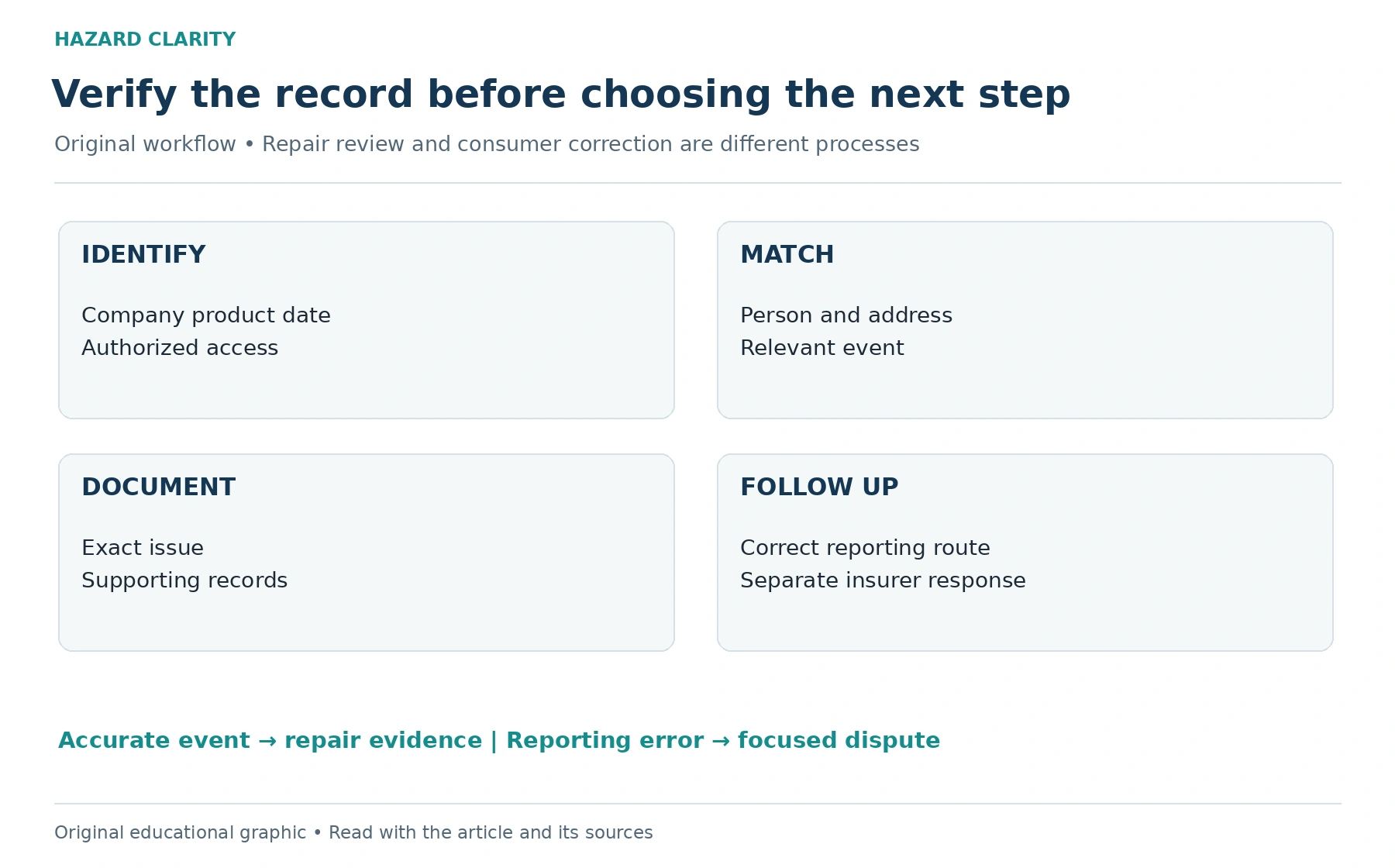
A property’s insurance claims history can raise questions during a purchase, but the report is not an inspection of the home. An entry may help you identify an event to investigate, while the repair records and current professional evaluation answer different questions. A buyer who treats the report as a condition guarantee can miss important information; a buyer who treats every entry as proof of an unresolved defect can also misread the evidence.
The practical task is to verify the relevant record, connect it to the property documents, and correct inaccurate or incomplete consumer information through the appropriate process. This article focuses on that workflow. HC’s existing CLUE explainer addresses the broader concept; here the emphasis is on what to do when the actual records become part of a purchase or insurance conversation.
A good claims-history file tells you which report was reviewed, whose information it contains, which entry prompted a question, and what evidence supports the response. It also preserves the distinction between a consumer reporting dispute, a repair question, and an insurer’s underwriting decision. Those are related conversations, but they should not be collapsed into one task.
Identify the report before interpreting an entry
Start with the reporting company, product name, date, and identifying details. A summary described as a claims report may not be the complete consumer disclosure or the particular product an insurer used. Ask the person providing it to explain what it is and which part of the insurance or property review it supports. Keep the original document when you are authorized to receive it.
The Consumer Financial Protection Bureau lists LexisNexis C.L.U.E. and explains consumer reporting access and dispute information. Use the current official directions to request your own eligible records or obtain help with your information. A buyer should not assume they can access a seller’s private consumer report merely because they are interested in the house.
For a seller’s property history, work through the seller and the transaction professionals to request appropriate documentation and sharing. Ask what is available and authorized rather than attempting to obtain another person’s information through your own request. HC’s CLUE report overview can help frame why the records are useful without turning that usefulness into an assumed access right.
Match the entry to the correct person and property
When you review your own report, check the identifying information and the entries that prompted the question. If a record appears to belong to another address or person, identify the mismatch specifically. A dispute that says the report is wrong without naming the record is less useful than one that explains the exact field or entry and the evidence supporting correction.
For a property record shared by the seller, verify the address and the relationship of each relevant event to the home under review. A seller may own more than one property, and the document should not be casually generalized. If the report format is unclear, ask the reporting company or appropriate professional to explain it instead of guessing what a code or label means.
Keep uncertain matches open. You can record that an entry appears relevant pending clarification without treating it as an established event at the house. This distinction matters when a buyer asks an inspector to review a repair or an insurer requests additional information. Accurate wording helps the next person understand what is confirmed and what still requires verification.
Build an event file without declaring a current defect
For a relevant property event, ask the seller for the date, affected location, repair scope, and supporting records they can provide. Gather contractor invoices, photographs, inspection findings, permits where applicable, and any follow-up evaluation. Put them in sequence so the file shows what happened, what was recommended, and what was completed.
A paid claim does not establish that every recommended repair occurred, and a repair receipt does not establish that the current condition is satisfactory. Likewise, an entry is not proof that the home still has damage. Ask the inspector which observations or further professional evaluation are appropriate for the documented event, leaving the technical assessment within its own scope.
HC’s hazard report versus inspection guide explains a similar evidence boundary. A record points to a question; the physical review and specialist work address the condition within their scopes. Keep those steps connected so the purchase decision reflects both history and current evidence instead of assuming one automatically answers the other.
Distinguish correction from disagreement with underwriting
The CFPB explains that a consumer can dispute information they believe is inaccurate or incomplete with the reporting company and the company that supplied it. That process addresses the record. It is different from asking an insurer to explain why it offered certain terms or made a decision based on information it considers accurate.
If the record is wrong, identify the factual issue and follow the reporting company’s current instructions. If the record is accurate but you believe the repair history or context matters to underwriting, ask the insurer what additional documents it will review. Both conversations may occur at the same time, but one should not be used to promise a particular outcome in the other.
Do not request deletion simply because an accurate entry is inconvenient. Explain the specific error or omission you believe exists and provide relevant support. If you do not understand whether the issue concerns a field, an event, or the insurer’s interpretation, ask for clarification first. A precise request keeps the discussion grounded in verifiable information.
Prepare a focused dispute packet for your own information
Identify the report date, the disputed entry, the information you believe is incorrect or incomplete, and the correction you are requesting. Include copies of relevant supporting documents as directed, keeping originals secure. Use the current contact and submission instructions provided by the reporting company or official resource. Do not send unnecessary sensitive information through an unverified channel.
Keep a copy of the submission, the supporting documents, any confirmation or reference number, and subsequent responses. Record the dates so the sequence remains understandable. This is an organizational method rather than a statement of legal deadlines. If you need advice about your rights, timing, or an unresolved dispute, consult the relevant official guidance or an appropriate legal professional.
When the response arrives, compare it with the specific request. If the information changes, retain the updated record alongside the earlier version and the response. If the issue remains unresolved, use the appropriate follow-up route rather than describing the record as corrected. Your purchase and insurance contacts should receive an accurate account of status, not an optimistic shorthand.
Keep the purchase moving on its own evidence track
A consumer dispute may not conclude within the buyer’s contract timeline. Ask your real estate or legal professional how unresolved information affects the agreement and decisions. Do not assume the dispute automatically extends a deadline or permits cancellation. At the same time, continue the authorized property review that does not depend on a final consumer reporting response.
For example, an inspector can review a documented roof repair while the owner seeks clarification of a report entry. The insurer can explain which evidence it needs to evaluate the application. Track these as separate tasks with responsible contacts and deliverables. That avoids leaving all work on hold because one process is still pending.
HC’s insurance timing guide for homebuyers offers broader context for beginning insurance work early. Use your actual closing and coverage requirements for the timeline. A report correction, a quote, and a bound policy are distinct milestones, so each needs its own confirmation before the buyer treats the insurance portion as complete.
Share the relevant result securely and accurately
Ask the insurer which documents it needs and which submission channel to use. A consumer disclosure may contain information unnecessary for a contractor or general transaction contact. Provide only the relevant material through an appropriate channel, and do not circulate the entire report casually to everyone working on the purchase.
When summarizing an issue, identify whether it is confirmed, disputed, corrected, or still awaiting clarification. Include the date and source of the status. A sentence such as the reporting company issued an updated record on a stated date is clearer than saying the problem went away. It also avoids implying that the insurer has already changed its decision.
After providing updated information, ask the insurer whether it has reviewed the documents and whether any further action is required. Retain the response with the application file. A corrected report can improve the accuracy of the evidence without guaranteeing a particular premium, eligibility result, or policy provision. Those outcomes require confirmation through the insurer’s own process.
Work through an illustrative example
Imagine a buyer whose own consumer report lists an event at an address they do not recognize. The buyer identifies the entry, requests clarification, and submits a dispute with relevant support through the official process. Separately, the buyer tells the insurance professional that a correction request is pending and asks what documents the application needs.
Now imagine the seller’s shared property records describe a genuine earlier water event. That situation calls for repair documentation and an appropriate current inspection, even if no reporting error exists. Treating both examples as the same task would confuse record accuracy with the home’s physical condition. Each needs the person and evidence appropriate to the question.
Keep the final file organized around those distinctions: report identity, event verification, repair evidence, dispute status, and insurance confirmation. Claims-history research becomes useful when it leads to precise next steps. It should leave the buyer with better evidence about the property and their own information, while preserving the limits of what a report can establish.
Sources and reference material
Consumer Financial Protection Bureau LexisNexis C.L.U.E. and Telematics OnDemand • Consumer-report access and disputes of inaccurate or incomplete information. Reviewed October 3 2026.
See this property’s own hazard picture.
Check an address