On this page
- Start with the pathway to the property
- Wind questions begin with the building
- Storm surge questions begin with the coastal setting
- Heavy rain questions extend beyond the shoreline
- Florida buyers should coordinate records and coverage
- Louisiana buyers should review water and wind separately
- North Carolina buyers should include inland questions
- South Carolina buyers should include ownership responsibilities
- Compare documents without collapsing the hazards
- Keep a source log for the coastal review
- Finish with a property and policy review
- Sources and reference material
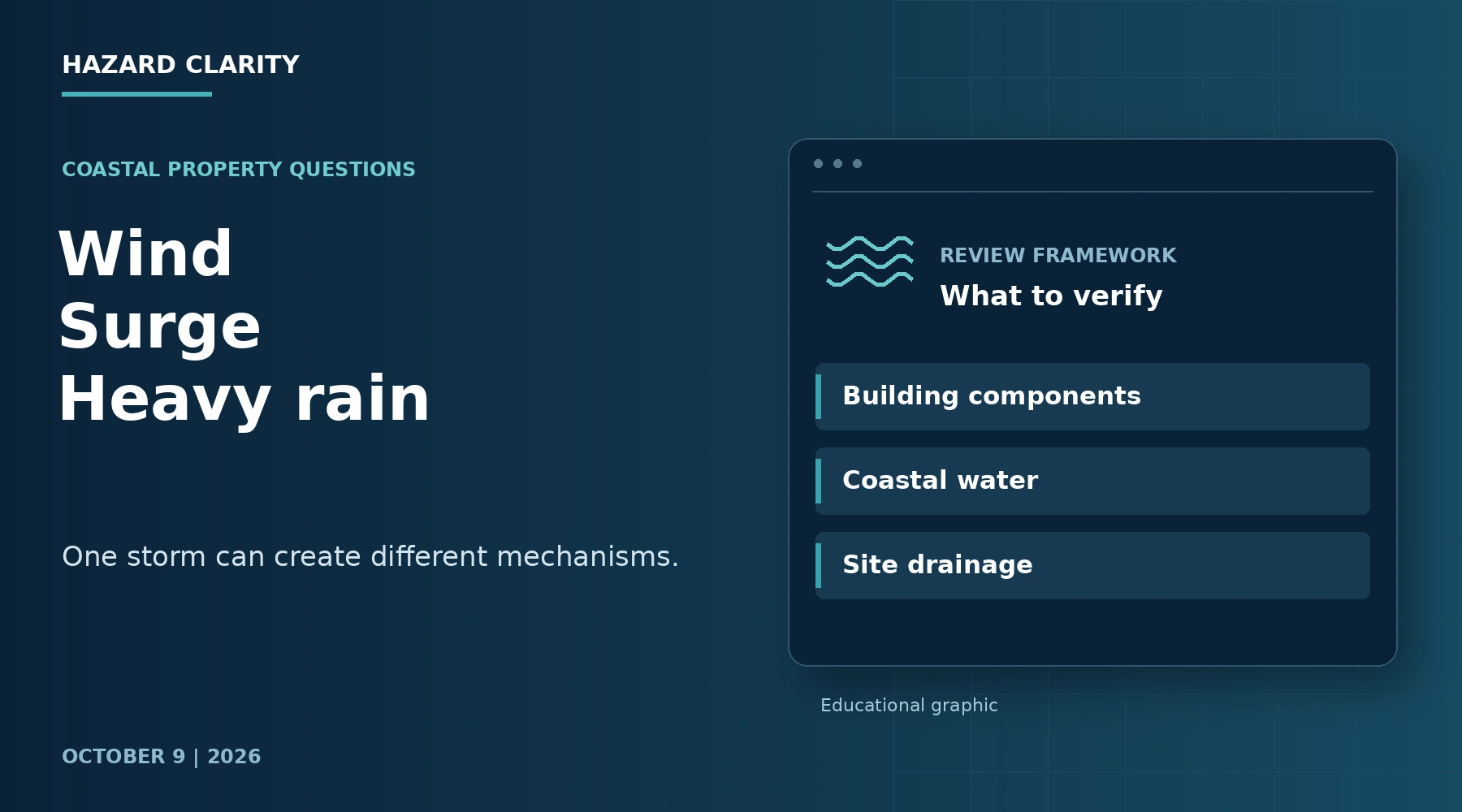
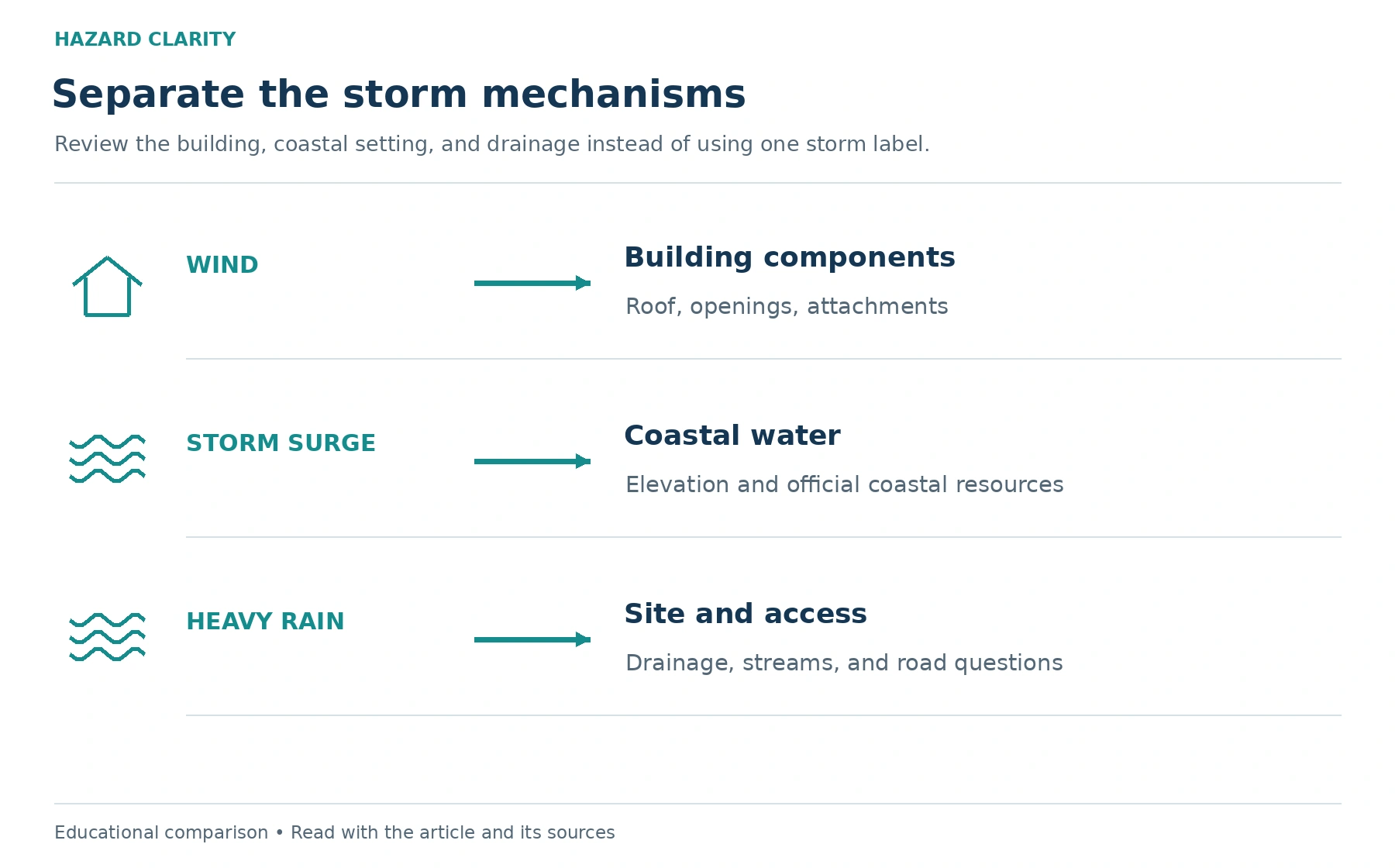
When someone says a coastal home has “hurricane risk,” the phrase can hide several different questions. Wind can affect the building. Storm surge can bring coastal water onto land. Heavy rainfall can create flooding well beyond the shoreline. These mechanisms deserve separate attention because a single storm can involve more than one of them.
A useful property review connects the hazard mechanism with the home, its surroundings, access, and proposed insurance. It does not reduce the entire decision to a storm category or a distance from the beach. Those details may be relevant, but they cannot settle every question about a specific address.
Use HC’s overview of hurricane coverage as a starting point. Then build a file that distinguishes the wind, coastal-water, and rainfall questions you need answered before buying or renewing coverage.
Start with the pathway to the property
Ask how the relevant conditions could affect the building or the routes you use to reach it. Wind-related questions may concern the roof, openings, attachments, and documented construction. Water-related questions may concern elevation, mapped hazards, drainage, and the position of equipment or occupied areas.
The National Weather Service identifies destructive winds, storm surge, and inland flooding from heavy rain among tropical cyclone hazards. It also explains that even relatively weak tropical systems can produce substantial rainfall inland. That is why a property review should consider water questions beyond a narrow coastal strip.
Create separate notes for each mechanism. A map of one hazard is not automatically a complete map of all the others. Read the source description and legend, and preserve the date of the information so you know what the map or report actually represents.
Wind questions begin with the building
Ask for the roof installation history, permitted improvements where applicable, inspection findings, and available documentation of protective features. Request records rather than relying on appearance. A home that looks solid can still need clarification about how a roof, garage door, or opening was installed.
Have an appropriate inspector evaluate accessible condition within the agreed scope. If the inspection identifies a concern requiring a specialist, allow time for that follow-up. Location information does not establish whether a particular component is sound, and an exterior photograph cannot answer every question about concealed construction.
If a seller describes the property as wind mitigated, ask what documentation supports that description and when it was prepared. Ask the insurer which records it recognizes for the proposed policy. The existence of a protective feature does not guarantee a discount, acceptance, or performance in a particular storm.
Storm surge questions begin with the coastal setting
Storm surge deserves its own inquiry because it involves water associated with coastal storm conditions. Ask which official coastal hazard and evacuation resources apply to the address. Keep regulatory flood maps, emergency planning maps, and any modeled surge information identified by purpose rather than treating them as interchangeable.
Ask the local floodplain manager about available building records and relevant elevation information. If an elevation certificate exists, review it with someone qualified to explain its scope and measurements. A general statement that the home is “raised” is less useful than understanding the actual building configuration and available documents.
HC’s storm surge explainer can help frame the conversation. Use it to prepare questions about the specific property; it does not replace official emergency instructions or a property-specific engineering, surveying, or floodplain determination.
Heavy rain questions extend beyond the shoreline
Rainfall can raise questions about streams, drainage systems, low spots, access roads, and water entering the property. Ask the seller about past water events and request records of repairs or drainage work. Keep the described event separate from any conclusion about its cause until appropriate evidence supports that conclusion.
At the property inspection, ask about visible moisture indicators and the limits of the evaluation. If the visit occurs during dry weather, a lack of visible water does not document how the site behaves during a downpour. The inspector may identify questions that need drainage or other specialist review.
Review the property’s access as well as its footprint. Ask local officials about relevant road conditions and emergency planning resources. An elevated living area can still leave practical questions about reaching the home, protecting equipment, or storing items in lower spaces.
Florida buyers should coordinate records and coverage
For a Florida home, bring the proposed homeowners policy, any separate flood proposal, and available building documentation into the same review. Ask the agent to explain wind coverage, exclusions, hurricane deductible terms, and documentation requirements. Do not assume a general homeowners quote includes every form of storm-related water damage.
Florida’s Department of Financial Services publishes specific guidance on hurricane deductibles and their application. That is a reason to use Florida-specific resources rather than carry assumptions from another state. Ask the agent to apply current guidance to the actual policy and explain the relevant terms in writing.
Use HC’s Florida information to organize the location side of the review. Keep any association or shared-building responsibilities visible if the property is a condo or part of a community with shared infrastructure.
Louisiana buyers should review water and wind separately
For a Louisiana property, ask where the proposed wind coverage resides and whether a separate arrangement is involved. Request the complete deductible schedule and identify which events trigger each amount. A premium comparison is incomplete if one proposal carries materially different out-of-pocket terms.
The Louisiana Department of Insurance advises homeowners to review hurricane deductibles and flood insurance. It notes that flood damage from heavy rain or storm surge is excluded from most homeowners policies. Have the licensed agent explain the actual proposals and confirm their effective dates before relying on coverage.
Use HC’s Louisiana information to prepare address-specific questions. Ask local authorities about relevant floodplain records and drainage responsibilities, particularly when improvements or shared systems affect the site.
North Carolina buyers should include inland questions
In North Carolina, a coastal purchase may require discussion of both the building and the surrounding water setting. Ask which local floodplain and emergency management resources apply. If the property sits near a creek, low roadway, or drainage feature, include those questions even when the listing emphasizes beach access.
Ask the insurance agent how wind and flood are addressed for the actual address and whether any separate policy or program is being proposed. Request written terms and identify who handles each coverage question. Avoid assuming the arrangement used by a friend in another county will fit this property.
Keep HC’s North Carolina information with your inspection and local records. The useful question is what remains to be verified for this home, rather than whether the entire state belongs in a single hazard category.
South Carolina buyers should include ownership responsibilities
For a South Carolina home, ask who maintains nearby drainage features and any shared infrastructure. Request association documents or easement information where relevant. A feature visible on the lot may involve responsibilities that are not obvious during a showing.
Review proposed insurance terms with the licensed agent, including the applicable wind-related deductibles and flood arrangement. Ask how accessory structures, lower-level storage, and equipment are treated under the actual forms. Their treatment should not be inferred from the dwelling premium alone.
Use HC’s South Carolina information as a research starting point. Bring unresolved questions to the local authority or appropriate specialist and retain the responses with the purchase file.
Compare documents without collapsing the hazards
Imagine two hypothetical homes with similar prices. One has detailed roof records but unresolved drainage questions. The other has useful elevation records but an unclear roof history. Calling one “better for hurricanes” skips the work needed to understand both properties.
Instead, record what is documented for wind, coastal water, rainfall, access, and insurance. Assign each unknown to the person who can answer it. Ask whether the missing information can be obtained within the purchase deadlines and whether the remaining expense fits your ownership budget.
This comparison does not create a scientific score or predict which home will experience damage. It gives you a consistent method for deciding what to investigate, what to price, and which uncertainties you are prepared to accept.
Keep a source log for the coastal review
For each map, report, or response, record what question it answers and what it leaves unresolved. Include the address, source organization, date, and any relevant geographic limits. This prevents a regional map from quietly becoming a building-specific conclusion when you revisit the file later.
Keep competing information together when sources appear to disagree. Ask whether they use different dates, purposes, or definitions before choosing one. A regulatory designation, an emergency planning zone, and a private model may be answering different questions. Identifying those differences is more useful than averaging the outputs or treating the most reassuring one as final.
Finish with a property and policy review
Before closing, confirm that inspection follow-ups are complete or clearly unresolved, relevant records have been reviewed, and insurance arrangements are documented. Ask about effective dates, outstanding conditions, and how changes to the property information might affect the proposal. Save the final versions rather than only the first quote.
After closing, keep a maintenance and document update plan. Retain repair records, photographs, local information, and policy renewals. Emergency preparation should follow current official instructions for your area rather than an article written for general property research.
For the next step, write three separate questions about wind, coastal water, and rainfall for the address you are considering. See how Hazard Clarity works to organize location context, then connect that information with the building evaluation, official records, and proposed policies.
Sources and reference material
National Weather Service — Hurricane hazards • Reviewed October 2, 2026
Florida Department of Financial Services — Florida hurricane deductible • Reviewed October 2, 2026
Louisiana Department of Insurance — Hurricane season consumer tips • Reviewed October 2, 2026
Sources support the article’s factual foundations; the research workflow, worksheets, and hypothetical examples are original editorial guidance. Confirm current requirements and policy terms for the actual property before relying on a transaction-specific conclusion.
See this property’s own hazard picture.
Check an address