On this page
- Start with the property location
- Keep regional context separate from building condition
- Request the records before choosing the specialist
- Understand the scope of the general inspection
- Ask what a retrofit would actually address
- Check what a completed-work claim means
- Review earthquake insurance on its own terms
- Translate the deductible before deciding
- Make preparedness part of the ownership handoff
- Use a three-part purchase worksheet
- Sources and reference material
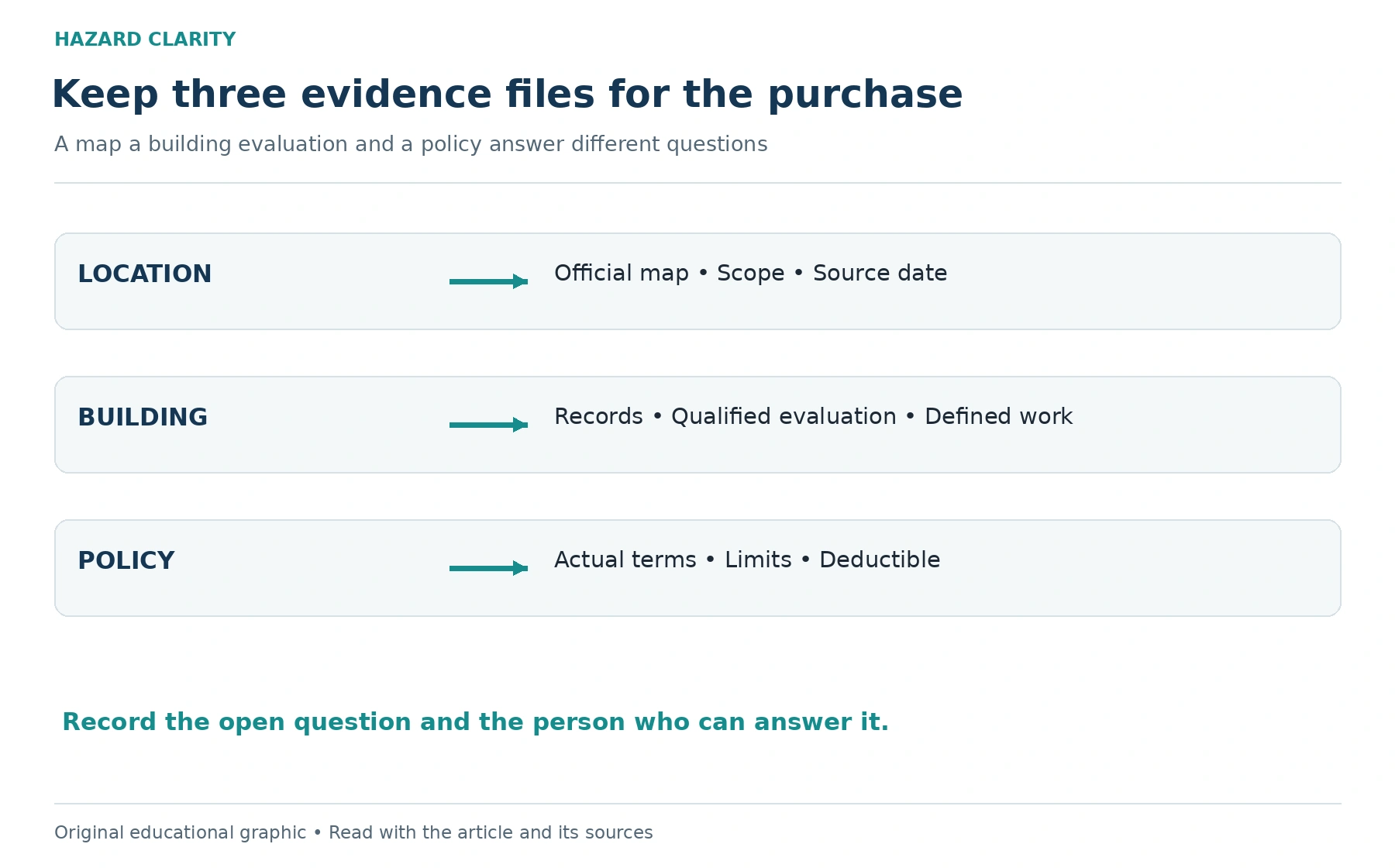
When buying a Washington home, separate earthquake research into the location, the building, and the insurance policy. A regional hazard map can help explain the setting. Building records and a qualified evaluation can address how the structure was built or modified. Insurance documents describe financial protection. None of those records can answer every question on its own.
The goal is a practical review before you commit to the property, not a prediction of the next earthquake. Washington’s Department of Natural Resources publishes earthquake information and homeowner resources that can help you identify the right follow-up. Start with the questions you need answered for the actual home and keep the source behind each answer.
Hazard Clarity’s Washington earthquake information offers a starting point for the broader property context. Use it alongside official geological resources, appropriate inspections, and a conversation with a licensed insurance professional. This article focuses on assembling those records into a purchase file you can use.
Start with the property location
Confirm the address and the building you are researching before interpreting a map. Large parcels, multiple structures, and irregular boundaries can make a single address marker an incomplete guide. Save the relevant map source and identify whether you are looking at the whole parcel, a building footprint, or a general area.
Washington DNR describes several earthquake-related hazards, including ground shaking and liquefaction. Liquefaction refers to certain soils losing strength during shaking. A mapped susceptibility area is a prompt for further investigation; it is not a statement that a specific foundation has failed or that an event will occur on a particular date.
Ask the appropriate local office or qualified professional what the map can establish at the scale shown. If site conditions need evaluation, request the right service rather than enlarging the map until it appears precise. Zooming in changes the display, not necessarily the quality or intended resolution of the underlying information.
Keep regional context separate from building condition
Two homes in the same mapped area may have different construction histories and present different evaluation questions. A building’s foundation, framing, connections, alterations, and maintenance matter to a structural review. Listing photos usually reveal very little about those details, even when the interior looks freshly updated.
Do not treat a renovation date as proof of seismic work. A kitchen remodel, new flooring, and a painted exterior can improve a home without changing its structural connections. Ask what work actually occurred and request supporting records. The same distinction applies to an owner’s statement that a house is “earthquake ready.”
Write the question in a form someone can answer: what structural work was performed, who designed or installed it, and what documentation remains? That is more useful than asking whether the home is earthquake proof. No ordinary document should be turned into a guarantee about future damage or a complete engineering opinion.
Request the records before choosing the specialist
Ask the seller for available plans, permits, inspection sign-offs, engineering reports, and invoices related to the foundation or structural alterations. Request the original reports when possible rather than an advertisement or a summary from a contractor’s website. Preserve any stated limitations and areas that were not evaluated.
Organize the documents by date and project. A permit application, a contractor estimate, and a final inspection record represent different stages. Keep proposed work separate from completed work. If one stage is missing, label it as an open item and ask the appropriate office or provider how to confirm it.
Those records can help a professional define the service you need. Explain your concerns and share the documents when requesting an evaluation. A more specific starting file may reduce confusion about whether you are seeking a general inspection, a structural assessment, or advice about a potential retrofit. It does not remove the need for professional judgment.
Understand the scope of the general inspection
A general home inspection can identify visible conditions within its agreed scope. It should not automatically be treated as a comprehensive seismic evaluation. Ask the inspector what accessible foundation and framing components are included, what areas cannot be observed, and what findings would lead to a specialist referral.
If the inspector reports a concern, preserve the wording and photographs. Avoid translating a limited observation into a diagnosis of the entire building. A reference to missing visible connections, for example, may require additional evaluation to understand the configuration, appropriate work, and the areas hidden from view.
Arrange follow-up early enough to use the findings during your inspection period. Tell the specialist what the general inspector observed and what decision you need to make. Your REALTOR can coordinate access and deadlines, while the qualified evaluator should explain technical conclusions. Separate those responsibilities so scheduling pressure does not become a substitute for analysis.
Ask what a retrofit would actually address
Washington homeowner resources discuss seismic retrofits as ways to address vulnerabilities in a building. For a particular home, ask a qualified professional which components a proposed retrofit would address and which concerns would remain outside its scope. The word retrofit is a category of work, not a complete description.
A proposal should identify the building, assumptions, design or permitting needs, access requirements, and the work included. Ask whether finishes must be opened and who is responsible for restoration. If conditions cannot be confirmed before opening a wall or entering a crawlspace, understand how those uncertainties affect the proposal.
Avoid selecting hardware or copying a connection detail from a general illustration on your own. Building configurations vary. An educational diagram can organize questions but cannot specify an installation for every home. The useful outcome is a documented property-specific scope, with an explanation of why the proposed work fits the actual structure.
Check what a completed-work claim means
If the seller reports a previous retrofit, request the project file and ask what can be verified today. An invoice establishes a transaction, but its description may not show the full design, installation, or final status. A professional can help determine which records are meaningful for the current building.
Ask whether later additions or remodels changed the areas covered by the original project. A dated report may accurately describe the home as it existed then while leaving questions about current alterations. Keep the older record and document the newer work instead of treating one as a replacement for the other.
For a hypothetical house with an old retrofit invoice and a later addition, the next step might be to request both sets of plans and ask an evaluator to explain their relationship. It would not be reasonable to assume the addition was included in a project completed years before it existed. Dates are part of the evidence.
Review earthquake insurance on its own terms
The NAIC explains that standard homeowners policies generally do not cover earthquake losses. Ask a licensed insurance professional about any earthquake coverage proposed for the home and obtain the actual documents. An ordinary homeowners premium is not enough information to evaluate this part of the purchase.
Read Hazard Clarity’s earthquake insurance explanation before preparing your questions. Then ask about the policy’s limits, deductible, settlement terms, exclusions, and any relevant building or property requirements. These details depend on the proposed contract and should not be inferred from a regional map.
If you are comparing proposals, keep the same home details and requested coverage in each conversation. Ask the professional to identify important differences in plain language. A smaller premium may reflect a different deductible or coverage scope. A retrofit record may be relevant to a carrier, but it does not establish eligibility or guarantee a discount.
Translate the deductible before deciding
If the proposed earthquake coverage uses a percentage deductible, ask which stated amount the percentage applies to and how the policy applies it. Do not automatically multiply the percentage by the purchase price. The applicable base and the treatment of different coverages must come from the policy.
Use a written example supplied or confirmed by the insurance professional. Record the base, percentage, illustrative dollar amount, and explanation of the relevant terms. Keep that calculation with the proposal so you can compare it accurately if another option uses a different approach. An example explains arithmetic; it does not predict a future claim payment.
Review the potential out-of-pocket amount alongside your ownership budget and emergency reserves. This is a financial decision for the household, informed by professional advice and actual terms. Avoid treating the premium as the only cost. The amount you would need to manage after a covered loss can matter just as much to the decision.
Make preparedness part of the ownership handoff
Structural evaluation and insurance review do not replace household preparedness. Washington DNR publishes emergency preparedness resources for earthquake planning. Use those official materials to build a household plan appropriate for the people living in the home, including communication, supplies, and the locations where they spend time.
During the purchase, ask where the home’s relevant systems and records are located. After closing, use qualified guidance for any work or safety procedures you are unfamiliar with. Do not perform structural work or manipulate utilities based solely on an article. A preparedness plan should make responsible action easier rather than encourage improvised repairs.
Keep professional contact information accessible outside the property. A paper binder in the home can be useful, but a backup gives you access if the building is unavailable. Include the insurance contact, key building records, and the household plan. Assign someone to review the file when people, property use, or major improvements change.
Use a three-part purchase worksheet
Create a worksheet with separate sections for location information, building evaluation, and insurance terms. Under location, record the official source, map scope, and questions needing confirmation. Under the building, list available records, observed concerns, the evaluator, and any defined follow-up. Under insurance, list the actual proposal and unresolved policy questions.
Add a due date and responsible person to every open item. Mark missing records as unknown. Do not convert unknowns into a zero-dollar repair estimate or an assurance that no work is needed. Your transaction advisers can help you decide how those uncertainties affect your purchase options and contractual deadlines.
Start a property review with Hazard Clarity and bring the location questions to the right professionals. A useful Washington earthquake review ends with evidence you can name, work you can define, and policy terms you understand. It gives you a stronger basis for deciding how the property fits your plans.
Sources and reference material
Washington DNR Earthquakes and Faults • Shaking liquefaction and homeowner research resources. Accessed October 2 2026.
Washington Association of Building Officials Earthquake Home Retrofit • Building retrofit scope background; no installation specification reproduced. Accessed October 2 2026.
NAIC Your Annual Insurance Checkup • Standard homeowners earthquake exclusion and policy review; January 1 2011 background guidance. Accessed October 2 2026.
See this property’s own hazard picture.
Check an address