On this page
- Understand the concern before buying equipment
- Compare the cooking methods by your actual constraints
- Give outdoor conditions a decision point
- Plan food preparation with official guidance
- Assign an adult to the cooking method
- Keep children pets and guest routes in the plan
- Check supporting equipment without improvising connections
- Include serving storage and cleanup in the choice
- Ask coverage questions without using coverage as permission
- Choose the alternate plan while choices are easy
- Sources and reference material
Before making a turkey fryer the centerpiece of Thanksgiving, decide whether the cooking method fits your equipment, space, and household. The easiest way to reduce the number of holiday cooking decisions may be to choose a familiar oven method or obtain a prepared turkey. A method that looks exciting online is not automatically a workable plan for your gathering.
This guide focuses on choosing and organizing the cooking plan. It explains official fryer concerns and practical alternatives without providing a hot-oil setup tutorial. Follow the exact equipment instructions and current official safety guidance for any method you use. Insurance questions should support responsible planning; they should never become a reason to proceed with an arrangement you do not understand.
Understand the concern before buying equipment
The USFA turkey fryer safety handout identifies several hazards: fryers can tip, oil can overflow, partially frozen food can cause splattering, and hot components can cause burns. Those concerns are reasons to evaluate the method before the holiday, rather than treating the equipment purchase as the decision that settles everything.
The agency also suggests considering an electric or air fryer. That does not make every product with those words suitable for every turkey or location. Read the particular model’s intended use, capacity, and instructions. A different device still requires a workable plan and an adult who understands its operation.
If the method remains uncertain, choose another one. You do not have to learn a new cooking system to host a memorable Thanksgiving. The useful decision is which plan the household can carry out with suitable equipment and clear responsibilities, without improvising around a last-minute problem.
Compare the cooking methods by your actual constraints
Start with what you have: a functioning oven, available refrigerator space, experienced help, suitable serving areas, and time to prepare. A conventional oven plan may fit those resources. If the oven is awaiting service or the menu is too large for it, address that conflict directly rather than automatically moving the main dish outdoors.
A prepared turkey or shared meal arrangement can reduce equipment demands at home. Ask the provider about pickup, transport, reheating, and storage instructions. Those details matter as much as ordering the food. A prepared option should have its own workable schedule and handling plan.
For unfamiliar equipment, review documentation before committing. Avoid product comparisons based solely on speed, advertised capacity, or social-media demonstrations. A method’s suitability depends on how it will be used at your property and who will manage it. This article does not recommend a brand or establish that one product is appropriate for your setup.
Give outdoor conditions a decision point
If you are considering outdoor cooking, think through how weather, available space, and guest routes could affect the plan. Use current local official information when conditions approach. Do not treat a forecast from an earlier week as confirmation that the gathering’s arrangement will be suitable on Thanksgiving.
Follow the product instructions and official safety guidance for location and operation. This guide does not supply a workaround for unsuitable conditions or a procedure for moving operating equipment. If the intended environment is unavailable, use the alternate cooking plan you selected in advance rather than improvising a new arrangement.
Decide who can make that change and when it will be communicated. A backup meal plan is useful only if the cook and household understand it. Guests bringing dishes may also need an update if the menu or meal timing changes. Keep the decision practical and early enough to avoid unnecessary rushing.
Plan food preparation with official guidance
Use the USDA Thanksgiving resource for food preparation questions. Its refrigerator thawing guidance allows roughly 24 hours for every four to five pounds of turkey. Build the schedule around the actual food and instructions, with suitable storage space available.
For cooking and handling details, consult the USDA turkey roasting guide and the appropriate method-specific information. Keep food-safety instructions separate from equipment setup assumptions. A cooking appliance advertisement should not replace official guidance about safe preparation and handling.
If preparation is behind schedule, seek the relevant official instructions or change the plan. Do not use an uncertain shortcut simply to preserve the original meal time. A later serving time or another main dish can be easier to manage than a method whose preparation requirements have not been met.
Assign an adult to the cooking method
Identify who understands the equipment and will manage the cooking process. Ask that person to review the instructions before the gathering. A willing volunteer and a person familiar with the particular device are not always the same. Keep unfamiliar operation questions with the manufacturer or an appropriate qualified source.
Separate cooking responsibility from greeting visitors, moving furniture, handling deliveries, or coordinating children’s activities. Those tasks can be assigned to other adults. The arrangement should not depend on the cook continuously switching roles because everyone assumes hosting means doing every job at once.
The USFA cooking guidance emphasizes attention during cooking. Use that principle when arranging the household roles. This article’s purpose is to choose a method and plan the work in advance; detailed active cooking and emergency instructions should come from the appropriate official guidance.
Keep children pets and guest routes in the plan
Think through where people will gather and how they will move between the home, serving area, and outdoor spaces. Explain the arrangement to the adults responsible for children and pets. A busy gathering can change familiar routines, so the plan should not rely on every visitor already knowing where equipment is operating.
Use equipment instructions and official guidance for the relevant separation and access needs. Avoid setting up a route that requires guests to pass through the cooking workspace to reach the gathering. If you cannot establish a suitable arrangement, reconsider the method rather than treating the guest traffic as an unavoidable inconvenience.
Discuss the plan before visitors arrive. A simple explanation of where drinks, food, and family activities will be located can reduce confusion. Household adults should know who handles questions about the cooking area, while the cook retains the attention required for the method in use.
Check supporting equipment without improvising connections
Review any supporting appliances or components the meal plan requires. Use their instructions for intended use and maintenance. If you notice damage or do not understand the arrangement, seek appropriate advice before relying on it. Thanksgiving should not be the first time you discover that a needed component is missing or unfamiliar.
For electrical questions, use a qualified professional. HC’s wiring and insurance article can help organize property documentation, but it does not establish that a proposed connection is suitable. Avoid interpreting a general consumer article as permission to modify wiring or improvise power delivery.
Keep the method simple enough that the supporting equipment is understood. If a plan requires several unfamiliar products, a new connection, and a last-minute workaround, reconsider the menu or preparation route. Reducing complexity is a useful hosting choice when it removes unresolved questions from the cooking day.
Include serving storage and cleanup in the choice
The cooking method is only part of the meal. Decide how food reaches the serving area, who handles the appropriate containers, and how leftovers will be managed under current food-safety guidance. Make suitable space available rather than assuming everything will fit after the dishes are finished.
Ask what cleanup the equipment instructions require and when it is appropriate. This article does not provide hot-oil handling or disposal steps. If the cleanup plan is unclear, resolve it with the manufacturer or relevant official source before choosing that method. Do not leave an unfamiliar task for a guest to improvise after the gathering.
Identify who remains responsible after the meal is served. The cook’s role should have a clear finish consistent with the equipment instructions. A hosting plan that ends at the first plate can leave equipment and cleanup questions unassigned. Include those jobs in the household discussion before committing to the method.
Ask coverage questions without using coverage as permission
If you want to understand fire or liability terms, describe the planned activity to your licensed agent or insurer. Ask about relevant conditions, exclusions, limits, and the reporting route. The company must address the actual policy and facts. A general promise that cooking accidents are covered should not replace that explanation.
The NAIC event insurance resource provides background for home-hosting conversations. It does not certify a cooking arrangement or mean that an insurance product makes an unsuitable activity acceptable. Keep the coverage question and the decision about method suitability separate.
Store any response with the policy and hosting records. If you discuss a possible change, ask how it becomes effective and how confirmation is provided. Do not treat a quote as completed coverage. Regardless of that conversation, follow official guidance and change the cooking plan when the arrangement cannot meet its requirements.
Choose the alternate plan while choices are easy
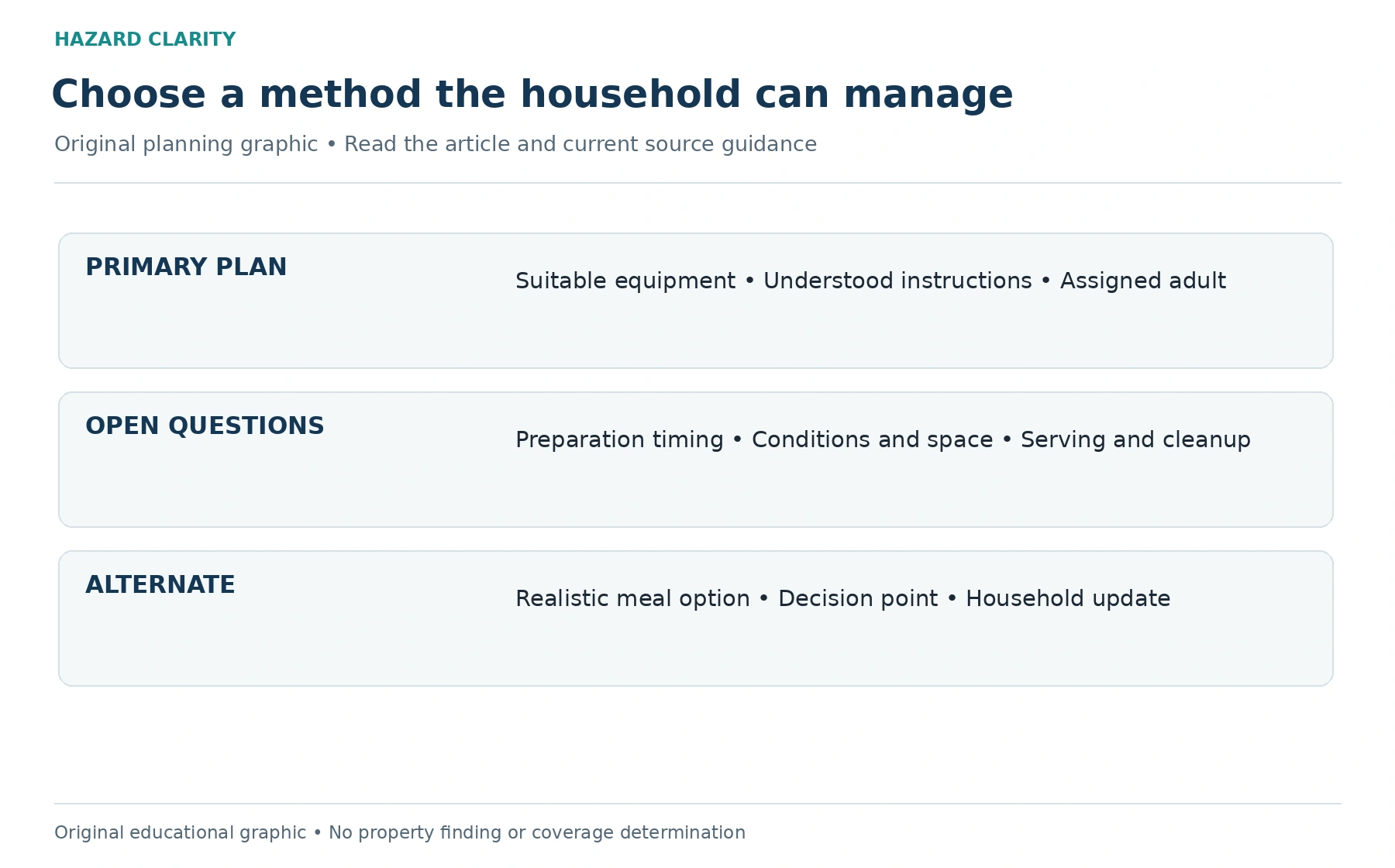
Write down the primary method, the adult responsible, the equipment and food preparation questions still open, and the alternate option. Identify which unresolved issue would cause you to switch. That might be unavailable equipment, unsuitable conditions, or a preparation schedule that no longer fits the official instructions.
Confirm the alternative is realistic. If it involves a prepared meal, know the provider’s arrangements. If it uses the oven, make sure the rest of the menu can work around it. If another household is contributing, ask them to agree before treating their help as part of the plan.
The best Thanksgiving cooking method is one your household can manage with understood equipment and a clear preparation route. You can keep the tradition of a shared meal without keeping every detail of a plan that no longer fits. Choose early, resolve the open questions, and leave the holiday with more room for the people you invited.
Sources and reference material
USFA Turkey fryer fire safety • Reviewed October 3 2026.
USDA FSIS Happy Thanksgiving • Reviewed October 3 2026.
USDA FSIS Turkey roasting guide • Reviewed October 3 2026.
USFA Cooking fire safety • Reviewed October 3 2026.
NAIC Event insurance • Reviewed October 3 2026.
See this property’s own hazard picture.
Check an address