On this page
- Separate the weather question from the roof question
- Build a useful roof history
- Understand what an evaluation can actually tell you
- Treat age and maintenance as their own budget questions
- Review coverage before comparing premiums
- Ask about conditions attached to the quote
- Use estimates that explain the work
- A hypothetical purchase shows the difference
- Make the inspection deadline work for you
- Keep the roof file after closing
- Sources and reference material
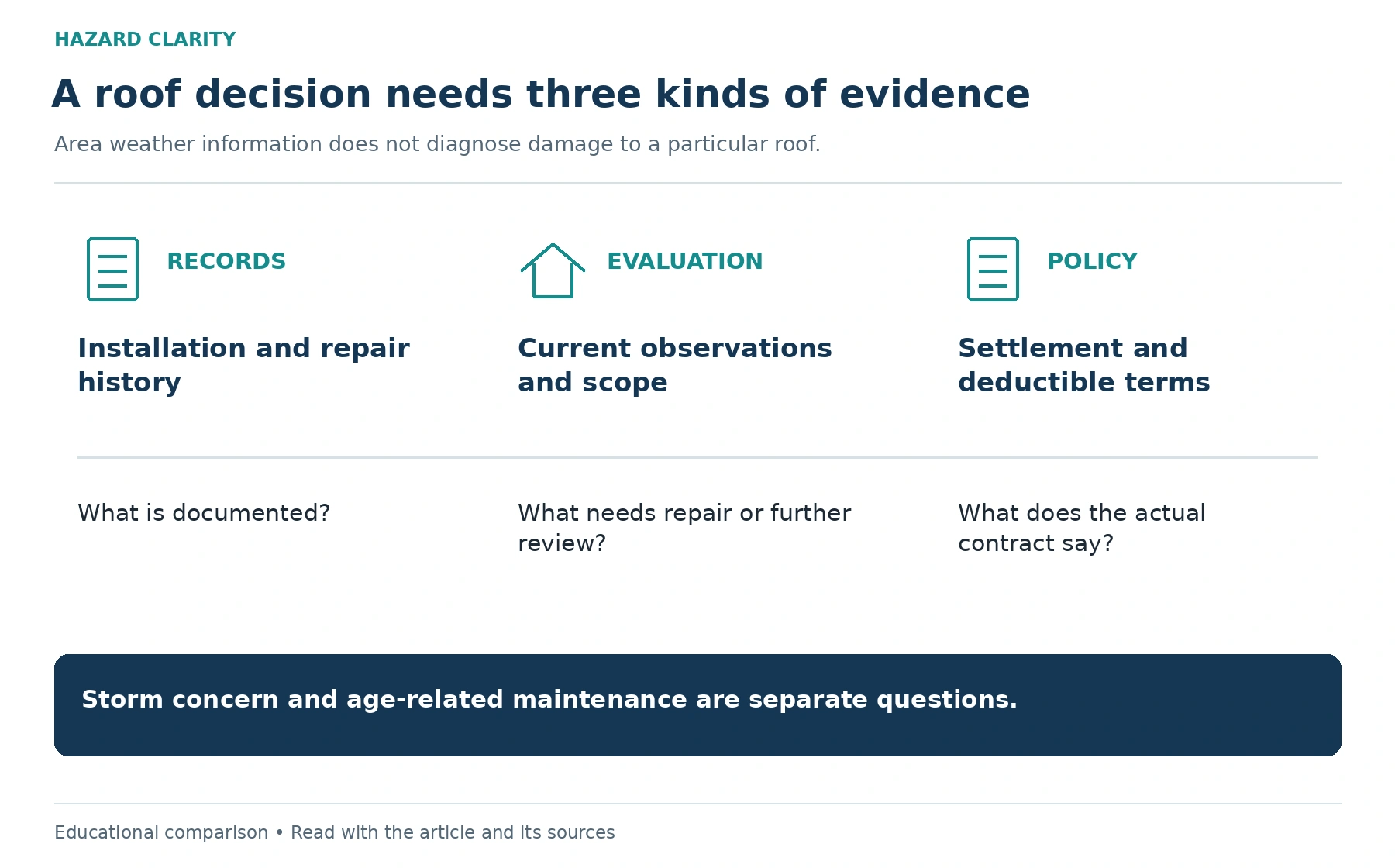
A roof can look acceptable from the driveway and still leave a Texas homebuyer with important unanswered questions. How old is the covering? Has the roof been repaired after a storm? Who evaluated the damage? What will the proposed insurance policy cover? These questions belong together, but each requires its own evidence.
Hail exposure does not establish that a particular roof has hail damage. An older roof does not establish that every defect came from ordinary wear. The practical approach is to gather records, obtain a property-specific evaluation, and review the actual insurance terms before treating the roof as a settled part of the purchase.
Start with Hazard Clarity’s Texas property information for location context. Then use this guide to build a roof file that supports a clear conversation with the seller, inspector, roofing professional, and insurance agent.
Separate the weather question from the roof question
A weather record describes an event or conditions reported in an area. A roof evaluation describes observations at a specific building. Connecting the two requires more than seeing a hail symbol near an address. The location, timing, roof materials, installation, maintenance, and available observations all matter to the evaluation.
If a seller says the neighborhood had a major storm, ask what records exist for this home. Was the roof inspected afterward? Is there a written report, dated photograph, repair invoice, or insurance correspondence the seller can provide? Keep each document with its date and author so you can distinguish a reported event from a documented property finding.
Avoid using online weather information to diagnose the roof yourself. It can help you choose questions and identify a period to investigate. It cannot establish the cause, extent, or insurance treatment of damage to a particular roof assembly.
Build a useful roof history
Ask for the installation date, contractor invoice, material information, permits where applicable, warranties, and repair records. If the roof has several sections, ask whether they were installed at the same time. A replaced porch roof and an older main roof should not be described simply as one recently replaced roof.
Record whether the age is documented or estimated. A seller’s recollection may be useful, but it is different from an invoice identifying the property, work, and completion date. If the documents disagree, preserve the disagreement as an open question rather than choosing whichever date makes the home look better.
Ask what each repair addressed. Replacing flashing around a penetration, correcting a leak, and replacing an entire roof covering are different scopes of work. A receipt that says “roof repair” may need clarification before it helps you understand what remains on the building.
Understand what an evaluation can actually tell you
Before hiring someone, ask how the roof will be evaluated and which portions can be accessed safely. The written scope should identify whether the service is a general home inspection, a roofing assessment, or a more specialized investigation. Ask how inaccessible areas, weather conditions, and concealed components will be handled.
Request findings that identify the observed condition, its location, the basis for any stated cause, and recommended next steps. Photographs should be connected to a roof section or component. A collection of close-up pictures without explanation is difficult to use when you need to understand the whole roof.
Ask the evaluator to distinguish observed facts from estimates and unresolved questions. If a finding requires additional testing or access, that limitation belongs in the report. A cautious explanation can be more useful than a confident label that lacks supporting observations.
Treat age and maintenance as their own budget questions
A roof does not need a new storm claim to become an ownership expense. Its age, installation, drainage details, maintenance history, and present condition can create repair or replacement planning needs. Ask the roofing professional what work is needed now and what should be monitored over time.
Do not assume that an insurance payment will cover ordinary aging. The Texas Department of Insurance explains that a roof being old or worn out is not, by itself, a reason for an insurer to pay for a new roof. A buyer’s maintenance budget should therefore stand on its own rather than depend on a future claim.
If the evaluator offers an estimate of remaining service life, ask what it means and what assumptions it uses. It is a planning judgment, not a guarantee of how long the roof will perform or a commitment from an insurance company to keep providing the same coverage.
Review coverage before comparing premiums
Ask the insurance agent to identify the roof settlement provisions in the proposed policy. Replacement cost and actual cash value are different approaches, and roof-specific provisions can change the practical result. Get the explanation tied to the quoted forms and endorsements rather than a general description of homeowners insurance.
Texas insurance regulators also advise consumers to ask whether wind and hail have a different deductible from other covered losses. Write down the amount in dollars and the event or cause that triggers it. If it is expressed as a percentage, ask which coverage amount is used in the calculation.
For background, read HC’s guide to hail coverage and replacement cost versus actual cash value. Use those explanations to prepare questions; the proposed contract controls the property-specific answer.
Ask about conditions attached to the quote
A price shown on a quote may not resolve every underwriting question. Ask whether the insurer needs roof photographs, an inspection, documentation of installation, or completed repairs before coverage begins or continues. Confirm the status of those requirements before closing and keep the response in your transaction file.
If the home has a known roof concern, describe it accurately to the agent. Do not let an estimated installation year become a documented replacement year on an application. Ask how to record uncertain information and which supporting documents the insurer needs.
Coordinate insurance timing with the purchase schedule. A repair that cannot be completed before closing may affect your options, but the consequence depends on the actual insurer, contract, and transaction. Identify the unresolved condition early enough that you can discuss available choices with the appropriate people.
Use estimates that explain the work
If work is recommended, request a written scope that identifies the materials, affected areas, disposal, related components, and exclusions. Ask whether the estimate addresses only visible damage or includes other work needed for a complete installation. Compare the scope before comparing the bottom-line price.
Ask who will handle permits, inspections, and any applicable local requirements. If the property is in a Texas coastal area, raise the question of windstorm-related documentation with the contractor and the relevant authority. Do not assume that a roof invoice alone establishes compliance or eligibility for a particular insurance arrangement.
Keep insurance claim handling and construction contracting understandable as separate services. Ask what you are signing, what the contractor is promising, and what remains subject to insurer review. A contractor’s prediction about payment is not the insurer’s coverage decision.
A hypothetical purchase shows the difference
Imagine a buyer considering a Texas house whose seller describes the roof as “recently repaired after hail.” The file contains an invoice for a small repair but no documented installation date for the main covering. The inspection recommends further roof evaluation. None of those facts, by itself, answers whether replacement is needed.
The buyer requests the earlier records, commissions the recommended evaluation, and shares accurate findings with the insurance agent. The roofing report identifies a current repair need and an age-related planning concern without resolving every historical cause. The insurance proposal includes a roof provision the buyer had not noticed when looking only at the premium.
The useful result is a defined set of decisions: obtain the missing information, clarify the proposed repair, understand the insurance arrangement, and decide how the remaining ownership expense fits the purchase. This example is illustrative, not a documented claim or a recommendation to accept a particular home.
Make the inspection deadline work for you
Ask your real estate professional to explain the actual contractual deadlines for inspection, notices, negotiation, and termination rights. Then schedule roof follow-up with enough time to read the findings. A technically useful report received after a relevant deadline may leave you with fewer practical choices.
Keep a short question log with the issue, responsible person, requested record, and response date. For example, “main roof age” belongs with the seller’s documents, while “current roof condition” belongs with the evaluator. “Roof settlement provision” belongs with the licensed insurance agent and insurer.
When a repair is negotiated, ask how completion will be documented and independently verified if appropriate. A promise that work will happen is different from a final invoice, a completed inspection, or evidence that the specific concern was addressed. Your agreement should make the expected result clear.
Keep the roof file after closing
Save installation and repair records, material information, warranties, dated photographs, inspection findings, and the policy documents. Keep estimates separate from completed-work invoices. That organization helps you maintain the home and explain its history without relying on memory several years later.
Review roof coverage when renewing insurance, especially if the renewal documents introduce new terms. If your roof is replaced or materially repaired, ask the insurer how to update its records and what evidence it requires. Do not assume that a contractor automatically communicates those changes for you.
For your next step, assemble the roof documents and write down the three biggest unanswered questions about condition, cost, and coverage. See how Hazard Clarity works to add location context. Use that context alongside the property evaluation and actual insurance proposal to make a more informed purchase decision.
Sources and reference material
Texas Department of Insurance — Insurance and your roof • Reviewed October 2, 2026
Texas Office of Public Insurance Counsel — Residential property shopping guide • Reviewed October 2, 2026
Sources support the article’s factual foundations; the research workflow, worksheets, and hypothetical examples are original editorial guidance. Confirm current requirements and policy terms for the actual property before relying on a transaction-specific conclusion.
See this property’s own hazard picture.
Check an address