On this page
- Give the report a defined job
- Confirm the property and the source
- Separate the finding from its interpretation
- Keep the inspection and hazard review connected
- Route questions by responsibility
- Bring insurance into the process early
- Make comparisons consistent
- Coordinate follow-up with the contract timeline
- Document the information accurately
- Handle conflicting information openly
- Use a repeatable review worksheet
- Make the report useful after closing
- Add clarity to the buyer workflow
- Sources and reference material
A property hazard report can help a REALTOR give buyers a clearer starting point for location questions. The strongest use is straightforward: show what the information says, explain its source and limits, and help the buyer identify the professional or official who can answer the next question.
That approach adds value without turning the REALTOR into a floodplain administrator, insurance underwriter, engineer, or weather specialist. You can coordinate a useful research process while keeping technical conclusions with the people qualified to make them.
This article offers an educational workflow, not legal advice or a complete statement of a REALTOR’S duties. Licensing rules, disclosure obligations, agency responsibilities, brokerage policies, and contract requirements vary. Follow the guidance applicable to your work and consult your broker or attorney when a question involves those responsibilities.
Give the report a defined job
Introduce the report as an information layer within property due diligence. Its purpose is to organize relevant address context and reveal questions worth exploring. Avoid presenting it as a verdict about whether the buyer should purchase the property.
Use HC’s explanation of how the report works to describe the starting point accurately. Do not promise a finding that the current product has not verified or claim the report replaces another service.
A defined purpose helps buyers interpret the result. They know why you are sharing it, what it can contribute, and why some findings may need additional review. That clarity is especially helpful when a buyer is unfamiliar with the local area or sees a map category for the first time.
Confirm the property and the source
Before discussing a finding, confirm the address and the location represented. Similar street names, parcel boundaries, and approximate pins can create confusion. If the result appears close to a meaningful boundary, flag that as a verification task rather than quietly assuming the location is exact.
Identify the source, date, and geographic scope available in the report. Ask whether the information is an effective regulatory map, a historical record, or modeled exposure. Those categories can support different questions and should not be treated as interchangeable.
If a source or detail is unavailable, say so. Missing data should remain an open item. A simple explanation of what is known and unknown is more useful than adding confidence that the record does not support.
Separate the finding from its interpretation
Start with the information actually shown. A map designation, nearby feature, or regional event history is a finding with a defined scope. The next question is what that information means for this building, transaction, or ownership plan.
For example, a flood-related map result can lead to questions about the structure’s location, available elevation records, lender requirements, or coverage options. It should not immediately become a statement that the home will flood or that insurance will be unavailable.
Keeping those steps separate helps the buyer understand the process. You are not minimizing a relevant concern. You are making sure the next answer comes from the appropriate evidence and professional review rather than an improvised conclusion.
Keep the inspection and hazard review connected
The property’s setting and its observable physical condition are different layers. A hazard report can help the buyer prepare questions for an inspection, but it does not perform that inspection. Likewise, an inspection does not automatically resolve every map or insurance question.
The Consumer Financial Protection Bureau encourages buyers to arrange an independent inspection promptly. As a transaction coordinator, you can help the buyer understand the schedule and ask the inspector about the service’s scope. The buyer should know which concerns require separate testing or specialist evaluation.
Use HC’s guide to checking natural-disaster risk before buying as supporting education. Pair it with the inspection process rather than presenting either resource as complete protection from future issues.
Route questions by responsibility
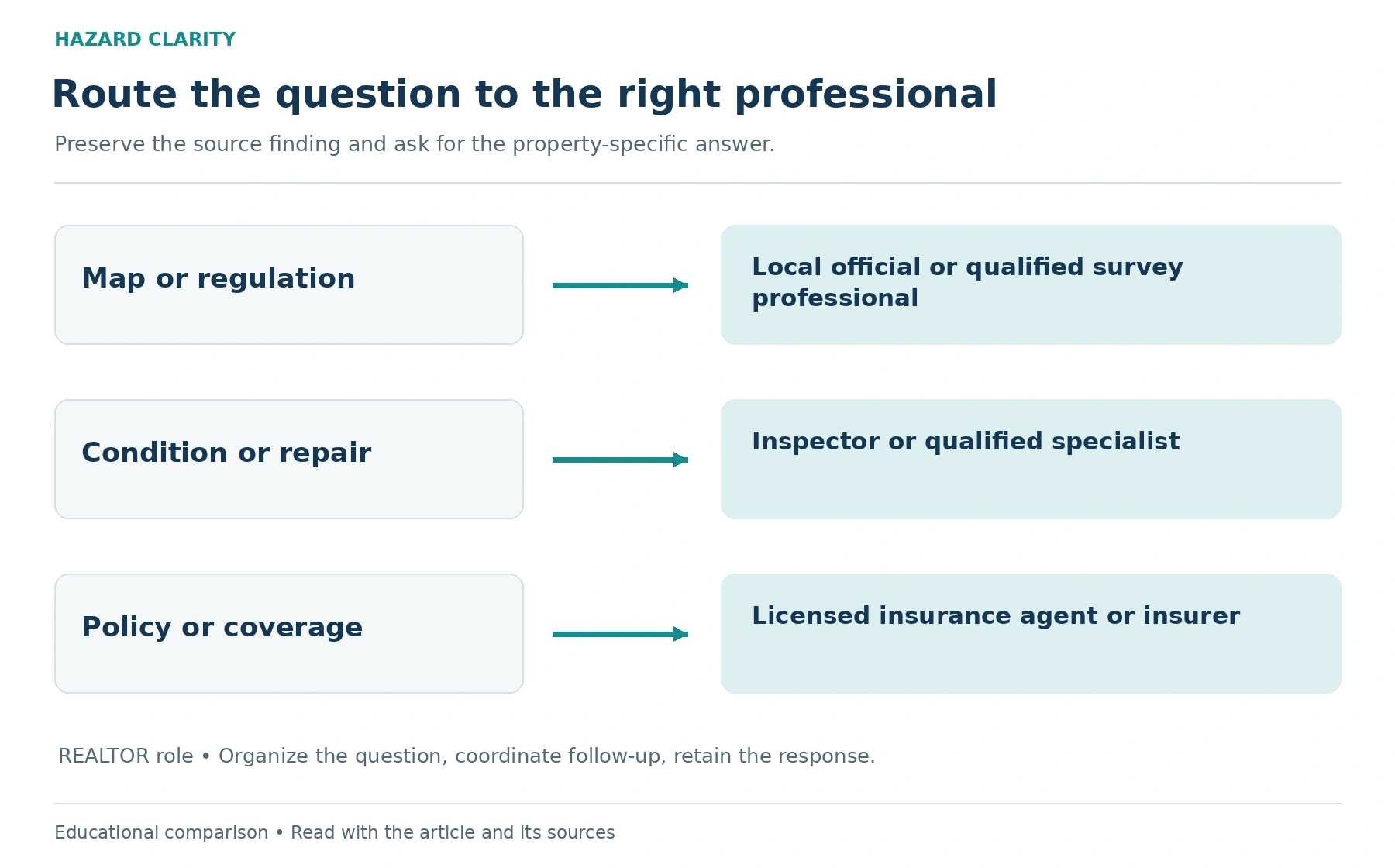
A flood-map interpretation question may belong with the local floodplain administrator or a qualified surveying professional. An observable building concern may require the inspector or a specialist. A coverage question belongs with a licensed insurance professional or the insurer.
The REALTOR’S role in this workflow is to help identify the question, coordinate the request, and keep the transaction organized within the applicable scope of practice. Legal rights, disclosure requirements, and contract interpretation should be handled according to broker guidance and qualified legal advice.
Avoid assuming one professional can answer everything related to a category. A contractor can evaluate work without deciding an insurance claim. An agent can explain coverage without completing structural analysis. Clear routing reduces confusion and makes follow-up more productive.
Bring insurance into the process early
Buyers often begin with the monthly cost, but useful insurance preparation includes more than a premium. They need to understand the proposed coverage, deductibles, exclusions, required documents, and effective date. Timing matters when those questions could affect closing preparations.
Share HC’s insurance questions before buying a house as an educational resource. Let the buyer choose how to seek licensed advice, and describe any HC professional-connectivity option only as it actually operates.
Do not imply that an introduction guarantees a quote, policy, savings, or preferred outcome. Follow applicable brokerage and legal requirements around referrals and commercial relationships. A useful report should retain its value even if the buyer does not request an insurance connection.
Make comparisons consistent
If the buyer is comparing several homes, use the same research framework for each. Record location findings, physical-condition questions, coverage questions, and unresolved items. A consistent process avoids giving one listing a detailed review while another receives only a quick impression.
Do not rank homes by unrelated scores from different tools without understanding their methodology. A historical-event layer and a future-exposure model may describe different things. If buyers ask why two outputs differ, help them identify the sources and direct meaningful interpretation questions appropriately.
A comparison worksheet should support the buyer’s judgment. It can show what has been verified and what still needs attention without pretending to calculate the best home. Budget, lifestyle, condition, maintenance capacity, and professional answers remain part of the decision.
Coordinate follow-up with the contract timeline
When a report raises a question, identify the responsible contact and the date the buyer needs an answer. Link that task to the transaction calendar. A good question delivered too late may be difficult to resolve within the agreement’s process.
Have the buyer understand the applicable deadlines through your brokerage-approved workflow and legal guidance where appropriate. Sharing a report does not extend an inspection period or create a new contractual right. Do not suggest otherwise.
Track the request, response, and any remaining uncertainty. If the professional recommends additional evaluation, help the buyer understand the scheduling implications. The value is in completing a coherent process, not merely forwarding a report and assuming the job is finished.
Document the information accurately
Keep records according to your brokerage policies and applicable requirements. Note which report was shared, the date, the relevant source information, and the follow-up requested. Use factual descriptions rather than adding conclusions you cannot support.
If a professional provides a written answer, retain the answer with the document it explains. If the explanation is verbal, follow your approved process for documenting the communication and requesting clarification when needed. Avoid reducing a detailed answer to a shorthand phrase that changes its meaning.
Documentation should reflect the actual work, including unresolved questions. It is not a reason to make sweeping claims that the buyer accepted every possible hazard or that a tool eliminated your professional responsibilities.
Handle conflicting information openly
A seller’s statement, public map, inspection observation, and commercial report may not line up neatly. Before calling them contradictory, ask whether they address the same subject, location, and date. Different records may describe different parts of the property question.
If the difference matters, help the buyer seek clarification from the source or appropriate professional. Keep the competing information visible rather than choosing the answer that makes the transaction easier. A disagreement should become a research task, not an argument based on a screenshot.
For flood questions, HC’s FEMA flood-zone guide can prepare the buyer for a more focused conversation. The final technical or regulatory interpretation should remain with the responsible professional or authority.
Use a repeatable review worksheet
Create a simple record with five fields: the finding, the source, the buyer’s question, the responsible professional, and the next action. Add the needed date and answer status. These fields are enough to keep a useful review organized without building a complicated grading system.
For a hypothetical creekside listing, the worksheet might identify a map-boundary question for the local official, a moisture observation for the inspector, and a policy question for the insurance agent. Those tasks address different parts of the property and should not be collapsed into one broad concern.
When the answers arrive, review the remaining open items with the buyer through your approved process. The objective is not to provide a technical verdict yourself. It is to help the buyer understand which questions have been answered and where additional advice is needed.
Make the report useful after closing
A buyer may want to keep the report with inspection records, policy documents, and maintenance information. That creates an organized starting point for later review. Make clear that sources and conditions can change, so an older report should not be treated as permanently current.
For ongoing ownership, the buyer can revisit relevant information when circumstances change or questions arise. Avoid promising automatic monitoring or alerts unless the product currently provides them. Describe the actual experience and give the homeowner a clear way to return.
This approach supports long-term usefulness. The report becomes part of a property-information habit rather than a one-time sales tool. Its value comes from helping the owner ask informed questions at the moment they need answers.
Add clarity to the buyer workflow
A REALTOR does not need to interpret every hazard scientifically to provide useful service. A consistent process can make the research easier: verify the address, identify the source, explain the scope, route the question, and coordinate the timeline.
Review an address with Hazard Clarity and use the results within your approved buyer workflow. Keep the consumer’s understanding at the center, preserve professional boundaries, and make the next question easier to answer with reliable evidence.
Sources and reference material
Consumer Financial Protection Bureau — Schedule a home inspection • Reviewed October 2, 2026
FEMA and NFIP — What are flood zones and maps • Reviewed October 2, 2026
Sources support the article’s factual foundations; the research workflow, worksheets, and hypothetical examples are original editorial guidance. Confirm current requirements and policy terms for the actual property before relying on a transaction-specific conclusion.
See this property’s own hazard picture.
Check an address