On this page
- Request the actual assessment file
- Understand the educational purpose
- Check what changed after the visit
- Organize the recommendations by location
- Separate routine tasks from building work
- Confirm who controls shared areas
- Keep local rules separate from general guidance
- Ask how the insurer uses the records
- Document completion in a way someone can verify
- Build the buyer handoff file
- Sources and reference material
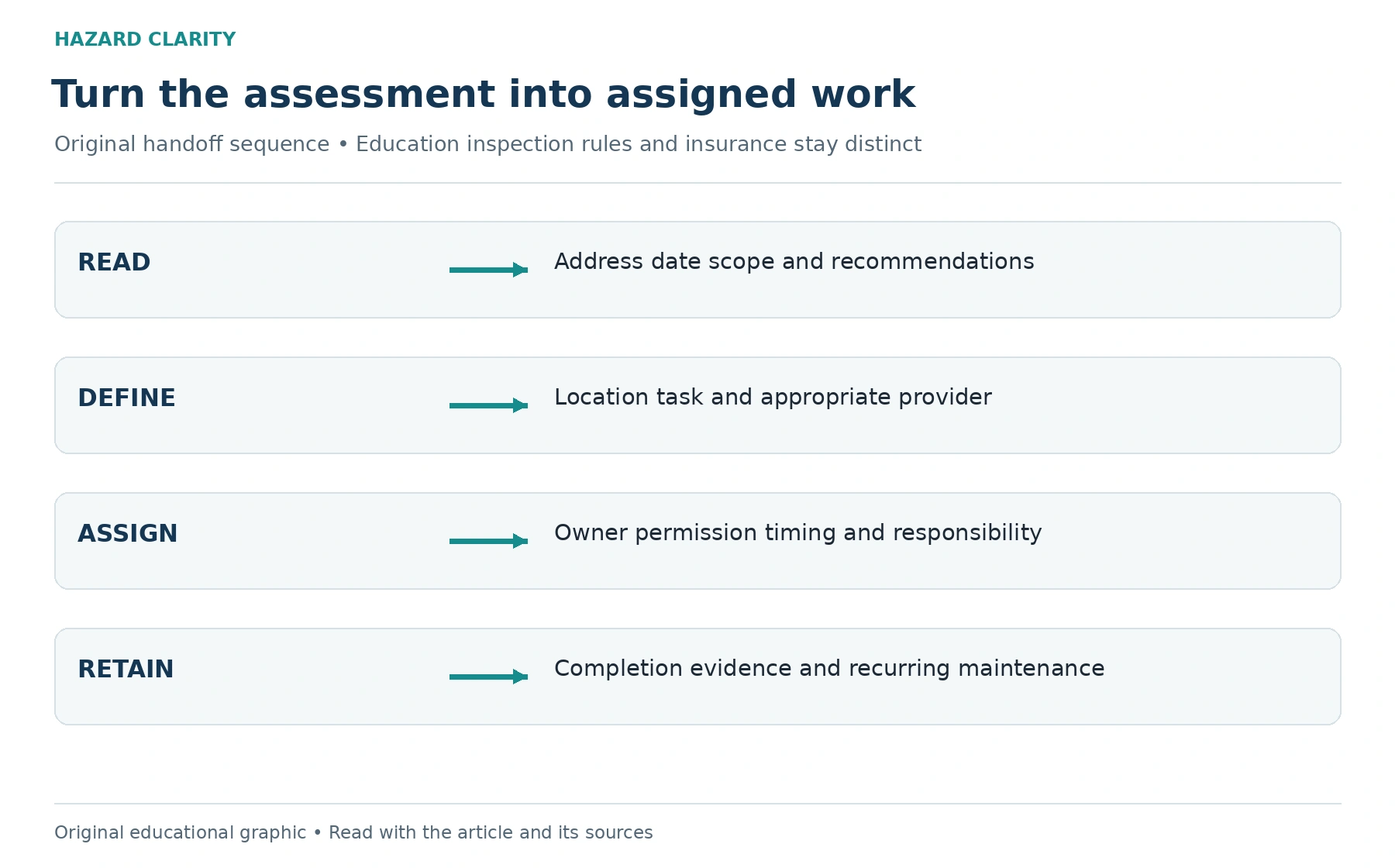
For an Oregon homebuyer, a wildfire assessment is most useful when it becomes a clear ownership plan. The document should help you understand the observations, proposed tasks, responsible people, and records needed to confirm completion. A seller’s statement that the property was assessed is a starting point, not the end of the review.
Oregon’s State Fire Marshal offers an education-focused defensible-space assessment program. Its guidance can help owners identify practical improvements. When researching a purchase, keep that educational role separate from building inspections, legal requirements, and insurance decisions. Ask what the actual visit covered and how its recommendations apply to the property today.
Use Hazard Clarity’s Oregon wildfire information for broader context. This guide focuses on the assessment record and the handoff from seller to buyer, including how to turn a list of suggestions into manageable work. It does not assign a wildfire score or promise an insurance result.
Request the actual assessment file
Ask whether the property has received a defensible-space visit or other wildfire-related review and request the complete record. Look for the address, date, provider, scope, photographs, recommendations, and any limitations. A short email saying the property was reviewed can leave important details unresolved.
Confirm that the record describes the building and site you are buying. Large properties may contain several structures, and the file may address only some of them. If the assessment used a map or sketch, keep it with the written recommendations so references to locations remain understandable.
A missing file does not establish that no review occurred. Ask who performed the visit and whether the owner can obtain a copy. If the record cannot be located, mark it as unavailable and discuss what current assessment would be useful. The aim is an accurate starting point, not an assumption based on the seller’s memory.
Understand the educational purpose
The Oregon State Fire Marshal describes its free defensible-space assessment as an education-focused visit that gives owners tips to start or improve their defensible space. That description is important. The visit should not automatically be presented as a comprehensive structural inspection or an insurer’s approval of the property.
Ask the provider what the visit includes, what it does not cover, and whether any follow-up is offered. If another organization performed the assessment, use its own scope rather than assuming every program is identical. Preserve the original terminology when discussing the report so a recommendation does not become a supposed requirement through paraphrasing.
For transaction decisions, identify what you still need beyond education. A contractor may be needed to evaluate building work, an appropriate authority to explain local requirements, and an insurance professional to discuss coverage. The assessment can organize those conversations while each professional remains responsible for the questions within their role.
Check what changed after the visit
An assessment records a point in time. Vegetation grows, debris accumulates, building features change, and owners add or move stored materials. Ask what has happened since the visit and whether any substantial project altered the areas described. A dated recommendation may remain useful without showing the current condition.
Compare available photographs with present observations where it is safe and appropriate. Document visible differences neutrally: a new fence connection, additional planting, or a recently modified deck. Do not use those observations to diagnose performance. Use them to ask whether a current evaluation or updated guidance is needed.
Keep the original report even if a new review is arranged. Together, the files can show what was recommended and what changed. Replacing history with an updated summary may make completed work harder to verify. Dates help you understand which parts of the record remain relevant and which questions need a fresh answer.
Organize the recommendations by location
Translate the report into a work list that identifies each task’s location. Examples might involve debris near a structure, landscaping areas, or a building feature needing qualified review. Use the assessment’s wording and current official guidance rather than adding your own technical specification.
The Oregon program discusses the home and several surrounding zones. Those categories can help organize the list, but property boundaries, shared areas, slope, and other conditions still matter. Do not assume you can perform work beyond the parcel or apply every general example to every site without checking its relevance.
A practical record includes the observation, recommended action, person to consult, and completion evidence. If a recommendation is unclear, ask the assessor to explain it. A specific question such as which fence section needs evaluation is more useful than a general request to make the property ready for wildfire. Defined tasks can be priced and scheduled.
Separate routine tasks from building work
Some recommendations may involve ordinary maintenance, while others require qualified contractors or additional design advice. Ask the assessor and relevant professionals to help distinguish them. A roof, vent, siding, deck, or electrical component should not become a do-it-yourself project simply because it appears on a checklist.
For proposed building work, request a written scope and ask about compatible materials, required approvals, and restoration. The right solution depends on the actual structure. An educational image or generic checklist cannot specify every installation detail. Keep contractor estimates separate from an assessment’s observations so it is clear who recommended what.
Avoid assuming all work can be completed in a single weekend or at a standard price. Access, building condition, vegetation, and local requirements can affect the process. Get actual proposals for significant tasks. A realistic ownership plan identifies what you can maintain routinely and what needs professional evaluation, funding, and time.
Confirm who controls shared areas
A buyer may be able to maintain the private yard but have limited authority over a shared driveway, association-owned land, or neighboring vegetation. Identify those boundaries before promising work. Ask your title and legal advisers about relevant documents, and request association information where shared responsibilities are involved.
If a recommended task relates to common property, ask who approves and performs it. Keep the response in the transaction file. A buyer’s intention to complete work does not establish permission to change land or structures owned by another party. Coordinate through the appropriate owner or authority.
For a hypothetical property with a shared access road, the maintenance plan should identify the responsible group and the relevant agreement. It should not assign the entire task to the buyer by default. Clear responsibility is part of preparedness because a useful recommendation can remain unfinished when everyone assumes someone else will handle it.
Keep local rules separate from general guidance
An educational recommendation, a local requirement, and an insurer’s requested condition are different things. Ask the relevant authority which current rules apply to the parcel and proposed work. Do not infer a legal obligation from a general webpage or an old article about statewide policy discussions.
Oregon’s defensible-space webpage describes a model code that local governments can adopt. A model is not proof that the same requirements apply everywhere. For the property you are researching, obtain current local information and identify its source and date. Legal questions about obligations should go to an appropriate adviser.
If you receive conflicting descriptions, preserve both and ask for clarification. Identify the jurisdiction, rule, property, and work in question. A written local response is more useful than an informal statement that the whole state follows one rule. This approach keeps the article’s educational guidance from becoming an unsupported transaction-specific legal conclusion.
Ask how the insurer uses the records
Share relevant assessment and completed-work records with your licensed insurance professional when requested. Ask whether the proposed carrier has its own inspection, documentation, or maintenance requirements. An education-focused assessment does not guarantee eligibility, a premium reduction, or continued coverage.
HC’s wildfire and homeowners insurance guide can help frame the conversation. For the actual property, obtain the proposed policy and any written conditions. Ask what must be completed, what evidence is needed, and when it is due. Keep the answer connected to the carrier and proposal it describes.
Do not undertake a project solely on the assumption that it will earn a discount. Confirm the carrier’s applicable program and documentation process first. A task may still have value as maintenance or preparedness, but its insurance effect is a separate question. Record those purposes honestly so the buyer can evaluate cost and benefit without a promised financial outcome.
Document completion in a way someone can verify
For each completed task, save relevant before-and-after photographs, invoices, work descriptions, and provider details. Use the same item identifiers as the assessment work list. This makes it easier to show which recommendation the documentation addresses and avoids a folder full of unrelated images.
Ask the provider what follow-up or review is appropriate. A photograph may document that debris was removed, while building work may require different evidence. Do not mark a technical recommendation complete solely because a surface looks new. Record the type of confirmation you actually received and retain any limitations.
Separate completed work from recurring maintenance. Some tasks will need attention again as conditions change. Assign a review interval based on appropriate guidance and the property’s needs rather than treating the initial project as permanent completion. An ownership plan should show both what was done and who will maintain it after the sale.
Build the buyer handoff file
Before closing, assemble the assessment, current local responses, contractor scopes, completion records, unresolved questions, and any relevant insurer instructions. Add contact information for the people who can explain each part. Store a backup outside the home and make it accessible to the adults responsible for the property.
Discuss unfinished items through the purchase agreement with your REALTOR or attorney. A credit, completed work, or later ownership project has different timing and management implications. Use actual scopes and records to compare the options. Avoid a vague promise to improve defensible space when the parties have not identified which tasks are included.
Start with the address at Hazard Clarity and connect the location context to a documented property plan. The useful result is not a badge declaring the home safe. It is an assessment you understand, work with clear responsibility, and a maintenance file that the next owner can continue to use.
Sources and reference material
Oregon State Fire Marshal Defensible Space • Education-focused free assessments and model-code context; local applicability must be confirmed. Accessed October 2 2026.
See this property’s own hazard picture.
Check an address