On this page
- Start with the places people and buildings depend on
- Use North Carolina weather context without predicting damage
- Gather earlier work and ownership information
- Define the arborist visit around the open question
- Keep utility work with the utility
- Ask insurance questions about the actual scenario
- Separate prevention costs from loss handling
- Connect the tree review to access planning
- Preserve the condition record before authorizing follow up
- Keep the result useful for the next season
- Sources and reference material
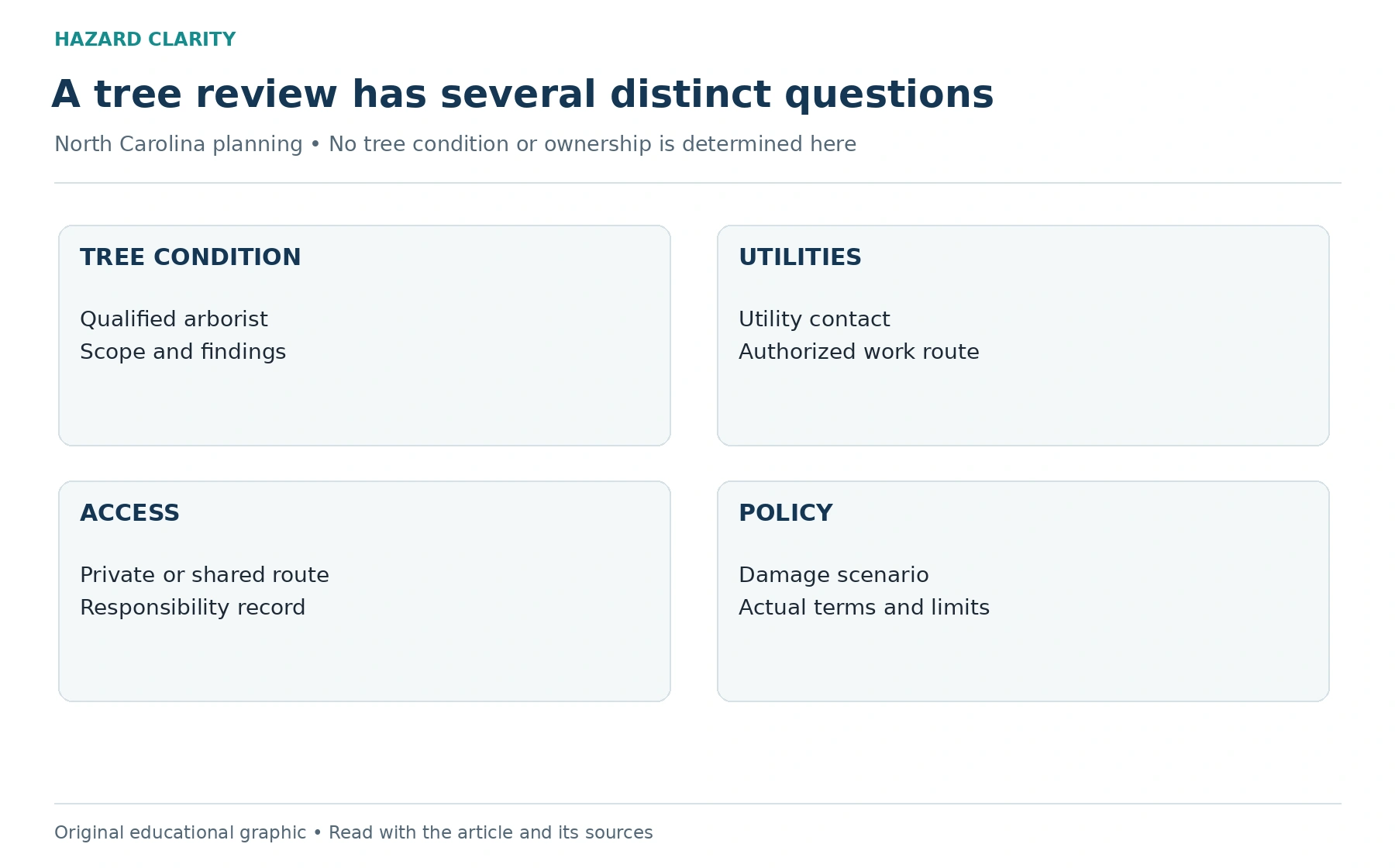
A fall tree check is a useful part of a North Carolina home plan, especially when branches are near the house, driveway, or utility lines. The homeowner’s role is to identify observations and arrange the right evaluation. A ground-level walkthrough cannot determine the structural condition of every tree, and it should not become a pruning or removal project without qualified help.
This guide connects a practical observation record with an arborist discussion and North Carolina insurance resources. It focuses on the questions before work begins. Keep immediate hazards, utility concerns, and active storm response with the appropriate authorities and professionals rather than relying on a seasonal checklist.
Start with the places people and buildings depend on
Walk the property from a safe position and identify trees near occupied structures, entrances, parking areas, and the route to the public road. Include trees beside a detached garage or other structure you use. A concern can affect access even when the main house is not directly involved.
Note visible changes you can describe without diagnosing them: a hanging branch, a new lean, a visibly damaged area, or a change reported after earlier work. Photograph the tree and surrounding context when safe. A close-up alone may not show the building, driveway, or utility arrangement that makes the question important.
Do not enter a hazardous area, approach damaged lines, or stand under an apparently unstable branch to improve the record. Contact the appropriate provider or emergency resource when needed. The fall plan should reduce uncertain tasks, not encourage a homeowner to conduct a technical inspection around an immediate danger.
Use North Carolina weather context without predicting damage
The National Weather Service’s North Carolina winter preparation resource explains regional winter weather, including freezing rain affecting trees and other surfaces. It provides a reason to organize preparation before winter; it does not predict which tree at your address will fail.
North Carolina locations and properties vary. Tell the arborist about the setting, access route, and any earlier storm-related observations. A mountain lot, an urban street, and a coastal property may present different work logistics. Avoid assigning a single statewide condition to every home.
Ask a qualified arborist what evaluation is appropriate for the trees you identified. The professional should explain the scope and limitations of the review. A weather resource, hazard report, and tree evaluation answer different questions. Keep the evidence connected while preserving what each source can actually establish.
Gather earlier work and ownership information
Find prior arborist reports, tree-service invoices, property surveys if available, and notes about shared boundaries or access. Identify which tree and location each document concerns. A report about one tree should not be generalized to every tree on the lot.
If ownership or boundary location is unclear, ask how that question should be resolved before authorizing work. Do not infer ownership simply because the trunk appears closer to one house. A qualified survey or appropriate professional advice may be needed. Keep boundary questions separate from the arborist’s condition evaluation.
For shared access or association-managed areas, confirm who can approve work and who manages the service request. A homeowner may be responsible for contacting an association even when the eventual contractor is selected elsewhere. Record the actual arrangement instead of assuming someone else is already handling the concern.
Define the arborist visit around the open question
When booking, explain what you observed and which location matters. Share a small set of labeled photographs and earlier records. Ask whether the visit evaluates the specific tree, a group of trees, or a broader property area. Clarify whether a written report is included.
Request findings and recommendations in a form you can use. Ask the provider to identify the reason for proposed work, its priority, and whether further evaluation is needed. Avoid translating a recommendation into a stronger conclusion than the professional made. Preserve any limits or conditions in the record.
If work is proposed, compare scopes as well as prices. A proposal for selected pruning, a broader management plan, and removal of a particular tree are not interchangeable. Ask the provider to explain the intended result and what remains outside the work. Check credentials and insurance appropriate to the service before approving the project.
Keep utility work with the utility
Branches near utility infrastructure need a different route from ordinary landscape maintenance. Contact the utility or its designated provider when the concern involves its lines or equipment. Explain the location and observation, and follow its instructions about access and safety.
Do not hire a contractor for work near lines without clarifying the appropriate provider and authorization. A general tree-service business may not be the right party for every task. Ask the utility which parts of the situation it handles and what remains the property owner’s responsibility.
Retain the contact record and any instructions. A utility inquiry should have a date, the location reported, and the next step. If you are told another provider is responsible, confirm who that is. Keep the task open until the route is clear rather than marking the tree concern complete because one phone call occurred.
Ask insurance questions about the actual scenario
The North Carolina Department of Insurance homeowner FAQ addresses tree damage questions, including trees from neighboring property. Use it to frame the discussion, while the policy and facts determine the insurer’s response.
Ask your licensed agent or company how it distinguishes damage to an insured structure, removal of a tree from that structure, debris elsewhere on the property, and damage to a vehicle. Those scenarios may involve different limits or contracts. Do not reduce them to the broad assumption that “tree damage is covered.”
Describe any existing concern accurately. Asking about coverage does not replace maintenance or a professional condition review. A contractor’s estimate is not a guarantee that the insurer will pay. If the company asks for a report or work record, provide the document with its scope intact rather than summarizing away qualifications.
Separate prevention costs from loss handling
An arborist visit or maintenance project can have value regardless of insurance reimbursement. Ask the insurer before assuming a preventive service will be paid under the homeowners policy. Plan the household budget around confirmed responsibilities instead of treating coverage as a reason to postpone evaluation.
If damage actually occurs, contact the insurer through its appropriate reporting route and ask about safe mitigation and documentation. The North Carolina claim information resource is an official starting point for that process. Follow the actual policy requirements and avoid hazardous attempts to improve a photograph or move debris.
Keep emergency work records, invoices, and communications together. Identify what was done to protect the property and what remains for later repair. A removal invoice, building repair estimate, and insurer decision may concern different parts of the event. Preserving that distinction can make the later conversation easier to follow.
Connect the tree review to access planning
A driveway or walkway can be important even when the house is not directly affected. Explain to the arborist if a tree is near the only access route, a shared road, or an entrance used by someone with mobility needs. Ask about the appropriate evaluation and work logistics.
Clarify who manages shared access and whom to contact if it is obstructed. A private road arrangement may involve several households or an association. Keep the contact information and responsibilities in your home plan. Do not assume that a public agency maintains an access route simply because emergency vehicles may use it.
HC’s North Carolina tree and access guide offers additional planning prompts. Use it to connect the property question to household logistics, then rely on actual records and qualified providers for ownership, condition, and work decisions.
Preserve the condition record before authorizing follow up
Keep the arborist’s original report and the proposal together. If a later visit changes the recommendation, retain both dates and ask the provider to explain the update. That history can be useful when comparing the intended work with the completed result.
Do not edit a professional report into a general statement about the safety of the property. Its findings may concern a particular tree, visible areas, or conditions at the time of the visit. Share those limits with anyone relying on the record, including a contractor, insurer, or prospective buyer.
When an insurer requests evidence, ask whether it wants the entire report, photographs, or a completion document. Send the appropriate record through the company’s requested route. Keep a note of what was provided and when. This helps avoid later uncertainty about whether the company reviewed the proposal, the findings, or only the invoice after work was performed.
Keep the result useful for the next season
After work, obtain the completion record and any follow-up recommendation. Label photographs by location and date. Ask what ordinary observations should prompt another call and whether a later review is recommended. Keep the professional’s explanation rather than turning it into a claim that every future storm concern has been resolved.
A homeowner might finish with one tree evaluated, selected work completed, and a utility inquiry still open. That is a useful result when the status is clear. A single “trees done” checkbox would hide the remaining issue. Give the open item a responsible person and a next step.
A North Carolina fall tree plan should help you act on specific observations with appropriate expertise. Start on the ground, identify the relevant structures and access routes, and bring the record to a qualified arborist. Ask your insurer about defined scenarios under the actual contract. Finish with documented work and visible follow-up, rather than a broad promise that the property is protected from every event.
Sources and reference material
NWS Raleigh Winter preparation • Reviewed October 3 2026.
NC DOI Homeowner FAQ • Reviewed October 3 2026.
NC DOI Claims information • Reviewed October 3 2026.
See this property’s own hazard picture.
Check an address