On this page
- Identify the appliance and its records
- Book a visit with a defined purpose
- Bring Minnesota winter context into the discussion
- Keep cleaning and condition evaluation separate
- Review the space around the appliance
- Check the warning and response plan
- Ask how the insurer records this equipment
- Plan the homeowner maintenance handoff
- Prepare the file for a later sale or change of use
- Decide when the task is complete
- Sources and reference material
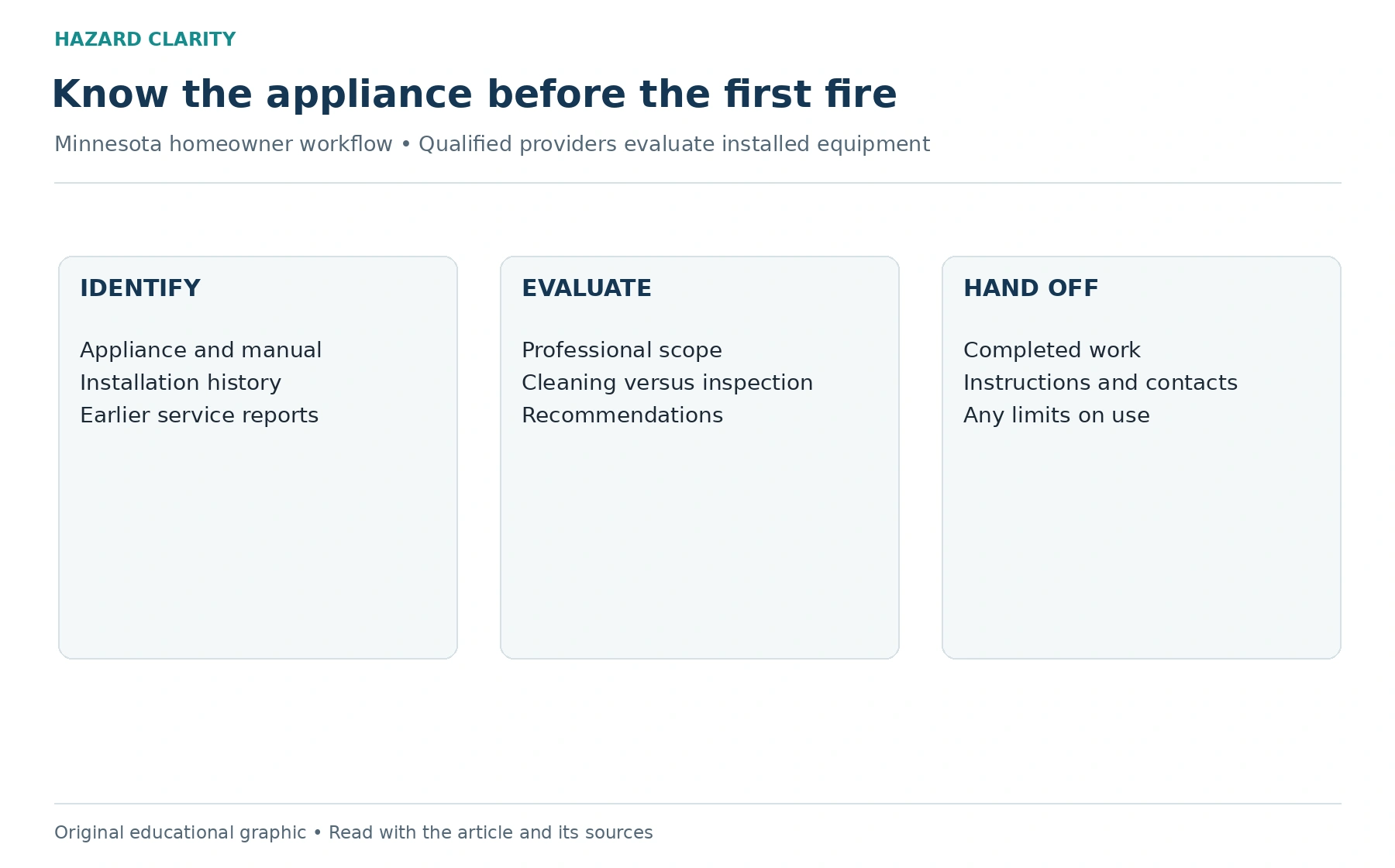
Before the first fire of the season, a Minnesota homeowner should know what appliance is installed, how its service history is documented, and who can evaluate the fireplace or chimney. A clean hearth and an attractive mantel do not answer those questions. Start with the records and a qualified visit, then follow the instructions for the actual system in your home.
This guide focuses on fall preparation for Minnesota households using a fireplace, wood stove, or another installed heating appliance. It is not an installation or operating manual. Different equipment, venting arrangements, and buildings need different evaluations. Treat uncertainty about the setup as a reason to ask for professional help before using it.
Identify the appliance and its records
Find the manual, installation invoice, permit records if available, and previous inspection or cleaning reports. Record the manufacturer and model when safely accessible. If the home has more than one appliance, keep the records separate. A report for one chimney or device should not be generalized to every heating feature in the house.
For a recently purchased home, ask for the complete documentation rather than a verbal assurance that the fireplace “works.” Identify whether a prior visit involved inspection, cleaning, repair, or installation. Those services may have different scopes. A receipt for one does not establish that the others occurred.
If the appliance cannot be identified, describe what you know to a qualified service provider and ask how to proceed. Do not choose a fuel, replacement component, or maintenance procedure based on appearance alone. The instructions and appropriate professional evaluation should establish what the appliance is and how it is intended to be used.
Book a visit with a defined purpose
Tell the provider whether you want a seasonal inspection, cleaning, evaluation of a concern, or review of missing records. Ask what equipment and areas the proposed visit includes. Clarify whether the provider evaluates the appliance, accessible chimney components, venting arrangement, or another specific part of the setup.
Share earlier reports and any unresolved recommendations before the appointment. A previous note about further evaluation should remain visible, even if the appliance has been used since then. Use ordinary descriptions for current concerns, such as damage you can see or an observation reported by an earlier owner. Avoid presenting an assumed cause as a finding.
Ask about credentials and insurance appropriate to the proposed work, and request the scope in writing. Comparing two prices is easier when you can see what each provider will do. A cleaning-only appointment and a broader evaluation may not be equivalent services. Choose the service that addresses the question you actually need answered.
Bring Minnesota winter context into the discussion
The University of Minnesota Extension winter home resource provides local educational context for heating and household preparation. Use that resource to organize questions, while appliance instructions and qualified evaluation address the specific installation.
A Minnesota home may use the appliance for occasional enjoyment, supplemental heat, or a more substantial part of its heating routine. Tell the provider which applies. Explain whether household use has changed, whether a room was remodeled, and whether anyone relies on the appliance when the primary system is unavailable.
Ask how the planned use relates to maintenance needs and the provider’s instructions. Do not assume that an arrangement suitable for occasional use fits a different routine. If the appliance is part of a power-outage plan, discuss the exact equipment and its operating requirements before relying on it. Avoid improvising a backup heating arrangement during an outage.
Keep cleaning and condition evaluation separate
A cleaning record should tell you which components were included and whether access limitations prevented part of the work. An evaluation record should explain the provider’s observations and recommended response within its scope. Ask for clarification when a document uses broad terms such as “serviced” without explaining the work.
If the provider identifies a concern, ask whether the appliance should remain unused until additional work is completed. Follow the qualified provider’s instructions rather than interpreting the seriousness from a photograph or a short note. Record the recommendation and the next step in the same file so it is not lost when the invoice is paid.
After repairs, ask what completion documentation is provided and whether another inspection or authorization is needed. Keep records of the components and areas involved. A repair to one part of the arrangement does not necessarily answer questions about the rest. Preserve the scope of each finding and each completed task.
Review the space around the appliance
Look at ordinary household changes that may affect the area: new furniture, seasonal decorations, stored materials, or a different traffic route. Ask the provider about the required arrangement for the exact appliance and use the manufacturer’s instructions. Do not infer that a photograph of another home shows a suitable clearance for yours.
The USFA heating guidance is an official source for general fire prevention. It complements the appliance-specific review. Ask questions when household storage or furnishings make the instructions difficult to follow. A practical solution should be established before the appliance is used.
Include household members and regular caregivers in the discussion. Explain any instructions the provider gave and where the written record is kept. A visitor may not know that an appliance is awaiting repair or that a nearby area needs to remain clear. Make the status easy to understand without expecting everyone to interpret a technical report.
Check the warning and response plan
Review the home’s smoke and carbon monoxide alarm records as a separate task. Confirm that model instructions, test reminders, and replacement follow-up are available. A chimney visit does not automatically test household alarms, and an alarm test does not evaluate the appliance or venting.
If the professional recommends an alarm review because of the equipment or layout, ask who should perform it. Keep the recommendation specific. A household with hearing, mobility, or other access needs may require a more deliberate plan for receiving a warning and leaving the home.
Use official emergency guidance when an alarm sounds or a potentially hazardous condition is suspected. Do not keep using the appliance while trying to decide whether the observation is serious enough for a service call. The maintenance file can support follow-up after people are safe; it should not delay an appropriate response.
Ask how the insurer records this equipment
Tell your licensed agent or insurer which installed heating appliances the home uses. Ask whether its records are accurate and whether recent installation, replacement, or repair work should be reported. Provide the model and service documents when requested. Avoid assuming that a general description such as “fireplace” captures the insurer’s relevant questions.
Ask what evidence the company requires for the appliance and whether any conditions or inspection requirements apply under your policy. If the equipment is used differently from when the policy was arranged, explain the change. Keep the insurer’s reply with the actual contract and endorsements.
HC’s insurance inspection explainer can help frame that conversation. It does not replace the insurer’s specific request. Likewise, a service provider’s opinion about coverage should be taken back to the licensed agent or company for confirmation. The provider evaluates its work; the insurer addresses policy terms.
Plan the homeowner maintenance handoff
Ask the service provider what routine tasks are appropriate for the owner and what belongs with a professional. Request written instructions for the exact appliance. If you cannot perform a recommended task safely, arrange help rather than shortening or changing the procedure.
Set reminders based on those instructions and the provider’s recommendations. An annual calendar entry can prompt a visit, but actual service needs depend on the equipment and use. Record changes that the provider tells you to report, and keep its contact information available for follow-up questions.
Include the appliance file in your broader Minnesota seasonal readiness plan. That state resource is a planning aid; it does not certify an installation. Keep the winter household plan linked to qualified service records and clear instructions for the people who use the home.
Prepare the file for a later sale or change of use
Keep the appliance records in a form you could hand to another owner without overstating them. Identify the installed equipment, completed visits, and unresolved recommendations. A future buyer should be able to distinguish a cleaning receipt from a condition evaluation or repair record.
If you change how the property is occupied or plan to rent it, revisit instructions, maintenance responsibilities, and insurer disclosure with the appropriate providers. An arrangement understood by your household may need a more formal handoff for someone else. Do not assume the earlier policy conversation applies to a different use.
Keep copies of professional reports intact. Removing pages or shortening a qualification can change what a reader believes was evaluated. A useful file supports an accurate conversation about the appliance and its history. It should not be repackaged into an assurance that the whole system is approved for every future owner, fuel, or operating routine.
Decide when the task is complete
The preparation task is complete when the intended evaluation or service has occurred, the records are received, and recommended follow-up has been addressed or clearly scheduled. If the provider says not to use the equipment until work is completed, preserve that status prominently. A booked appointment is progress, but it is not the completed result.
For example, a report may identify a component that needs repair and recommend another visit before use. The next step is to confirm the scope, complete the work with the appropriate provider, and retain the completion record. Do not turn the first report into a general statement that the fireplace was approved.
A Minnesota fall fireplace plan should make ordinary use easier to manage because the household understands the equipment and its status. Gather the documents, define the service scope, and follow the provider’s instructions. Then keep the insurance questions specific to the installed system, with written answers that match the policy you actually hold.
Sources and reference material
UMN Extension Keep your home warm and safe in winter • Reviewed October 3 2026.
USFA Heating fire safety • Reviewed October 3 2026.
See this property’s own hazard picture.
Check an address