On this page
- Trace one drainage route at a time
- Watch what changes during rain
- Separate leaf removal from drainage repair
- Use Michigan winter guidance for the next question
- Check the property beyond the downspout
- Ask insurance questions by water mechanism
- Build a useful contractor request
- Make a discharge change a planned project
- Recheck the result and preserve the record
- Sources and reference material
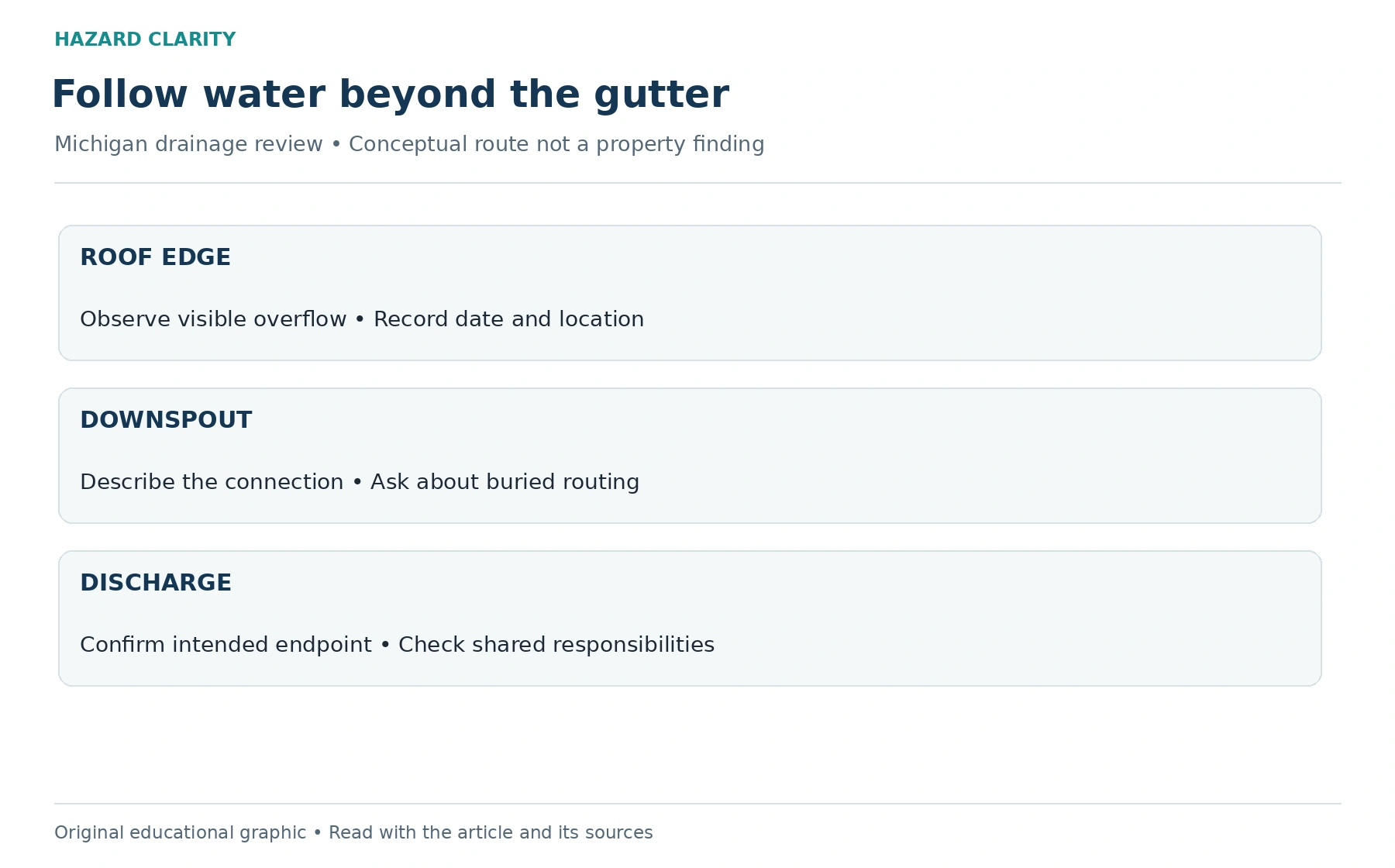
Michigan fall maintenance is a good time to follow water from the roof to the ground. Leaves can obscure a drainage problem, and a clean-looking gutter does not explain where a downspout sends the water. A useful review looks at the whole route, records what you can observe safely, and sends the right questions to a contractor or local drainage contact.
This is an exterior drainage planning guide for Michigan homeowners. It does not determine whether a particular home will flood or diagnose roof damage. Start with observations during ordinary conditions. Arrange professional help for work at height, unfamiliar drainage systems, or persistent water entry. The most valuable result is a defined next step for each problem you find.
Trace one drainage route at a time
Begin with one side of the home. Identify the roof edge, gutter, downspout, and visible discharge area from the ground. Look for disconnected sections, visible sagging, staining, or water appearing where you would not expect it. Describe the condition without assuming a cause. A stain may justify review even when you cannot tell how or when it formed.
Repeat the process around the building. Photograph enough of the surrounding area to show how each component relates to the house. Label the images by location rather than using a collection of indistinguishable close-ups. A contractor should be able to understand which downspout or corner you mean before arriving.
Where a discharge enters a buried line, note the connection and ask where the line goes. Do not assume it connects to a particular public system. Earlier owners may have altered the arrangement, and a visible pipe does not establish the route below the ground. Look for available installation records and ask a qualified provider how to investigate uncertainty.
Watch what changes during rain
If you can observe from a protected, safe position, record whether water overflows a particular gutter, pools near an entry, or stays in one area after rainfall. Include the date, approximate duration of your observation, and what you actually saw. You do not need to invent rainfall measurements to make the note useful.
A photograph before rain and another afterward can provide context. Explain if the condition is new, repeated, or only noticed during one event. Keep earlier photographs when they show a change. A new wet area after landscaping work deserves a different conversation from a condition that existed for years before the work.
Avoid approaching water, unstable ground, electrical equipment, or damaged components to improve the record. If the situation appears hazardous, seek the appropriate professional or emergency response. Maintenance documentation can wait. The purpose of the log is to support investigation under reasonable conditions, not to encourage a homeowner to inspect during a storm.
Separate leaf removal from drainage repair
A cleaning visit can remove debris without correcting a poorly supported gutter, a damaged connection, or an unexplained underground discharge. When requesting service, ask the contractor to identify the areas included and whether the visit involves cleaning only or evaluation of visible defects as well. Those are different scopes.
Ask for a short record of the completed work. It should identify the location, date, and any problems observed or left unresolved. If the contractor recommends another service, ask what question that service should answer. “Needs drainage work” is less useful than a description of the affected area and the reason for additional evaluation.
Do not judge completion only by the appearance of the gutters from below. Confirm what the provider says was cleaned and what could not be accessed. A missing section or recurring overflow may require a separate proposal. Keep that proposal with the cleaning record so the problem remains visible after the first invoice is paid.
Use Michigan winter guidance for the next question
Michigan’s official ice dam preparation resource explains how melting and refreezing can create a roof-edge problem. That is a reason to ask about the roof and attic when winter symptoms occur; it is not evidence that cleaning a gutter will prevent every ice dam.
Tell a qualified roofing or building professional about earlier winter water entry, ice observed at roof edges, and any attic or roof work. Keep those records separate from ordinary fall cleaning. Ask whether the proposed review includes the roof, attic conditions, drainage components, or only one of them.
The useful Michigan-specific habit is to connect the fall exterior record with the next season’s observations. Save dated photographs and service notes now so you have a baseline if a winter problem develops. Avoid treating an official general explanation as a diagnosis of your home. The actual building arrangement and conditions still need evaluation.
Check the property beyond the downspout
The discharge point is part of a broader site. A low area, shared driveway, nearby public drain, or recent grading change can raise questions beyond gutter maintenance. Identify whether a concern appears to involve the house, the lot, a shared system, or public infrastructure before choosing whom to contact.
For Michigan homeowners, local public works or municipal contacts may be relevant when the observation concerns a public drain or road. Ask which office handles the location and what information it needs. A public drainage inquiry does not replace a contractor’s review of privately owned components, and a contractor may not know the ownership of every nearby line.
HC’s Michigan drainage guide offers additional questions for the site around the home. Use it to organize the discussion, not to infer that one correction on your lot will resolve water behavior throughout the neighborhood. Keep shared responsibilities and private maintenance tasks distinct.
Ask insurance questions by water mechanism
A wet basement, roof leak, and overland flood can involve different causes and policy terms. Before asking whether “water damage” is covered, describe the observed route or explain that it is still unknown. Ask what information the insurer needs and which policy sections may be relevant to the situation.
HC’s flood coverage explainer helps separate flood questions from ordinary homeowners coverage questions. If the concern involves sewer backup or another mechanism, raise that specifically. Do not substitute an assumed label for a professional evaluation when the source of water remains uncertain.
For recurring leakage or deterioration, ask how the policy distinguishes maintenance issues from potentially covered damage. Record the question and response with the relevant policy documents. A contractor’s statement about coverage is not a binding answer from the insurer. Likewise, an insurer’s coverage discussion does not establish the cause or repair scope of a building condition.
Build a useful contractor request
Send a small set of labeled photographs, your observation log, earlier work records, and a clear question. For example: water was seen overflowing at the northwest corner during two rain events after a cleaning visit; the buried downspout route is unknown; please identify the appropriate evaluation and proposed scope. That request gives the provider something specific to assess.
Ask whether the provider handles both the visible components and the buried drainage route. If not, ask which trade or specialist should take the next question. Check credentials and insurance appropriate to the work, and request a written proposal with the work location and any exclusions. Avoid comparing proposals only by the total price when their scopes differ.
After work, ask what observations would justify another call and what routine maintenance is recommended. Keep the response with the invoice. A useful handoff explains how the homeowner should manage the completed arrangement and what remains outside the provider’s work. It does not require the contractor to guarantee the property will never have water problems.
Make a discharge change a planned project
If a contractor proposes moving a downspout outlet or altering a buried route, ask where the water will go and what other areas could be affected. Identify whether the work involves only your property or raises shared-system questions. Keep the proposed endpoint in the written scope so the completed arrangement can be compared with the plan.
Ask which approvals or local requirements need verification before the project begins. A contractor may help with that process, but confirm who is responsible for each step. Do not assume that an outlet already used by another property is available for yours.
After completion, keep a sketch or photographs that explain the new arrangement. Record the date and any maintenance instructions. These details are especially useful when a later owner or different provider needs to understand a buried line. A project record that shows both the intended route and completed work is more informative than a payment receipt by itself.
Recheck the result and preserve the record
Use a later ordinary rain event, when safe, to observe the same location again. Note what changed and what did not. If overflow continues, contact the provider with the new record rather than assuming the work failed for a particular technical reason. There may be more than one problem, and the next evaluation should be based on evidence.
Keep records of substantial modifications to gutter or discharge arrangements. Ask whether permits, association approval, or local rules apply before changing the route; verify the requirements for your property rather than borrowing a neighbor’s setup. A discharge change can affect other areas, so the contractor should understand the intended endpoint before work begins.
The fall goal is a drainage route you can describe and maintain, with unanswered questions assigned to the appropriate provider. Michigan’s winter context makes that record especially useful, but the process starts with ordinary observations: where water goes, what interrupts it, and who can evaluate the concern. Finish with a short task list and the records needed to follow through.
Sources and reference material
Michigan State Police Preventing roof ice dams • Reviewed October 3 2026.
See this property’s own hazard picture.
Check an address