On this page
- Walk the route as a visitor would
- Review steps and railings with qualified help
- Ask guests about the route they need
- Use Massachusetts accessibility resources for winter planning
- Verify local requirements rather than guessing
- Keep lighting and electrical work separate
- Ask the insurer about hosting scenarios
- Give helpers a defined role
- Keep the service scope with the guest plan
- Recheck the route close to the visit
- Sources and reference material
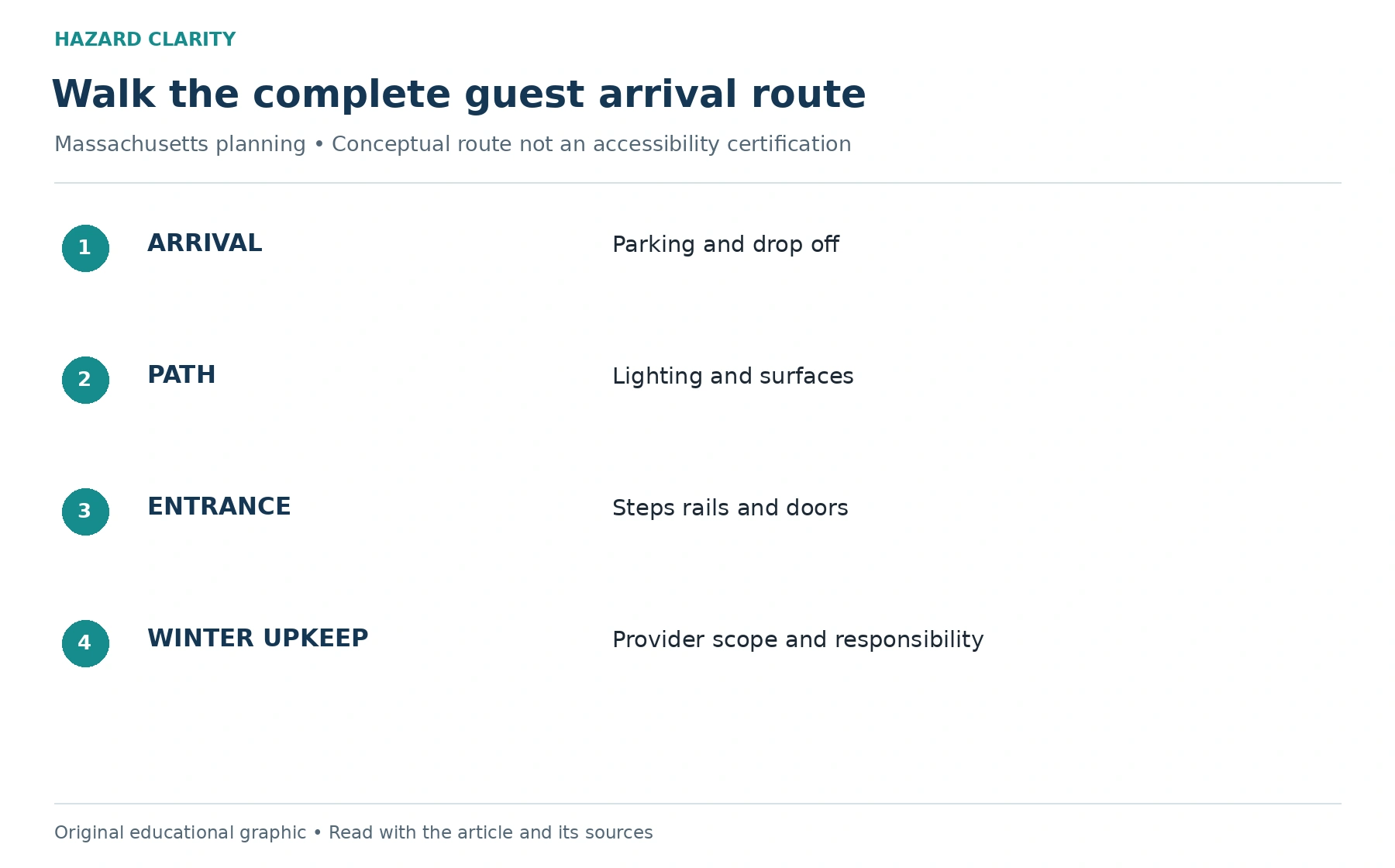
Before holiday guests arrive, walk the route they will actually use. Start where they park or are dropped off, continue to the entrance, and include the steps, railings, lighting, and walking surfaces along the way. In Massachusetts, this fall walkthrough is also a chance to organize snow and ice responsibilities before colder conditions complicate the route.
The purpose is practical preparation. It does not determine legal liability or certify that an entrance meets every applicable requirement. Identify observations, arrange appropriate repairs, and ask the right people about shared responsibilities. Then use the findings to have a focused insurance conversation before the gathering.
Walk the route as a visitor would
Approach the home from the parking area rather than beginning at the front door. Notice where a visitor would turn, whether the intended entrance is obvious, and whether the path changes level. A household member may automatically avoid an uneven surface that a first-time guest will not recognize.
Repeat the observation after dark when it can be done safely. Note areas where the route is difficult to see, where light is obstructed, or where the entrance number is hard to identify. Describe the observation without diagnosing electrical equipment. A qualified provider can evaluate the installation when needed.
Take photographs showing the overall route and specific areas that need attention. Add the date and the intended follow-up. A photo of a loose-looking component should prompt an evaluation, not a homeowner’s conclusion about its structural adequacy. Keep the record concrete enough for a contractor to locate the concern.
Review steps and railings with qualified help
Note visible deterioration, a change in a walking surface, or a railing that concerns you. Do not test unfamiliar components aggressively to decide whether they are secure. Describe what you observed and ask an appropriate contractor to evaluate the condition and proposed repair.
A repair request should identify the location, the reason for review, and any access needs for the household. Ask what the provider’s scope includes and whether further evaluation is needed. Painting over a surface concern and repairing an underlying condition are different tasks. The proposal should make the intended work clear.
Keep completion records and any limitations the provider identifies. A receipt does not automatically certify the entire entrance. If work remains open, ask about an appropriate alternative route and whether it is suitable for expected guests. Do not assume that directing visitors elsewhere solves every access question.
Ask guests about the route they need
Before choosing an entrance or sleeping arrangement, ask whether a visitor has mobility, vision, or other access needs. Keep the conversation practical and respectful. A route that works for one person may be unsuitable for another, even if it is the home’s usual entrance.
Think about the full journey rather than a single threshold. Drop-off space, pathway width, doors, and interior movement can all matter to a guest’s experience. If you need an adaptation, consult an appropriate professional about the actual arrangement. Avoid improvising a ramp or structural modification from an online illustration.
Share clear arrival information once the route is established. Tell a guest which entrance to use and where someone can help if agreed. Do not disclose unnecessary personal information to other visitors. The goal is a welcoming plan that accounts for the person’s needs without expecting them to navigate an unfamiliar property unaided.
Use Massachusetts accessibility resources for winter planning
Massachusetts’ snow removal and accessibility resource explains the importance of keeping accessible routes usable during winter conditions. Use it as a planning prompt for the sidewalk and entrance around your property, including areas someone may need for a wheelchair or another mobility aid.
Clarify which surfaces are yours to manage and which involve a landlord, condominium association, or municipality. Ask for the applicable responsibility and contact route. A driveway service contract may not include the public sidewalk, curb area, or every entrance. Identify the actual scope before assuming the route will be handled.
If you hire a provider, explain the specific areas that need service and any access needs. Ask how it communicates timing and completion. Keep a backup contact if the usual arrangement is unavailable. Your household plan should be able to identify who acts, rather than relying on the broad statement that “snow removal is included.”
Verify local requirements rather than guessing
Massachusetts’ official snow and ice law resource provides a starting point for legal and local-rule questions. This article does not interpret those obligations for your property. Verify current municipal requirements and seek appropriate legal guidance when responsibility is unclear.
Do not borrow a deadline or rule from a different town without checking where it applies. An association agreement, lease, or service contract may also affect the practical arrangement. Keep those documents available and ask which party handles each area. A national checklist cannot settle a shared-responsibility question.
Record the answer and the contact who supplied it. If a disagreement remains, make it an open task rather than silently assigning the work to another party. Planning can proceed on the clearly understood areas while the unresolved responsibility is addressed through the appropriate route.
Keep lighting and electrical work separate
A homeowner can identify that a path is hard to see, but a qualified electrician should address installation and wiring questions. Ask about the intended use, location, and appropriate equipment. Tell the provider whether the concern involves an existing fixture, new work, or a temporary seasonal arrangement.
Do not run a temporary cord across a walking route to solve a lighting concern without suitable guidance. A quick fix can introduce a different problem. Ask the professional how to provide the needed lighting for the actual setting and follow product instructions for any owner-installed device.
HC’s wiring and insurance guide offers background for the documentation conversation. Keep the electrical work record separate from a general entry checklist. A photograph of a newly lit path shows an observable change; it does not establish the quality of concealed wiring.
Ask the insurer about hosting scenarios
Tell your licensed agent or insurer about the kind of gathering you plan if you have coverage questions. Ask how personal liability and medical payments differ under your policy, what limits apply, and whether particular activities raise additional questions. Explain relevant facts instead of asking whether “Thanksgiving is covered.”
The NAIC event insurance resource encourages discussions about home events, including liability concerns. Use it to prepare questions, not to decide that every gathering needs a separate product or that an injury would automatically be covered.
Keep the insurer’s reply with the actual policy and endorsements. If the answer recommends a limits review or another coverage discussion, ask when a confirmed change would become effective. Do not assume that a conversation or quote changes the contract. Continue addressing maintenance concerns regardless of the coverage discussion.
Give helpers a defined role
If family members, hired help, or a service provider will assist, explain the task and area involved. A household helper may be willing to turn on a light or notify you of an obstruction without being responsible for repairs or weather-related service. Confirm the arrangement rather than assigning it by assumption.
For a service contract, ask what happens when access is blocked or conditions prevent completion. Keep the provider’s contact information available. A useful plan includes how a missed task will be reported and who decides the next action. It should not imply that the provider guarantees every surface will remain clear continuously.
Share the completed arrangement with someone else in the household. They should know which route guests are using, which repairs are finished, and which tasks remain open. This makes the plan usable if the person who organized the gathering is occupied when visitors arrive.
Keep the service scope with the guest plan
If a contractor or snow service has agreed to work before a gathering, confirm the particular areas included and how the provider will notify you of completion. Keep the agreement accessible to another household member. A scheduled visit is useful progress, but the route still needs an appropriate recheck afterward.
Record any exclusions or areas left for another party. A provider may handle the driveway while a different arrangement covers the steps. That division can work when the responsibility is clear. It creates uncertainty when everyone assumes the other task is included.
If work cannot be completed in time, ask the relevant professional about suitable next steps and communicate a changed arrival arrangement if needed. Do not present an unfinished task as a completed repair simply to simplify the hosting checklist. A practical guest plan should reflect the actual condition and responsibilities on the date people arrive, including the household’s limits on what it can safely manage.
Recheck the route close to the visit
A fall repair can be complete while temporary conditions change later. Before the gathering, observe the route again when safe and note new obstructions or unfinished work. Use current official weather guidance for conditions that could affect arrival. Do not rely on a checklist completed weeks earlier as proof of the present route.
Massachusetts’ winter storm safety resource provides official preparation guidance. Connect that information with your actual property responsibilities and service arrangements. If conditions make the planned visit unsuitable, communicate the practical change without trying to resolve a safety decision through an insurance assumption.
A good guest-access plan leaves the household with a route it understands, qualified repairs where needed, and a clear arrangement for winter upkeep. The insurance conversation belongs alongside that work because it helps clarify the contract. It does not replace the maintenance task. Start at the parking area, follow the route, and resolve the specific questions that would otherwise greet a visitor at the door.
Sources and reference material
Massachusetts Snow removal and accessibility • Reviewed October 3 2026.
Massachusetts Law about snow and ice • Reviewed October 3 2026.
Massachusetts Winter storm safety • Reviewed October 3 2026.
NAIC Event insurance • Reviewed October 3 2026.
See this property’s own hazard picture.
Check an address