On this page
- Start with what happened and what is known
- Treat maintenance as a defined service
- Read the manufacturer warranty itself
- Recognize a purchased home service contract
- Keep homeowners insurance in its own file
- Use a furnace failure to separate the questions
- Separate an appliance repair from resulting water damage
- Compare costs that are still yours to understand
- Preserve the timeline of calls and approvals
- Build a simple agreement index before the next failure
- Sources and reference material
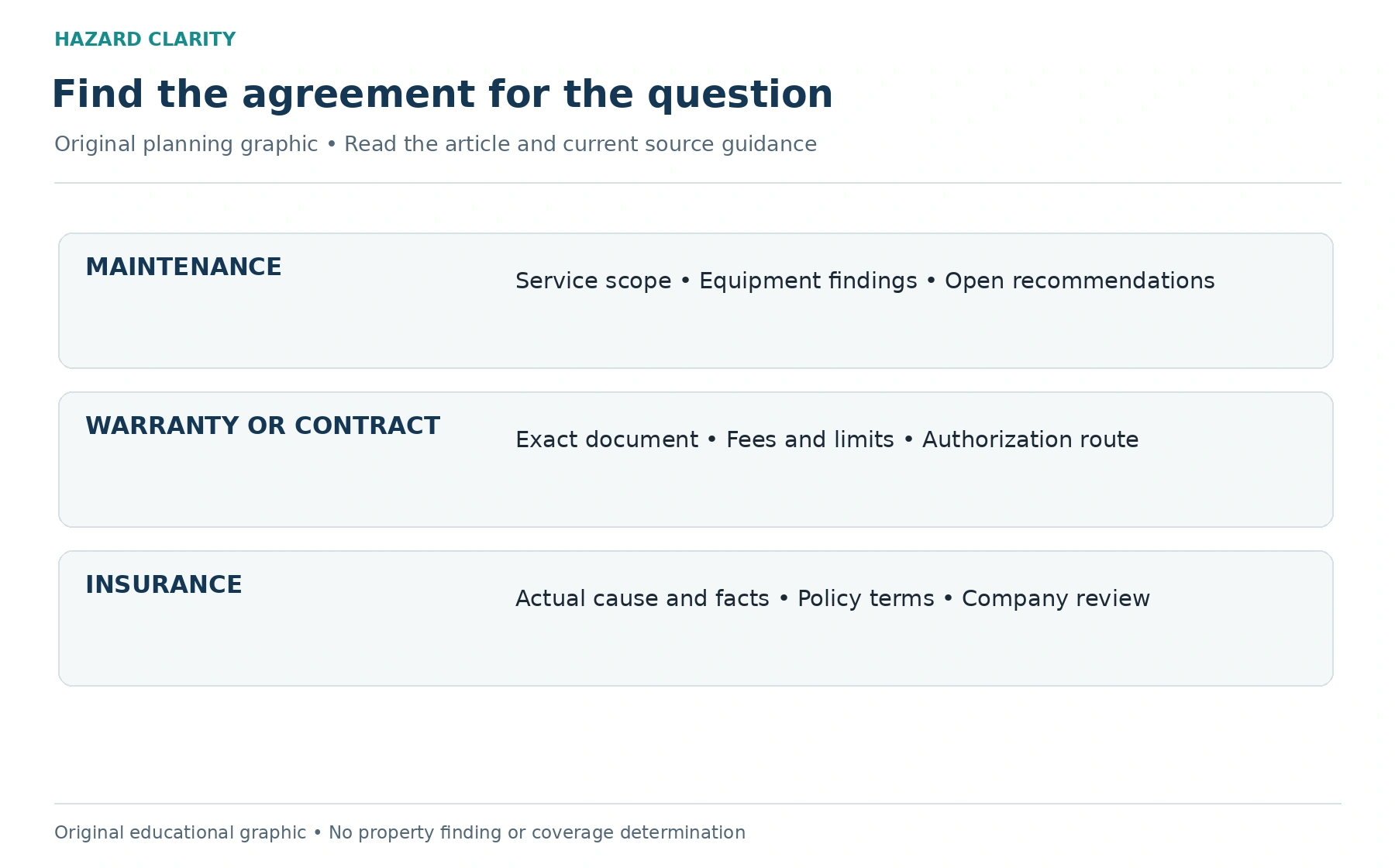
When an appliance stops working, the first question is often who pays. Before making that call, identify the agreement you are asking about. Routine maintenance, a manufacturer warranty, a purchased service contract, and homeowners insurance can address different issues. Their names may sound reassuring, but the actual documents determine what process and terms apply.
This guide helps you organize a failure or repair question without promising a coverage result. We will use ordinary furnace and plumbing scenarios to show how to separate the condition, the proposed work, and the possible payment route. These are discussion examples, not claim determinations. The provider or insurer needs the facts and the relevant contract.
Start with what happened and what is known
Describe the problem in plain language. The furnace stopped producing heat, a dishwasher left water on the floor, or a service provider recommended a worn part. Include when you noticed it, what you observed, and any professional findings. Do not choose a technical cause merely because it seems likely to fit a particular agreement.
Keep uncertain facts visible. A device that will not start may require evaluation before the provider can determine the failure. Water beside an appliance may require a separate investigation of the source. The initial description should be accurate enough to help the company explain its process, without presenting a guess as a diagnosis.
Ask what documentation is needed before work is authorized. If an immediate safety concern exists, seek appropriate emergency or qualified assistance. Administrative questions should not delay that response. When the situation is stable, the record can help the relevant provider review the problem and the steps already taken.
Treat maintenance as a defined service
Maintenance work is easiest to understand when its scope is clear. Ask what a routine visit includes, which equipment is being serviced, and how findings will be documented. A maintenance agreement may provide scheduled visits or selected services; do not assume it includes every repair or replacement after a failure.
Keep the equipment information, work date, and service report. If the provider identifies an open recommendation, record the next step separately from the completed visit. A paid maintenance invoice should not imply that an ordered part has been installed or that every concealed component was evaluated.
For a furnace, ask the provider how to distinguish ordinary care instructions from a condition that requires another appointment. Store its guidance with the actual model documentation. Avoid using a general article to adjust unfamiliar equipment. The service record should make your own responsibilities and the provider’s recommendations understandable.
Read the manufacturer warranty itself
A manufacturer warranty is associated with the product and its stated terms. Find the warranty document, purchase record, model, and identifying information. Ask the manufacturer or authorized service route which issue you are describing and what evidence is required. Do not assume a warranty follows the same process as the contractor who last visited.
Review the covered components, time periods, exclusions, and any procedural requirements stated in the agreement. Ask how labor, transportation, diagnosis, and installation questions are addressed. A statement that a part is under warranty may leave other costs unresolved. Get those distinctions before assuming the full job will be paid.
If ownership or installation has changed, ask how that affects the actual warranty. Keep the answer rather than relying on a neighbor’s experience with a similar appliance. The same brand can have different product terms, and the documentation needs to match the equipment you own.
Recognize a purchased home service contract
The FTC’s home warranty consumer alert explains that products commonly called home warranties are service contracts. That distinction is a useful reason to read the agreement before treating the label as broad protection. Ask what systems, components, and circumstances it actually addresses.
Find the contract’s service request process, fees, limits, exclusions, and approval requirements. Identify whether the company selects the provider or requires authorization before outside work. A repair bill from your preferred contractor may not satisfy the agreement’s process simply because the appliance is listed in marketing materials.
Ask how an unavailable provider or urgent repair is handled under the contract. Get the response through the company’s established route and keep it with the request record. This is especially helpful around holidays, when your ordinary contractor and the contract’s assigned provider may have different availability.
Keep homeowners insurance in its own file
Homeowners insurance should be reviewed using the actual policy, declarations, endorsements, and facts of the event. The NAIC homeowners insurance resource provides general background. It does not tell you whether a particular worn part, mechanical problem, or resulting damage will be paid under your contract.
Describe the scenario to the licensed agent or insurer. Ask which causes, exclusions, deductibles, and limits may be relevant and what professional findings it needs. If equipment breakdown coverage is mentioned, ask whether it exists on your policy and what its separate terms require. Do not infer it from the general phrase home protection.
Keep the insurer’s answer separate from the repair proposal. A contractor can identify a condition and estimate work, while the insurer addresses its agreement. Neither answer automatically replaces the other. The point is to connect accurate information to the correct decision maker.
Use a furnace failure to separate the questions
Suppose a heating provider evaluates a system that has stopped working and recommends replacing a component. The maintenance question is what the completed visit established and what work remains. The manufacturer warranty question is whether the identified component and associated costs fall within that warranty’s terms.
If you purchased a home service contract, the question is how to request service for this system and whether the company requires a particular authorization route. The homeowners insurance question is whether the actual cause and circumstances relate to coverage in your policy. Each company may need the professional report, but for a different review.
Do not send a vague message saying the furnace is covered by something and expect the contractor to choose the payment route. Gather the agreements, follow the required contact processes, and ask for explanations of unresolved costs. A clear file reduces the chance of authorizing work while assuming another party has agreed to pay.
Separate an appliance repair from resulting water damage
Consider a dishwasher problem accompanied by visible water on the floor. Ask the qualified provider what is known about the source and the appliance condition. Keep that finding separate from the record of affected flooring or belongings. Repairing the appliance and addressing damage elsewhere may involve different scopes and agreements.
HC’s plumbing and insurance article offers background for collecting system information. The record should include earlier work and current findings, without using the age of a component as a complete cause explanation. If the source remains uncertain, state that clearly.
Follow the relevant policy reporting and protection requirements safely if there is a loss. Ask the insurer what mitigation and documentation it needs. Meanwhile, ask any warranty or service-contract provider about the appliance request process. Keep receipts labeled by the work they address rather than placing every expense under one assumed payment promise.
Compare costs that are still yours to understand
Even when an agreement may apply, ask which charges remain unresolved. Diagnostic fees, service request fees, deductibles, excluded work, and limits can affect the decision. Use the terms of each agreement rather than a general rule that a covered component means a free repair.
Request an estimate with a clear scope from the provider handling the work. If an authorization covers only part of the proposal, ask who explains the difference and how you can review it before proceeding. Keep the company’s decision and the contractor’s scope together so you can compare what was approved with what is proposed.
For future planning, compare a service agreement’s included work and total cost with your actual needs. This article does not recommend purchasing or cancelling one. The useful exercise is to understand what you already hold and identify any gap or duplication you want to discuss before the next problem.
Preserve the timeline of calls and approvals
Record when you contacted each company, the request number, the person or route used, and the next instruction. Save relevant messages in their original form. A short timeline can clarify whether a provider was authorized, whether information is still missing, and which party has the next action.
If instructions appear to conflict, ask for clarification before assuming they are interchangeable. One company may request inspection before permanent repairs while another has a separate appliance service process. Explain the situation to both and seek the appropriate professional advice where necessary. Do not try to reconcile legal or contractual issues by rewriting the terms yourself.
Use HC’s insurance inspection guide to understand the role of a property review, then follow the actual company’s requirements. An inspection, a repair visit, and a contract authorization establish different things. Keep their records labeled accordingly.
Build a simple agreement index before the next failure
List each agreement, the company, covered property or equipment, current document location, contact route, and renewal or expiration information from the document. Keep a secure copy accessible outside the home. Another household member should be able to find the relevant record without guessing which folder contains home protection.
When equipment changes, update the index and ask the applicable companies what information they need. Preserve installation records and completed work reports. Old agreements may remain useful history, but distinguish them from the terms currently in force so the household does not rely on an expired document.
Begin with the condition, identify the agreement, and follow its process. That sequence makes the who-pays question more manageable without pretending that every home problem has the same answer. Your strongest next step is a precise request supported by the correct documents and a record of what the responsible provider actually confirmed.
Sources and reference material
FTC Home warranties and service contracts • Reviewed October 3 2026.
NAIC Homeowners insurance • Reviewed October 3 2026.
See this property’s own hazard picture.
Check an address