On this page
- Confirm what actually serves the home
- Request the well records
- Plan water testing with the right guidance
- Evaluate operation separately from water quality
- Review the well’s setting and access
- Request the septic file from the seller and county
- Arrange a septic evaluation with a defined scope
- Connect system capacity with your plans
- Budget for ownership and maintenance
- Use the transaction deadlines to resolve questions
- Keep the records after purchase
- Sources and reference material
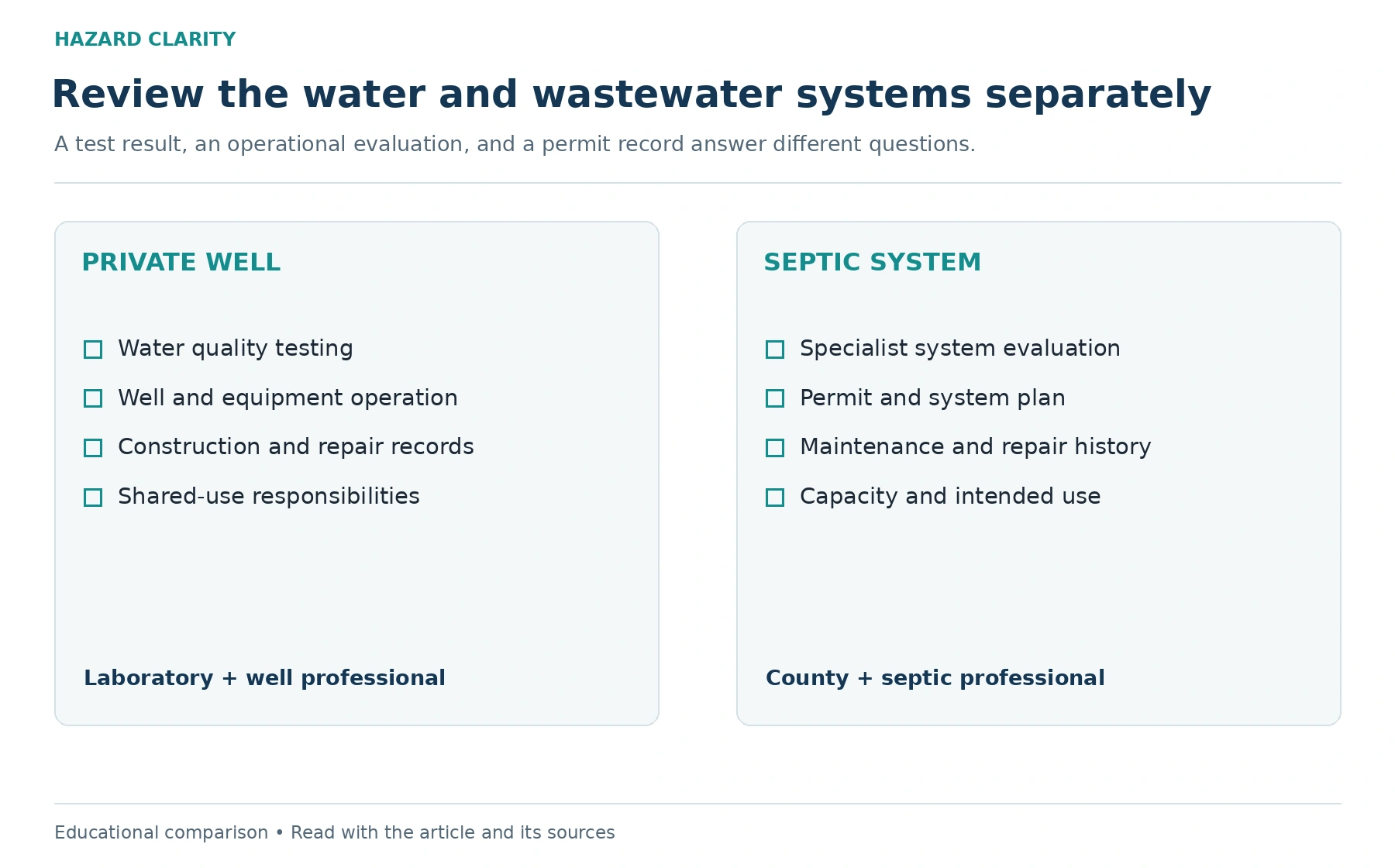
A private well and septic system can be important parts of an Indiana home’s ownership plan. They also deserve their own due diligence. A faucet that runs and a toilet that flushes during a showing do not provide a complete evaluation of the water supply or wastewater system.
Start by confirming which systems serve the property, locating available records, and arranging the appropriate evaluations. Keep water quality, water system operation, septic condition, and local requirements as separate questions. One favorable result does not automatically answer the others.
Use HC’s Indiana property information to organize location context. Then build the well and septic file described here alongside the home inspection, purchase agreement, and qualified local guidance.
Confirm what actually serves the home
Ask the seller to identify the drinking-water source and wastewater arrangement. Determine whether the property uses a private well, a shared well, public water, an onsite septic system, or another arrangement. Do not infer the answer from the neighborhood’s appearance or the absence of a visible utility bill.
If any system is shared, request the relevant agreements and ask who maintains it, pays for work, and controls access. Have the appropriate transaction professional review the arrangement. A verbal description that neighbors “split the cost” may not explain the rights and responsibilities transferring with the property.
Record the system locations and available identifying information. Ask where the well, septic tank, absorption area, and related components are located, as applicable. A seller’s sketch can help you ask questions, but it is different from an official record or a qualified location service.
Request the well records
Ask for available construction records, repair invoices, pump information, water treatment records, and prior laboratory reports. Keep the documents complete and dated. If a seller says the well was replaced, ask what was actually replaced: the well itself, pump, pressure tank, wiring, or another component.
Record whether the documents identify this property and system. A report for a nearby address or an earlier shared arrangement may need clarification. If the current layout differs from the records, ask a qualified well professional what the difference means and how to resolve it.
Do not treat a stack of maintenance receipts as proof of water quality. Those receipts may show equipment work or servicing. Water testing is a separate task with its own sampling, analysis, and interpretation requirements.
Plan water testing with the right guidance
Ask the local health department and an appropriate laboratory which testing is recommended for the property and circumstances. Explain the planned purchase and any known history. Confirm how samples should be collected, which tests will be performed, and how results will be interpreted.
Request the actual laboratory report rather than a verbal statement that the water “passed.” Read which substances or indicators were tested, when the sample was collected, and any limitations. A report answers the tests performed at that time; it should not be expanded into a guarantee about every possible contaminant.
If treatment equipment is present, ask how it affects sampling and what maintenance it requires. A professional can help distinguish questions about the source water from questions about water delivered after treatment. Preserve that distinction so you understand what the result actually represents.
Evaluate operation separately from water quality
Ask a qualified well professional about the appropriate evaluation of the well and associated equipment. Request a written scope explaining what will be observed or tested and what will remain outside the service. Water quality and system performance are related ownership concerns, but they are different findings.
Ask how the evaluation relates to your expected household use. If you plan activities that may change water demand, describe them. Do not assume that the seller’s experience under a different occupancy pattern guarantees the system will meet your plans.
If work is recommended, request a defined estimate and explanation of the remaining uncertainty. Ask whether further access or testing is needed before the scope can be priced. Keep estimates separate from completed repairs and avoid assigning an unknown expense a value of zero.
Review the well’s setting and access
Indiana’s Department of Health publishes recommended private-well construction standards that address location, protection from surface water, and separation from potential contamination sources. Use the official material to prepare questions for the qualified professional and local health department rather than attempting your own compliance certification.
Ask whether the well location can be identified and accessed for servicing. Discuss relevant site features, drainage questions, and any known changes around the well. A property map may help establish context, but it does not replace an evaluation of the actual installation.
If an unused or abandoned well is reported, ask how it was handled and request available records. Bring the question to the responsible authority or qualified well professional. Do not assume that an old opening or structure is harmless simply because it is no longer being used.
Request the septic file from the seller and county
Ask for the septic permit, available system plan, soil evaluation, installation information, pumping receipts, repair records, and inspection reports. The Indiana Department of Health’s onsite sewage program identifies local health departments as important participants in permitting and system oversight. Contact the relevant county office for available property records.
Compare the record with the current home and site. Ask whether additions, bedroom changes, new structures, or other work occurred after the system was approved. The record should be reviewed in relation to the property you are buying, not only the house as it existed when the paperwork was created.
If records cannot be located, ask what evaluation or process is appropriate. Missing documentation is an open question. It does not automatically establish system failure, but it should not be treated as proof of suitability either.
Arrange a septic evaluation with a defined scope
Ask an appropriate septic professional what the inspection includes, what access is needed, and what limitations apply. Confirm whether the service addresses the components and performance questions relevant to the purchase. A general home inspection may not include a complete septic evaluation.
Request a written report with observed findings, the basis for recommendations, and unresolved concerns. Ask how site conditions and occupancy affect what can be learned during the visit. An evaluation should explain its limits rather than promise future performance it cannot establish.
If the professional recommends further investigation, repair, or design work, schedule it within the purchase timeline where possible. Ask the local health department about any relevant approval process before assuming the proposed work can simply be completed by a contractor without additional review.
Connect system capacity with your plans
Tell the relevant professionals if you expect to expand the home, change occupancy, add living space, or alter the site. Ask whether the existing approvals and systems support that plan and what additional review is needed. A large lot does not, by itself, establish that an expansion is feasible.
Ask where protected system areas and any relevant future replacement considerations are documented. Before planning a driveway, pool, outbuilding, or major landscape change, have the proposal reviewed through the appropriate process. Visual open space can still contain important system constraints.
Keep informal guidance separate from completed approval. If someone describes a possible design or permitting route, record the next steps and uncertainties. Your purchase decision should reflect the actual status of the intended work rather than a hoped-for future outcome.
Budget for ownership and maintenance
Ask the service professionals to explain the maintenance plan for this system type and condition. Request information about inspections, servicing, treatment equipment, pumping, and any specialized components. Use property-specific guidance rather than assuming one universal schedule fits every installation.
EPA’s SepticSmart materials offer general homeowner education on septic care. Use them as background, then retain the instructions and service records for your actual system. A useful ownership file distinguishes routine maintenance from corrective work and keeps both visible.
If immediate work is identified, obtain a scope, estimate, timing, and explanation of required approvals. Include the expense in the purchase discussion and your ownership budget. Insurance should not be assumed to fund ordinary system aging or maintenance; ask the agent about the actual policy for any coverage question.
Use the transaction deadlines to resolve questions
Ask your real estate professional to explain inspection and notice deadlines under the agreement. Coordinate laboratory turnaround, record requests, and specialist visits early. A result received too late may be technically useful while leaving fewer choices in the transaction.
If the seller agrees to work, define how completion will be documented and verified. A pumping receipt, a repair invoice, a laboratory result, and an official approval answer different questions. Identify which evidence is expected rather than accepting a general statement that the system was serviced.
For a hypothetical example, a buyer might receive a recent pumping receipt but no permit plan, while a water report covers only a limited test panel. The buyer then requests county records, appropriate testing guidance, and defined specialist evaluations. The paperwork becomes a set of actions instead of a premature conclusion that both systems are fully cleared.
Keep the records after purchase
Retain the final reports, laboratory results, permits, location information, service instructions, invoices, and relevant agreements. Keep a dated maintenance log and note changes to the home or systems. Future contractors and buyers can make better use of an organized record than a recollection of what the seller once said.
For your next step, confirm the water and wastewater arrangements and request their existing records. See how Hazard Clarity works to add location context. Then use the county, laboratory, and qualified professionals to answer the system-specific questions before you rely on them in a purchase decision.
Sources and reference material
Indiana Department of Health — Onsite sewage systems program • Reviewed October 2, 2026
Indiana Department of Health — Recommended standards for private water wells • Reviewed October 2, 2026
U.S. Environmental Protection Agency — SepticSmart education materials • Reviewed October 2, 2026
Sources support the article’s factual foundations; the research workflow, worksheets, and hypothetical examples are original editorial guidance. Confirm current requirements and policy terms for the actual property before relying on a transaction-specific conclusion.
See this property’s own hazard picture.
Check an address