On this page
- Begin with the complete deductible schedule
- Convert a percentage into dollars
- Read the trigger rather than relying on the weather label
- Confirm the period of application
- Florida has specific hurricane deductible guidance
- Texas buyers should check wind and hail terms
- Louisiana owners should review the exact storm wording
- Keep flood deductibles separate from wind questions
- Compare the full proposal rather than one number
- Use a hypothetical budget conversation
- Review the terms before closing and at renewal
- Sources and reference material
A homeowners insurance proposal can contain more than one deductible. The amount that applies to a covered loss may depend on the cause, event definition, policy wording, and state-specific rules. Understanding that schedule is part of understanding the price of insurance.
Hurricane, named storm, and wind or hail deductibles should not be treated as interchangeable labels. Ask what each term means in the actual proposed contract and when it applies. Then translate any percentage into dollars using the correct coverage base before deciding whether the arrangement fits your budget.
Start with HC’s homeowners deductible explainer. This article adds a comparison method and questions for Florida, Texas, and Louisiana property owners without attempting to determine an individual claim.
Begin with the complete deductible schedule
Request the proposed declarations and the forms or endorsements that explain deductible application. Ask the licensed agent to identify each relevant amount, event definition, calculation base, and applicable time period. A quote summary may show the premium while omitting language needed to understand the practical exposure.
Record the ordinary deductible and any special storm-related deductibles separately. If a proposal uses a label you do not understand, preserve the exact wording and ask for an explanation. Do not substitute a familiar term from a previous policy without checking whether it has the same meaning.
Keep the proposal date and status visible. Ask whether the terms are final, whether underwriting information remains outstanding, and whether the deductible schedule could change. A comparison should use current documented proposals rather than assumptions from an earlier conversation.
Convert a percentage into dollars
Ask which policy amount the percentage applies to. A percentage deductible should not automatically be calculated from the home’s purchase price, the mortgage balance, or the repair estimate. The correct base comes from the actual policy and applicable rules.
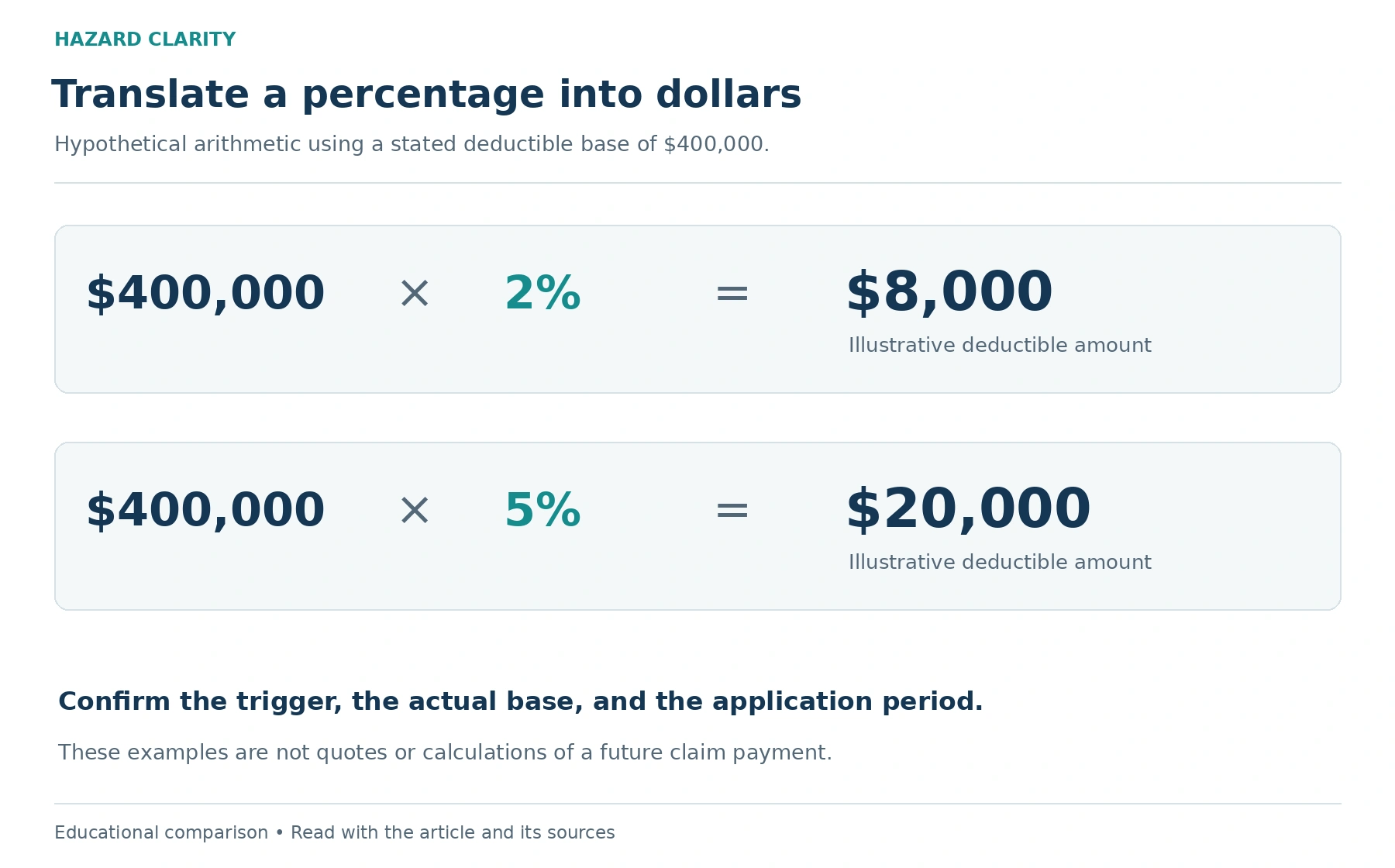
For a purely hypothetical illustration, if the stated base is $400,000 and the applicable percentage is 2 percent, the resulting amount is $8,000. At 5 percent of the same hypothetical base, it is $20,000. These examples demonstrate multiplication only; they are not quotes or predictions of a claim payment.
Write both the percentage and dollar amount in your comparison notes. Ask what happens if the relevant coverage base changes at renewal. A percentage can stay the same while the dollar amount changes, so reviewing only the percentage may miss an important budget difference.
Read the trigger rather than relying on the weather label
Ask which event or cause activates the special deductible. A television description, a weather app notification, or the informal phrase “big storm” does not necessarily reproduce the policy definition. Have the agent identify the actual wording and explain the applicable process.
Ask how the definition relates to timing and location. Some terms may refer to an officially classified event or a defined period, while other terms concern the type of loss. The details should be explained for the actual contract rather than generalized across insurers or states.
If two deductible labels appear potentially relevant, ask how the policy addresses that situation. Do not add amounts together or choose the smaller one yourself. The insurer must apply the contract and applicable requirements to the facts of the claim.
Confirm the period of application
Ask whether the relevant deductible applies per loss, per event, per calendar year, or according to another defined rule. This question matters if more than one storm occurs. It also matters when someone describes a deductible as already satisfied without explaining the basis.
Request the agent’s explanation of what records would be needed to establish prior covered losses or amounts credited under any applicable arrangement. Keep claim records and correspondence organized if a loss occurs. A general article cannot determine what credit applies to an actual later claim.
If you change insurers, ask whether and how that affects the deductible treatment. Do not assume an amount paid or credited under one policy carries into another. The actual insurer relationship, policy terms, and applicable state rules need review.
Florida has specific hurricane deductible guidance
Florida’s Department of Financial Services explains that state law addresses when a hurricane deductible applies, its duration, and its application during a calendar year. Its guidance also discusses insurer-group relationships and other important details. Florida owners should use that specific resource with their agent.
Ask the agent to show how the proposed policy reflects the applicable Florida rules. Include the hurricane trigger, dollar amount, relevant annual treatment, and the effect of changing insurers in the discussion. If you own more than one structure or a different property type, describe that arrangement explicitly.
Do not carry a simplified statement about Florida annual application into every policy or property situation. The official guidance contains conditions and distinctions. For location context, use HC’s Florida information while keeping the actual policy and current state guidance central to coverage questions.
Texas buyers should check wind and hail terms
The Texas Department of Insurance advises homeowners to ask whether the wind and hail deductible differs from the deductible for other damage. That difference can matter when comparing a roof-related proposal. Request the actual amounts and calculation method rather than assuming the ordinary deductible applies.
Ask where wind and hail coverage resides for the address and whether a separate policy or arrangement is proposed. If there is more than one policy, keep their terms and effective dates separate in the comparison. A low price on one part of the arrangement may not describe the total cost or exposure.
Use HC’s Texas information to prepare property questions. Then connect roof records and condition with the proposed settlement provisions and deductibles. A deductible calculation does not answer whether a particular roof loss is covered or how depreciation may be handled.
Louisiana owners should review the exact storm wording
The Louisiana Department of Insurance advises homeowners to review hurricane deductibles and flood coverage. Its consumer guidance discusses percentage-based named storm or hurricane deductibles. Use that material as a starting point and ask the agent to explain the exact label in your proposal.
Ask which event definition applies, what dollar amount results, and how the deductible operates under the actual contract. Keep any wind arrangement and flood policy visible as separate records where applicable. The terms should be understood before an approaching storm creates urgency.
Use HC’s Louisiana information for location research. Do not assume a neighbor’s deductible, insurer, or experience establishes the terms for your home. The property, policy, and claim facts need their own review.
Keep flood deductibles separate from wind questions
A storm can involve multiple mechanisms of damage. Homeowners and flood policies are different contracts, and their coverage definitions and deductibles must be reviewed separately. The phrase “hurricane deductible” should not be taken to mean that every water loss associated with a hurricane is covered by the homeowners policy.
Read HC’s flood coverage overview for background. Ask the licensed agent about the actual flood proposal, including building and contents terms where relevant, effective date, and any waiting-period issue. Do not wait to confirm timing until you need coverage immediately.
If a loss occurs, document observations and report it through the appropriate channels without deciding the cause yourself from a news headline. Coverage and deductible application depend on the actual contract and facts. Keep the insurer’s explanations and supporting records with the claim file.
Compare the full proposal rather than one number
When comparing two proposals, align the relevant coverage limits, settlement provisions, endorsements, exclusions, and deductible schedule as closely as possible. Ask the agent to explain remaining differences. A lower premium may reflect a higher amount you retain if a covered loss occurs.
Do not assume that a lower deductible always makes a proposal preferable. Consider the documented premium difference, your available funds, and the rest of the coverage. The decision should follow an accurate comparison and your budget rather than a universal recommendation about one percentage.
Use HC’s guide to comparing homeowners quotes to organize the discussion. Keep the actual proposed forms available so the comparison can be checked rather than reconstructed from a sales summary.
Use a hypothetical budget conversation
Imagine two proposals for a home with the same hypothetical $400,000 deductible base. One shows a 2 percent special deductible; the other shows 5 percent. The arithmetic difference is $12,000. That number becomes meaningful only after confirming that the same trigger and base actually apply to both proposals.
The homeowner asks the agent to compare the triggers, relevant coverage, settlement provisions, and premiums. The homeowner then considers how the documented retained amount would fit available funds. This is a budgeting conversation, not a calculation of the insurer’s payment for a future loss.
Other policy terms, exclusions, and claim facts can affect payment. Keeping that limitation visible prevents a simple multiplication example from becoming an unsupported promise that the insurer will pay every dollar above the deductible.
Review the terms before closing and at renewal
Before buying, confirm the final proposed arrangement, effective date, deductible schedule, and outstanding conditions. Save the current documents and agent explanation. Ask how any change in the property information or coverage amount affects the proposal before relying on it for closing.
At renewal, compare the dollar amounts and wording with the previous term. If something changes, ask why and what options are available. Keep the explanation with your records rather than assuming the deductible remained the same because the policy renewed automatically.
For your next step, write down every deductible in the proposal, its trigger, calculation base, and dollar amount. See how Hazard Clarity works to organize property context. Then use the actual policy and state-specific guidance to make the insurance discussion concrete.
Sources and reference material
Texas Department of Insurance — What to know about deductibles • Reviewed October 2, 2026
Texas Department of Insurance — Insurance and your roof • Reviewed October 2, 2026
Florida Department of Financial Services — Florida hurricane deductible • Reviewed October 2, 2026
Louisiana Department of Insurance — Hurricane season consumer tips • Reviewed October 2, 2026
Sources support the article’s factual foundations; the research workflow, worksheets, and hypothetical examples are original editorial guidance. Confirm current requirements and policy terms for the actual property before relying on a transaction-specific conclusion.
See this property’s own hazard picture.
Check an address