On this page
- Put the actual renewal date on the calendar
- Gather the complete document set
- Review what changed about the property
- Ask about the dwelling limit and its basis
- Read deductible changes in dollars
- Review belongings and special items
- Check the causes of loss you care about
- Ask about notices and required follow-up
- Compare alternatives with the same information
- Finish with a current household file
- Sources and reference material
A homeowners insurance renewal deserves a short review before you simply pay the bill. Check what changed about the home, what changed in the policy, and what the next term will cost and cover. A renewal review is useful even when you plan to stay with the same insurer and have no current claim.
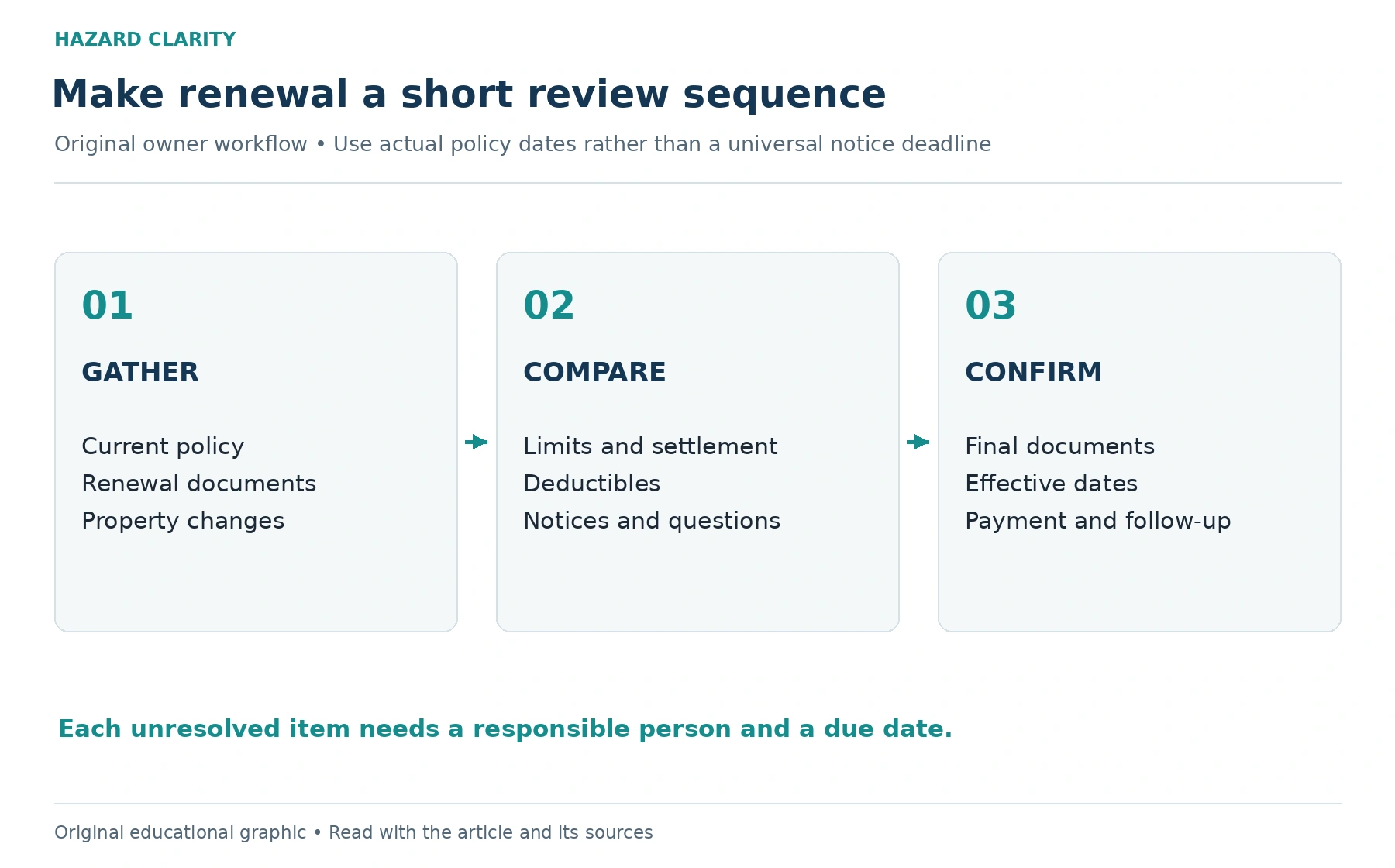
The National Association of Insurance Commissioners recommends reviewing insurance annually. You can turn that advice into a manageable calendar: gather the records, compare the current and proposed terms, ask questions, and confirm the final arrangement. Start early enough to resolve issues without making the renewal date your first day of research.
This guide provides an owner’s workflow rather than a state-specific notice deadline. Use the actual dates and instructions in your insurer’s documents. For a broader policy comparison, read HC’s guide to comparing homeowners insurance quotes. The renewal review begins with the property and contract you already have.
Put the actual renewal date on the calendar
Find the policy’s term dates and the insurer’s renewal documents. Record the time and date coverage begins and ends where the documents specify them. Add any payment, response, or documentation deadline. If something is unclear, ask the insurer or licensed agent rather than assuming the date printed on a bill tells the whole story.
Choose a personal review window that leaves time for questions. A reminder several weeks before renewal can be useful, but it is an organizational choice, not a universal legal notice requirement. The applicable rules and actual notice process vary. Follow the documents and obtain advice appropriate to your state and policy.
Keep one list of open items with a responsible person and due date. A coverage question, a requested photograph, and a payment task should not live in three disconnected notes. The purpose of the calendar is to complete the review while options remain available and avoid discovering an unresolved item after the next term begins.
Gather the complete document set
Collect the current declarations, policy form, endorsements, renewal proposal, change notices, and any correspondence describing requirements. A premium amount alone does not explain the contract. The declarations provide important details, while other documents can contain terms that change how the coverage applies.
Label the files by term and keep the current documents separate from the proposed renewal. If the insurer sends an amended proposal, identify which version is being offered. Do not compare an old preliminary quote with a later final arrangement without recognizing the difference. Ask the professional assisting you which set is complete.
Use a worksheet for the main questions rather than trying to memorize every page. Record the item, current term, proposed term, explanation, and action. Keep references to the relevant documents so you can return to the source. This method makes a review call more focused and helps prevent a verbal summary from replacing the actual policy.
Review what changed about the property
List significant improvements, additions, replacements, and changes in how the home is used. Include projects that may affect the information supplied to the insurer. A renovation invoice and a new roof record can be relevant documentation even if the overall address and household have stayed the same.
Describe completed work accurately. An estimate is not a completed project, and a partial repair is not a full replacement. If you are unsure how the insurer defines a requested detail, ask. Keep the contractor’s documentation and dates so the answer can be supported rather than guessed.
Mention relevant use changes, such as a home-based business, rental activity, vacancy, or other circumstances the insurer asks about. Do not assume the original application still describes the household. The licensed professional can explain how the current policy addresses your actual use and whether any change needs further review. Accurate information makes the conversation more useful.
Ask about the dwelling limit and its basis
Review the proposed amount of dwelling coverage and ask how it was established. The home’s sale price, land value, and the estimated cost to rebuild are different concepts. A rising real-estate value should not automatically be substituted for the insurer’s reconstruction estimate or the policy’s coverage basis.
Provide accurate details about the building and recent improvements. Ask whether the estimate reflects the home’s size, features, materials, and other relevant information. If a figure changed, request an explanation. The point is to understand the estimate and proposed terms, not to assume a percentage increase is either correct or excessive without context.
Read replacement cost versus actual cash value before discussing settlement language. Ask how the policy treats the dwelling and other relevant property, including any conditions or additional limits. A large stated limit does not answer every question about how a covered loss would be settled.
Read deductible changes in dollars
List each applicable deductible shown in the proposed documents and compare it with the current term. Ask whether different causes of loss use different deductibles and how those provisions apply. Do not assume a single number on the declarations describes every scenario relevant to the home.
If a deductible is a percentage, ask what base the percentage uses. Request a confirmed illustration of the dollar amount for that base. Keep the example with the policy reference and recognize that it explains the proposed terms rather than predicting a claim. A percentage applied to a coverage amount may differ substantially from the number you expected.
Use HC’s deductible explanation to prepare the questions. Then review the potential out-of-pocket amounts against your household’s available reserves. A lower premium paired with a larger deductible changes what you may need to manage after a covered loss. Evaluate both parts of the proposal together.
Review belongings and special items
Update your home inventory and identify significant purchases, sales, gifts, or changes in where items are stored. An older contents record may no longer represent the household. Bring the revised information to your insurance professional and ask whether the personal-property coverage and settlement terms remain appropriate.
Discuss special items and categories that may have different limits or need additional arrangements. Describe the actual property rather than relying on a broad total. An endorsement for one item does not establish the treatment of everything else. Keep any appraisals, receipts, and current policy documents together with the relevant inventory entries.
This review is also a chance to ask about business property and items stored away from the home. The inventory records ownership; it does not decide coverage. Obtain an explanation tied to the contract. If you change an option, request the final documentation and effective date so the inventory and insurance file stay connected.
Check the causes of loss you care about
Consider the property’s location and the questions raised by your home’s condition or history. Ask how the policy treats the relevant causes of loss, including any exclusions and optional protection. Do not assume every weather or water event is treated the same way because the premium includes a general homeowners policy.
Use Hazard Clarity’s property report to organize location questions, then take them to a licensed insurance professional. A hazard report cannot determine the coverage of a particular event. The actual contract, facts, and applicable requirements govern the insurance discussion.
If separate policies or endorsements are relevant, check their dates and payment arrangements alongside the homeowners renewal. Keep their documentation in the same household file while preserving each contract’s terms. A review that covers only the main bill can miss another policy’s renewal or an unresolved question about when additional protection becomes effective.
Ask about notices and required follow-up
Read every notice accompanying the renewal. Identify changes, requests, conditions, and the dates attached to them. If the insurer requests work or documents, ask exactly what is required and what evidence will be accepted. Keep the response with the notice rather than relying on your memory of a phone call.
Arrange appropriate evaluation for technical work. An insurance request does not make every repair a simple household task, and a contractor should understand the actual building condition before defining a scope. Ask the insurance professional how completion should be reported and whether confirmation is needed.
If you receive a nonrenewal notice instead of an ordinary renewal offer, treat it as a different process. Read HC’s nonrenewal guide and seek prompt professional assistance with the actual notice. This article’s routine calendar should not replace the deadlines or instructions in a formal notice.
Compare alternatives with the same information
If you seek other proposals, provide consistent property details and requested coverage so the comparison is meaningful. Record important differences in limits, deductibles, settlement terms, exclusions, endorsements, and conditions. Premium is one field in the comparison, not the entire decision.
Ask each licensed professional to explain material differences. A proposal may be attractive while still requiring changes before it meets your household’s needs or any lender requirements. Confirm what is being offered and what remains pending. A quote should not be treated as proof that coverage is already in place.
Avoid canceling an existing arrangement based on an unconfirmed replacement. Ask the responsible professionals how to coordinate effective dates, payment, and any required lender notification. Keep written confirmation of the final decision. The useful outcome is continuity you can document, with terms you understand, rather than a collection of estimates that never became an active policy.
Finish with a current household file
Once the renewal or replacement is arranged, save the final documents and confirm the effective dates, payment status, and contact information. Check that the address, named insureds, and relevant details are accurate. Ask about anything that still appears inconsistent. Keep obsolete proposals clearly labeled so they are not mistaken for active coverage.
Update the review worksheet with the answers and unresolved items, if any. Set reminders for promised follow-up and for the next annual review. Major property or household changes may deserve a conversation before that reminder arrives, so keep the agent’s contact information easy to find.
A useful renewal process produces three practical results: a current description of the home, a clear understanding of the proposed policy, and confirmation of the arrangement you selected. Learn how Hazard Clarity organizes property information and use that context to prepare focused questions. The final insurance decisions should rest on accurate records and the actual policy terms.
Sources and reference material
NAIC Your Annual Insurance Checkup • Annual review and changes at renewal; older general guidance used without claiming current state notice periods. Accessed October 2 2026.
NAIC Home Inventory • Belongings record as a coverage-review input. Accessed October 2 2026.
See this property’s own hazard picture.
Check an address