On this page
- Start with a manageable first pass
- Give each item a useful identity
- Keep receipts connected to the record
- Separate purchase price from policy settlement
- Give special items their own review
- Include the places you rarely look
- Distinguish household and business property
- Store the inventory where you can recover it
- Update through ordinary household events
- Use the file during an insurance conversation
- Sources and reference material
A home inventory is a record of what you own, supported by photographs and useful details. It helps you discuss personal-property coverage and gives you a starting file if you need to document a loss. The best inventory is the one you can find, understand, and keep current, rather than an elaborate project you never finish.
Start with a room-by-room walkthrough, then add detail for items that are expensive, unusual, or difficult to identify. Keep receipts and model information where available. You do not need to remember every purchase before you begin. A clearly labeled partial inventory is more useful than an empty folder waiting for perfect information.
The National Association of Insurance Commissioners offers a home-inventory resource and app. Your own system can also be simple: a spreadsheet, photographs, and a secure backup. This guide explains how to build a usable record and bring it into a conversation about what homeowners insurance covers.
Start with a manageable first pass
Choose one room and record what is there. Take wide photographs to show the space, then closer images of individual items. Name the room in the folder or file so someone reviewing the inventory can understand the organization. Continue through the home in a repeatable order rather than switching between categories at random.
A narrated video can help you remember details, but check that the lighting and audio are useful. Open closets and drawers only where it is appropriate and safe. Avoid filming sensitive documents or other people’s private belongings without permission. The objective is an ownership record, not a tour to post online.
Set a reasonable first-session goal, such as completing the main living area and one bedroom. Schedule the next session before stopping. A home inventory grows through small, consistent passes. If you wait until you can identify every serial number in the house, you may postpone the simplest and most valuable starting work.
Give each item a useful identity
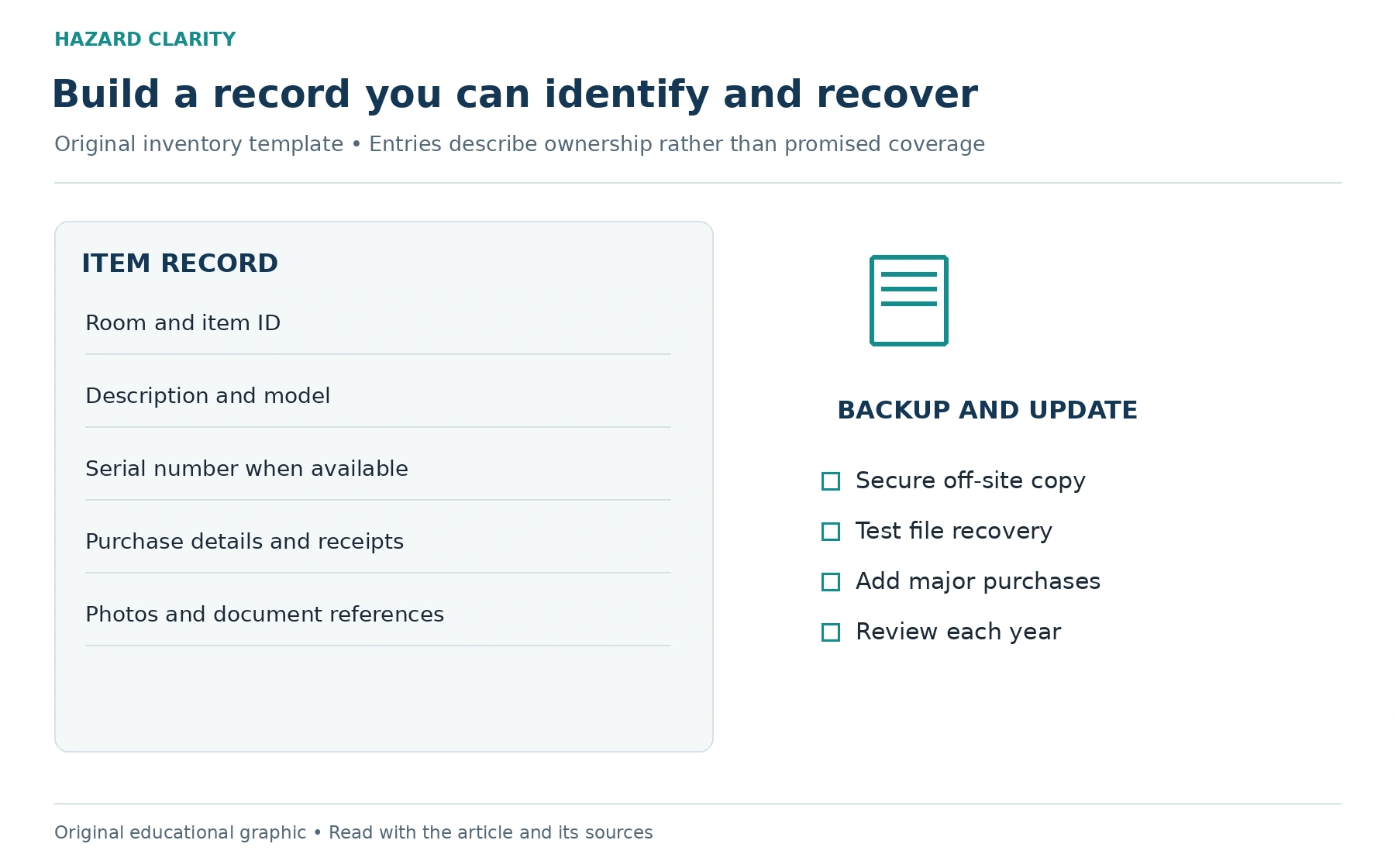
For important items, record a plain description, room, make, model, serial number when available, approximate purchase date, and supporting documents. Use a consistent item identifier to connect the record with its photographs and receipts. A label such as Kitchen 004 can work if it remains understandable to you.
Write down what you know and mark estimates honestly. An approximate purchase year should not be presented as a verified date. If you cannot find a receipt, keep the description and photographs anyway. Missing one field does not make the rest of the record useless, and you can improve it as additional information becomes available.
For similar everyday items, discuss with your insurance professional what level of detail would be useful. A household may choose a grouped record for ordinary kitchen utensils while documenting a specific appliance individually. The inventory should help identify ownership and support a conversation; it should not create false precision or invent evidence that does not exist.
Keep receipts connected to the record
Photograph or scan available receipts, invoices, appraisals, and purchase confirmations. Save each with the relevant item or include a clear reference in the inventory. A folder full of unnamed receipt images may be difficult to use later. A simple naming system makes the same evidence much easier to find.
Retain original documents where appropriate, especially for items with separate valuation or ownership records. If a receipt includes payment details, protect the file carefully. Consider keeping a working copy with unnecessary sensitive information removed while preserving the original in secure storage. Do not alter evidence in a way that misrepresents the purchase.
For gifts or inherited items, record the available history and ask an appropriate professional what documentation may be useful. Do not substitute a guessed retail price for a qualified appraisal. Your role is to assemble an accurate record. A specialist or insurance professional can explain whether additional valuation is needed for the purpose at hand.
Separate purchase price from policy settlement
What you paid for an item does not automatically establish what an insurance policy would pay after a loss. Coverage, limits, deductibles, exclusions, and settlement terms all matter. Keep the inventory’s factual ownership record separate from assumptions about reimbursement. A useful file supports a claim conversation without promising its outcome.
Read replacement cost and actual cash value explained to prepare for the terminology. Ask your licensed insurance professional how the actual proposed or current policy treats your belongings. Request an explanation of any conditions that apply to replacement-cost settlement rather than relying only on the phrase in a summary.
If you include values in the inventory, label their basis. Purchase price, a current estimate, and an appraisal are different records. Do not quietly replace one with another. This makes the file more credible and lets the professional helping you identify where the documentation is sufficient and where a particular item needs additional support.
Give special items their own review
Tell your insurance professional about jewelry, art, collections, equipment, or other items that may require a closer coverage discussion. A general personal-property limit should not be assumed to answer every category question. Ask whether the policy applies special limits or whether a separate endorsement or other arrangement is available and appropriate.
Bring the actual descriptions and supporting records to that conversation. The professional can tell you what information the insurer needs. For an unusual collection, an inventory might include individual entries, a catalog, photographs, and a qualified valuation where relevant. Avoid assigning a single invented total because documenting the pieces feels time consuming.
Keep the coverage decision with the item record. If you obtain an endorsement, save the relevant policy document and its effective date. If you decide against an option, keep notes about the question and the explanation you received. A future review becomes easier when you can see what was considered and which terms were actually selected.
Include the places you rarely look
The easiest items to miss often sit in garages, storage rooms, closets, sheds, or off-site storage. Add those locations to the inventory plan. Ask your insurance professional how the policy treats property away from the main home rather than assuming every location receives identical protection.
Document tools, hobby equipment, seasonal items, and the contents of storage containers at a level you can maintain. Label the location carefully, especially if items move between the house and another building. Keep a note when ownership is shared or an item belongs to someone outside the household. An inventory should describe what is actually yours.
Do not climb into unsafe spaces or handle hazardous materials just to finish the list. Record what can be documented responsibly and arrange appropriate assistance for the rest. The first inventory does not need to solve every access problem. It needs to identify the remaining work so it can be completed without avoidable risk.
Distinguish household and business property
If you work from home or keep business equipment at the property, bring that information into the insurance review. A personal home inventory does not establish that business property is covered under a homeowners policy. Describe how the items are used and ask the licensed professional to explain the applicable terms and options.
Keep separate lists if doing so makes ownership and use clearer. For example, a hypothetical household might have a personal laptop and several cameras owned by a business. The inventory should identify those distinctions instead of grouping everything under electronics. Clear records help the right professional ask the right coverage questions.
The same principle applies to rented or borrowed items. Record who owns the property and any relevant agreement. Do not include another person’s item as a personal purchase. Your inventory can note its presence without making a claim about coverage or responsibility. Questions about contractual obligations may require an appropriate legal or business adviser.
Store the inventory where you can recover it
Keep a backup outside the home and outside the single device used to create the file. A secure cloud account, another protected storage location, or a trusted arrangement can provide that separation. Choose a method you can access if your phone or computer is unavailable.
Protect the account with strong access controls and give only necessary people access. An inventory may reveal valuable belongings, personal routines, and sensitive purchase information. It should not sit in a publicly shared folder. Periodically check the sharing settings and confirm that links you no longer need have been removed.
Test the recovery process. Open the files from a second device or approved account and confirm that the photographs and documents are readable. A backup that cannot be opened is not a useful backup. Keep instructions for the household in a secure place so someone else can locate the file if the person who maintains it is unavailable.
Update through ordinary household events
Add major purchases when you make them and remove items that are sold, donated, or discarded. Note changes when belongings move to another location. These small updates are easier than rebuilding the entire inventory years later, and they keep the record closer to the household you actually have.
Use an annual review as a reminder to catch missed changes. Walk through the rooms, check the special-item list, and confirm that the backup still works. If you renovate, update records for new contents and keep the building project documents separately. An inventory of belongings and a file of structural improvements serve related but different purposes.
Assign responsibility in the household. One person can maintain the system while others send receipts or photographs of significant purchases. A shared process helps avoid gaps without giving everyone editing access to every sensitive document. Keep the method simple enough that additions take a few minutes rather than becoming another postponed project.
Use the file during an insurance conversation
Bring the inventory to your next coverage review and ask which categories deserve more detail. Discuss personal-property limits, settlement terms, special items, business use, and off-site storage. Request answers tied to the actual policy. An accurate list improves the conversation but does not make every item automatically covered.
If you experience a loss, follow the insurer’s reporting and documentation instructions and ask how to provide the inventory securely. Keep a copy of what you submit. Record additional information honestly and distinguish older records from observations made after the event. The insurer determines the claim under the contract and applicable requirements.
For location context, start with your address at Hazard Clarity. For belongings, start with one room today. A property report, an inventory, and a policy review work together by answering different questions. The practical result is a household file you can use before you need it and maintain as your life changes.
Sources and reference material
NAIC Home Inventory • Purpose and record tools. Accessed October 2 2026.
California Department of Insurance Home Inventory Guide • Practical inventory background; used as a national educational resource without importing state requirements. Accessed October 2 2026.
NAIC Your Annual Insurance Checkup • Personal property and special-item review. Accessed October 2 2026.
See this property’s own hazard picture.
Check an address