On this page
- Start with the association as well as the address
- Read the governing documents for responsibilities
- Request current financial information
- Distinguish inspections from reserve studies
- Follow the status of documented work
- Review meeting records for context
- Understand the association’s insurance layer
- Build the unit-owner policy around the actual unit
- Ask about loss assessments carefully
- Separate wind and flood questions
- Coordinate the transaction review early
- Make the condo decision with a complete file
- Sources and reference material
Buying a Florida condo means evaluating more than the unit you tour. Your decision also involves a shared building, an association, common expenses, maintenance responsibilities, and insurance that may be divided between the association and individual owners. The useful question is whether the documents explain how those pieces fit together.
A beautiful interior and appealing amenities can coexist with unanswered building or financial questions. That does not make the condo a poor choice. It means you need the right records and enough time to understand them before you commit.
This checklist helps you organize the review. It is an educational framework, not a statement of every document legally required in a particular transaction. Florida requirements can change and vary with the building and sale. Have your REALTOR, attorney, association contact, lender when applicable, and licensed insurance professional explain the records relevant to your purchase.
Start with the association as well as the address
Confirm the condominium association’s name, the building containing the unit, and the property covered by the documents you receive. A larger community may have multiple buildings or associations. A report or policy for one part of the property may not answer the question about yours.
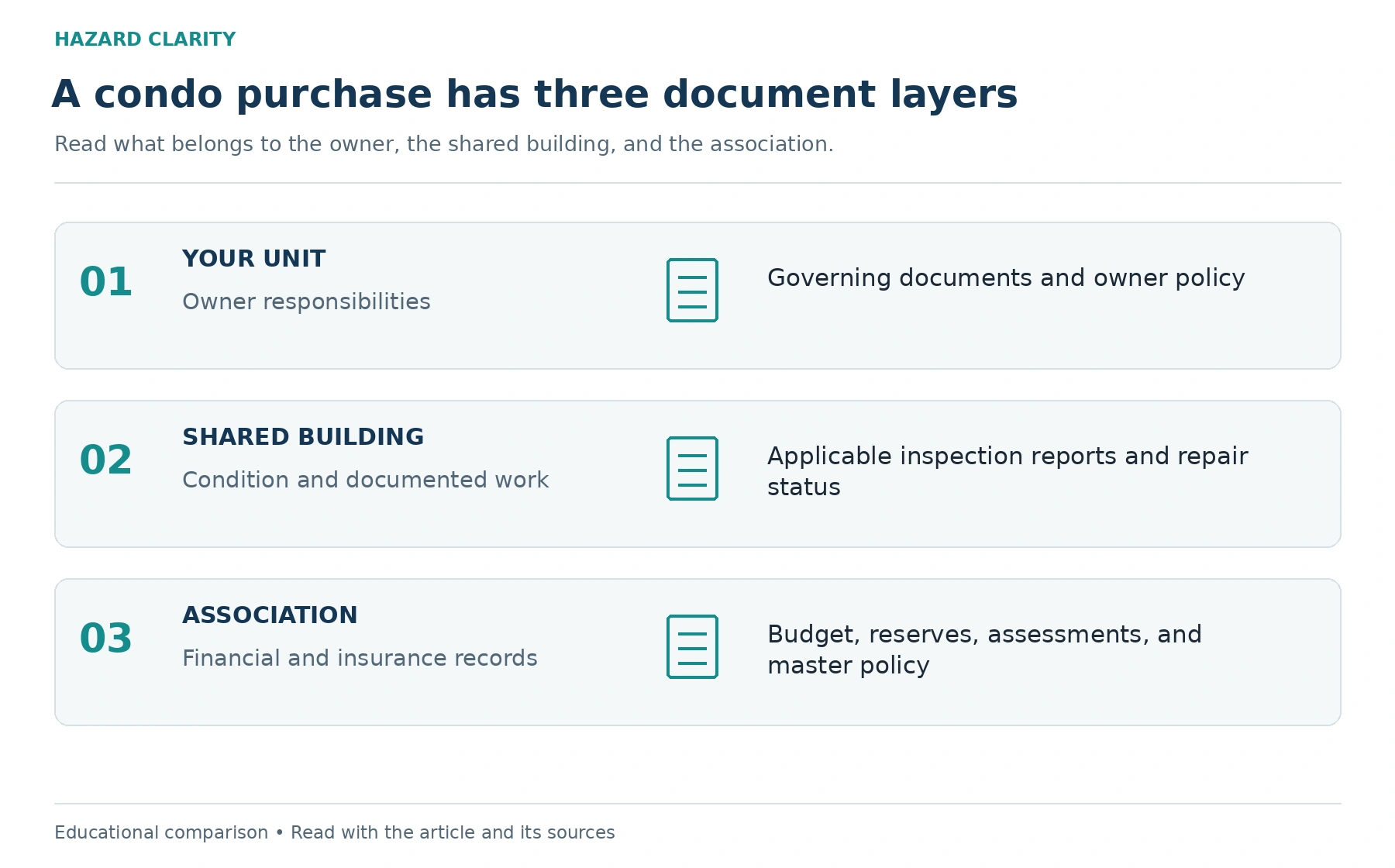
Create a file with separate sections for governing documents, financial information, building condition, insurance, and transaction questions. This simple separation makes gaps easier to see. It also helps you direct each question to the person who can answer it.
For local hazard context, review HC’s Florida page. Use the property information to prepare questions about the particular building rather than assuming every Florida condo faces the same conditions or uses the same insurance arrangement.
Read the governing documents for responsibilities
Request the relevant declaration, bylaws, rules, and amendments through the appropriate transaction process. These records help explain the association’s structure and the responsibilities assigned to unit owners. Ask your attorney or other qualified advisor to interpret provisions that affect your plans.
Focus on maintenance boundaries, alterations, access, use restrictions, and the process for approving work. A buyer planning new windows, a remodel, or rental use should understand the applicable rules before treating those plans as settled.
Do not rely on a casual description such as “the association handles everything outside.” The actual division of responsibility can be more specific. Ask how the documents treat the components you care about and which additional records or approvals would be needed.
Request current financial information
The association’s budget and available financial records help you understand what regular payments support. Ask what portion relates to operations, insurance, reserves, debt, and other commitments. Have a qualified advisor explain unfamiliar items rather than assuming a low monthly fee establishes affordability.
Review the current fee and any approved changes. Ask about outstanding or planned special assessments, how they are documented, and who is responsible for payment under the purchase agreement. An attorney can explain the contract allocation; a general article cannot decide it.
Your ownership budget should consider more than the advertised monthly amount. List known recurring charges, documented one-time obligations, your own insurance, and the costs of maintaining the unit. Keep uncertain amounts marked as questions until you receive reliable information.
Distinguish inspections from reserve studies
Florida’s Department of Business and Professional Regulation explains milestone inspections and structural integrity reserve studies as different tools. A milestone inspection addresses structural condition within the applicable program. A structural integrity reserve study helps plan funding for specified future maintenance and replacement needs.
Ask whether each applies to the building and request the relevant available reports, summaries, and updates. Applicability, timing, exemptions, and current requirements should be confirmed with qualified advisors or the responsible authorities. Avoid applying an older headline or another building’s deadline to your purchase.
Read what the report actually says. A completed study is not a promise that no future work will be needed. A reported repair is not fully explained until you understand its scope, status, funding, and any professional follow-up.
Follow the status of documented work
If reports identify repairs, request information about what has been approved, started, completed, or left unresolved. Ask for the applicable professional reports and association records rather than relying on a statement that the work is “being handled.”
A useful review connects the physical issue with its administrative and financial status. Who is overseeing the work? What records establish completion? Does the budget address it? Are there additional phases or decisions still pending?
You are not expected to perform your own structural analysis. The point is to identify whether the evidence supports a clear explanation and whether a qualified professional needs to answer remaining questions. Photos of fresh paint or a renovated lobby do not resolve the scope of a building report.
Review meeting records for context
Available board and owner meeting records can provide context about maintenance projects, insurance renewal, budgets, and proposed assessments. Ask for the appropriate records through your transaction contacts and review the dates carefully.
A discussion item is not necessarily an approved expense. An approved expense is not necessarily completed work. Keep those stages separate in your notes so a possibility does not become a certainty and a plan does not become a finished repair.
If a record references a supporting document, request that document. A short minute entry may summarize a longer proposal or report. Understanding the underlying information is more useful than interpreting a phrase in isolation.
Understand the association’s insurance layer
Request the available current insurance information for the association and have your licensed insurance professional review it. A certificate or brief summary may confirm certain facts without containing every term, exclusion, endorsement, or deductible that matters to your question.
Ask what property the association’s policy addresses and how that relates to the governing documents and your proposed unit-owner coverage. Do not assume the association’s policy replaces your own insurance needs.
Also ask when the policy renews and whether the available records describe a current policy or a prior term. The goal is to understand the actual arrangement at the time of your purchase. Avoid basing a long-term budget on an outdated summary or an informal promise about future premiums.
Build the unit-owner policy around the actual unit
Florida’s Department of Financial Services describes condominium unit-owner coverage as a separate policy category, commonly called HO-6. Your insurance professional should explain the proposal for your unit, including the relevant interior property, belongings, liability, and other applicable protection.
Bring information about improvements and how you plan to use the home. A primary residence, seasonal property, or rental use may raise different questions. Give accurate details and ask the professional to explain any conditions or exclusions rather than assuming a standard proposal fits every use.
Read the deductible and coverage limits alongside the premium. A lower price does not tell you whether the policy matches your needs. Request the documents necessary to understand the proposed protection and any remaining gap between the association and owner responsibilities.
Ask about loss assessments carefully
Loss-assessment coverage deserves a specific conversation. An assessment from the association is not automatically insured merely because your policy includes a line with that name. The underlying cause, policy conditions, exclusions, limits, and deductible treatment can matter.
Ask your agent to walk through the types of assessments you are concerned about using the actual proposed policy. Distinguish an assessment connected to an insured loss from ordinary maintenance, reserve funding, or other association expenses.
Avoid promising that a policy will cover every future assessment. Instead, keep a written explanation of the relevant terms and ask follow-up questions where the wording remains unclear. This is one place where a broad coverage label can conceal several different issues.
Separate wind and flood questions
Florida property research should keep wind-related and flood-related questions distinct. A hurricane can involve several mechanisms of damage, and the relevant policy response depends on the cause and coverage terms. The word “hurricane” alone does not establish which policy would respond.
Use HC’s Florida hurricane page for local context and its article on hurricane damage coverage to organize the insurance discussion. Ask how the association and unit-owner arrangements address the concerns relevant to this building.
Confirm any separate flood coverage and its scope rather than assuming the master policy includes it. The unit’s floor, common areas, building systems, and personal property can prompt different questions. A licensed professional can explain the applicable documents.
Coordinate the transaction review early
Create a list of outstanding documents and send it through the appropriate transaction contacts. Assign a responsible person and needed date to each item. This keeps the review moving and gives you time to ask follow-up questions.
If financing is involved, ask the lender about its condominium review requirements. A lender’s approval process is separate from your personal evaluation of costs, condition, and use restrictions. If you are paying cash, those ownership questions still deserve attention.
Have your REALTOR or attorney explain the applicable contract deadlines and document rights. Do not assume a request automatically extends your decision period. The strongest review connects documents, questions, and timing before the transaction reaches the final days.
Make the condo decision with a complete file
Before closing, summarize what you know about the unit, shared building, association finances, documented work, and insurance. Identify any remaining uncertainty and decide with your advisors whether more information is needed. Keep important answers in writing.
The objective is not to turn a condo purchase into a search for perfection. It is to understand the ownership arrangement you are entering and the responsibilities you may inherit. A clear file supports a more realistic budget and better professional questions.
Run the Florida address through Hazard Clarity as one part of that process. Pair location context with the building, association, and policy documents so the home you like is also a property you understand.
Sources and reference material
Florida Department of Business and Professional Regulation — Condominium inspections and reserve studies • Reviewed October 2, 2026
Florida Department of Business and Professional Regulation — Condominium and cooperative FAQs • Reviewed October 2, 2026
Florida Department of Financial Services — Homeowners insurance overview • Reviewed October 2, 2026
Sources support the article’s factual foundations; the research workflow, worksheets, and hypothetical examples are original editorial guidance. Confirm current requirements and policy terms for the actual property before relying on a transaction-specific conclusion.
See this property’s own hazard picture.
Check an address