On this page
- Identify the type of letter before summarizing it
- Match the document to the correct property
- Verify current status instead of relying only on the issue date
- Compare the letter with later property changes
- Track the lender requirement separately
- Make the insurance decision from actual terms and remaining exposure
- Keep local permitting questions independent
- Use an illustrative letter review to test the process
- Sources and reference material
A seller may tell you that a property was removed from a FEMA flood zone and hand you a letter as proof. That document can be important, but the buyer still needs to know exactly what it covers, whether it applies to the current property and map, and what the lender and insurer require. The phrase removed from the flood zone is too broad to finish the review.
A Letter of Map Change is a document with a defined purpose and scope. It should not be treated as a general assurance that water cannot reach the home, a construction approval, or an automatic instruction to cancel insurance. Reading the complete record is the first step toward asking the appropriate official and insurance questions.
This guide focuses on reviewing an existing FEMA letter during a purchase or ownership review. It complements a basic flood-map check by concentrating on document identity, the land or structures described, current status, and the handoff to the right people. It does not provide application engineering, certify eligibility for a map change, or decide a lender’s requirements.
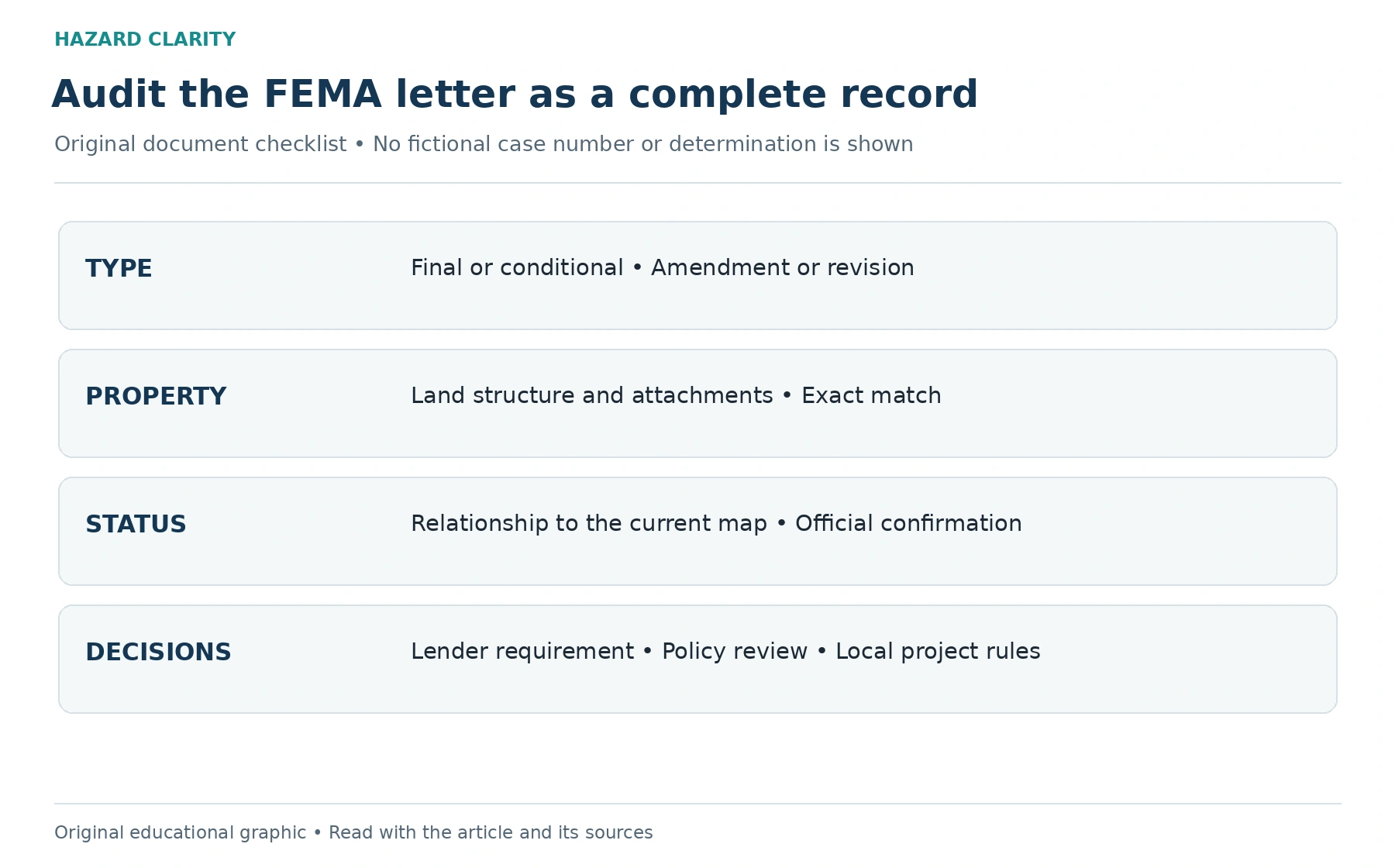
Identify the type of letter before summarizing it
FEMA uses different Letter of Map Change products. Its application guidance describes a Letter of Map Amendment, or LOMA, for relevant structures or land on natural ground, and a Letter of Map Revision Based on Fill, or LOMR-F, for relevant filled sites. FEMA also describes map revisions and conditional letters with their own purposes. These names should not be used interchangeably.
Read the actual title and determination instead of relying on the seller’s shorthand. A conditional document concerning a proposal is not the same as a final determination about completed conditions. If the letter’s meaning is unclear, ask FEMA or the local floodplain administrator to explain it and identify any additional records needed for your question.
HC’s FEMA flood-zone guide offers a starting point for locating the current map information. Keep that map reference beside the letter, while preserving the distinction between the two. The letter may address a specific land area or structure in ways that are not apparent from a broad map screenshot.
Match the document to the correct property
Check the community, address, legal description, case information, map-panel reference, and any attachments identifying the affected land or structures. Match them to the property under review with help from the appropriate professional when necessary. An old street name or changed parcel configuration can make the match less obvious, so do not rely on a familiar address alone.
Ask whether the determination concerns a structure, an entire parcel, or a portion of land. A letter relating to the house should not be casually extended to every outbuilding or all land on a larger parcel. Read the description and attachments for the stated scope. If multiple structures are involved, identify which ones are included and which need a separate question.
Retain the full document rather than only the first page or a cropped image of a favorable sentence. An attachment can carry the details needed to understand the determination. If the seller has only an excerpt, request the complete record through the appropriate official source. Keep the item open until the missing material is available or an authoritative explanation resolves the scope.
Verify current status instead of relying only on the issue date
An older letter can require review in relation to the current effective Flood Insurance Rate Map. FEMA provides information about LOMA revalidation statuses, reflecting how map updates and related records can affect earlier determinations. The practical buyer question is whether the document remains applicable to the current map and the property being discussed.
Ask the local floodplain administrator or FEMA how to confirm the current status using the case and map identifiers. Preserve the official response and any related revalidation document. Do not infer current validity solely because a letter is signed, appears on agency stationery, or was used by a prior owner. Authenticity and current applicability are different parts of the review.
If the available status is unclear, describe that uncertainty accurately to the lender and insurance professional. An open verification question is not the same as a determination that the letter is invalid. Conversely, the absence of an obvious problem in a casual search should not be presented as confirmation. The goal is a documented answer from the appropriate source.
Compare the letter with later property changes
Ask what construction, grading, additions, or other site changes occurred after the document’s underlying records were prepared. Gather the available plans and permits and ask the appropriate official or professional whether they affect the question being reviewed. A buyer should not assume the earlier determination answers a changed property configuration.
If the letter identifies one structure and a later addition is present, request clarification rather than extending the description yourself. Similarly, a new outbuilding may need its own inquiry even if the original house is clearly identified. Keep the changes in sequence so the official reviewing the file can see what existed when and which document describes it.
This is a records comparison, not a technical determination about elevations or map-change eligibility. A surveyor, engineer, or other appropriate professional may be needed for specific measurements or application work. Ask what scope is necessary and confirm the deliverable. Do not attempt to turn a consumer map measurement into a certified elevation or a completed FEMA application.
Track the lender requirement separately
Provide the complete verified letter and relevant current information to the lender through its requested process. Ask what review it requires and which documentation confirms its decision about flood-insurance requirements. Do not assume that a seller’s statement or an earlier lender’s decision determines what your lender will require.
A lender may have its own requirements and review procedures. Your useful task is to obtain the decision relevant to your loan and property, identify any outstanding documents, and retain the response. Completing that administrative review does not resolve every physical water concern or establish which insurance choice is appropriate for the owner.
If the loan process and official letter verification are proceeding at different speeds, track them separately with responsible contacts and dates. Ask your transaction professionals how unresolved items affect the purchase timeline. This article does not establish contractual deadlines, a right to delay closing, or a lender’s obligation to accept a particular document without its review.
Make the insurance decision from actual terms and remaining exposure
A map determination is not a promise that flooding is impossible. The homeowner should still review relevant water exposure and discuss flood insurance with a qualified insurance professional. Ask what the proposed coverage addresses, what limits and deductibles apply, and which property information is used. A changed requirement and a personal coverage choice are related but distinct questions.
HC’s flood insurance coverage explanation helps frame why ordinary homeowners coverage and flood coverage need separate review. Ask about the actual documents rather than assuming a letter creates coverage under another policy. Likewise, do not cancel an existing policy simply because someone summarizes the letter as good news.
If you are considering a change, request the appropriate process and effective-date information before acting. Keep any lender response and insurer explanation in the file, but do not paraphrase one as the other. The lender addresses its requirement; the insurer explains the available coverage and terms. The owner can then make a decision with those roles clearly identified.
Keep local permitting questions independent
If you plan work on the property, ask the local floodplain and building officials which requirements apply to the proposed project. A FEMA letter should not be treated as a blanket authorization for construction, grading, or other changes. Describe the actual work and provide the document so the official can explain how it relates to the local review.
Retain written permits, conditions, and project records where applicable. If an official requests additional professional information, put that on the project checklist. The fact that the purchase file contains a map letter does not eliminate the need to investigate new work. Each future project has its own facts, scope, and approval questions.
Keep the record of official guidance distinct from your own interpretation. A short note about a call is useful, but attach the written response or referenced instructions when available. The next owner or provider should be able to see the source of the conclusion rather than inherit an unsupported statement that the parcel has no flood-related restrictions.
Use an illustrative letter review to test the process
Imagine a buyer who receives a LOMA identifying the main house on a larger property. The seller describes the entire property as out of the flood zone. The buyer reads the scope, gathers the complete attachments, matches the structure, and asks the appropriate official about current status. A detached structure and the remaining land stay separate questions until the records address them.
The buyer then submits the relevant verified material to the lender and asks the insurance professional to review coverage options. If an addition is planned, the buyer brings the proposal to local officials. This process does not reject the letter’s value. It uses the document precisely, allowing each decision to be made with the evidence and authority appropriate to that question.
Store the letter, attachments, status verification, current map reference, lender response, and insurance correspondence together. Add later project records as the property changes. A useful FEMA-letter file explains which determination applies and what it leaves open, helping a buyer move beyond shorthand and giving an owner a dependable starting point for the next review.
Sources and reference material
FEMA Paper Application Forms for Letter of Map Changes • LOMA, fill-based, and conditional document distinctions; indexed official text reviewed. Reviewed October 3 2026.
FEMA Letters of Map Revision and Conditional Letters of Map Revision • Revision versus conditional proposal scope; indexed official text reviewed. Reviewed October 3 2026.
FEMA LOMA Revalidation Statuses • Current-map relationship and status review; indexed official text reviewed, direct retrieval blocked. Reviewed October 3 2026.
See this property’s own hazard picture.
Check an address