On this page
- Define what you are actually buying
- Put the deadlines in writing
- Arrange an appropriate home inspection
- Add location and hazard research
- Review water questions separately
- Shop insurance before the final days
- Understand title and recorded interests
- Confirm boundaries and access when they matter
- Review associations and recurring obligations
- Make repairs a documented decision
- Verify the closing process and payment instructions
- Finish with a clear ownership plan
- Sources and reference material
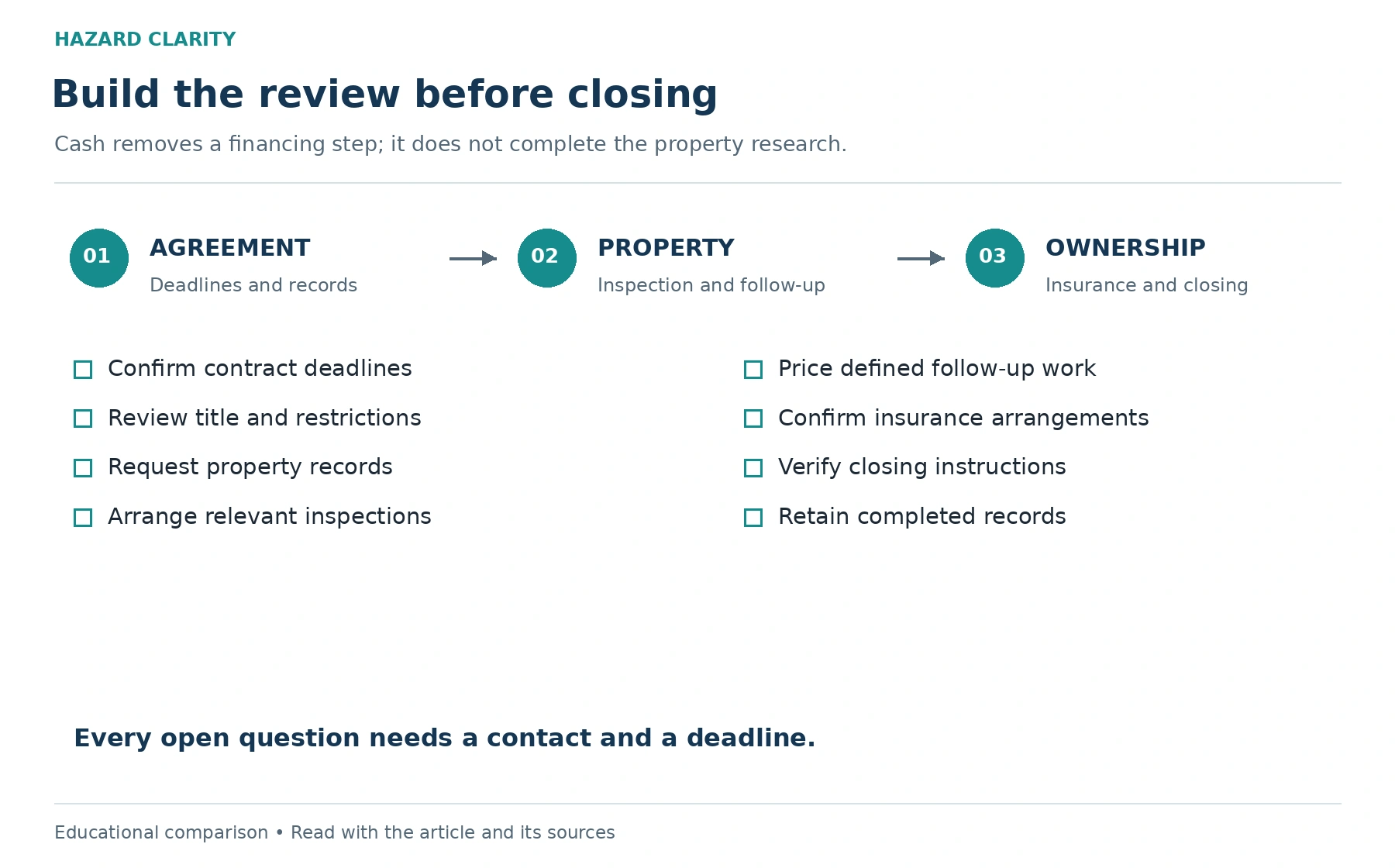
Buying a home with cash can simplify the financing side of a transaction, but it does not answer the questions that come with owning the property. You still need to understand the building, location, title, insurance options, recurring costs, and any rules affecting how you plan to use the home.
The difference is that you may have fewer lender-driven prompts to complete those checks. That makes your own due-diligence plan especially useful. A cash purchase should give you flexibility to organize the review, not a reason to skip the information you need.
This checklist is designed for buyers who want a clear process without unnecessary complexity. It does not prescribe the terms of your offer or replace advice from your REALTOR, attorney, inspector, closing professional, or insurance agent. Use it to make sure the property questions receive as much attention as the payment method.
Define what you are actually buying
Confirm the property address, legal description, included improvements, and items conveyed under the purchase agreement. Ask about detached structures, shared access, equipment, and other features that matter to your plans. An attractive listing description is not the final inventory of what transfers.
Be especially careful when the purchase includes multiple parcels, unusual boundaries, or a shared facility. Ask your closing professional or attorney which records establish the transaction’s scope. Do not assume a fence, driveway, or landscaping edge proves a legal boundary.
Write down how you intend to use the property. A primary home, seasonal residence, rental, or renovation project can raise different questions. Clear plans help your advisors identify relevant documents and prevent a late discovery about a restriction you never thought to ask about.
Put the deadlines in writing
Start with the purchase agreement and identify each due-diligence period, document deadline, and closing obligation. Have your REALTOR or attorney explain what the contract permits and requires. A cash offer does not create a universal right to cancel or investigate indefinitely.
Make a calendar for inspections, specialist appointments, insurance review, title questions, and any association documents. Put the decision date beside the appointment date. Receiving a report is not the same as leaving time to understand it and request clarification.
If something takes longer than expected, ask your advisor how to address the timeline. Do not assume an unanswered email or pending appointment automatically extends a contractual deadline. The checklist works best when research tasks and transaction obligations are managed together.
Arrange an appropriate home inspection
An inspection remains a useful way to understand observable condition even when no lender is involved. Ask about the inspector’s qualifications, written scope, exclusions, and report format. Share the concerns you already have so the inspector can explain what the service can address.
The Consumer Financial Protection Bureau encourages an independent inspection early in the purchase process. That general preparation step is valuable to cash buyers as well. You are protecting your own understanding of the property, regardless of whether someone else is financing it.
Ask separately about additional evaluations that may be relevant. A sewer line, septic system, private well, radon concern, pool, or structural question may require another service. Avoid assuming the general inspection includes every component, test, or concealed condition.
Add location and hazard research
The building is only one layer of the purchase. Review the property’s location and any hazard information relevant to it. Nearby water, wooded land, slopes, coastal exposure, and local weather conditions can lead to different questions about maintenance, documents, or insurance.
HC’s guide to checking natural-disaster risk before buying can help organize the starting point. Keep the source and date of meaningful findings. Ask whether a result describes the parcel, building, neighborhood, or a larger area.
Do not treat a category or color as a purchase instruction. The goal is to identify what deserves confirmation and which professional can explain it. A hazard report complements your inspection and document review; it does not replace them.
Review water questions separately
If the home has a basement, sits near water, or shows possible drainage concerns, separate the questions about flooding, sewer backup, seepage, and plumbing. They can require different evaluations and different policy discussions. One general statement about “water” may leave important details unexplained.
Ask for available disclosures, prior event descriptions, repair invoices, and relevant maps or surveys. Discuss observable conditions with your inspector and ask whether specialist review is appropriate. Keep an unresolved question visible rather than converting missing information into reassurance.
For flood mapping, begin with HC’s FEMA flood-zone guide. Confirm unclear boundaries with the appropriate official or professional. The absence of a lender’s flood-insurance requirement does not answer your personal coverage or ownership questions.
Shop insurance before the final days
A cash buyer may not have a loan officer requesting proof of coverage, but the insurance conversation still belongs early in the process. Ask a licensed professional what information is needed and request written options for the actual property and intended use.
Use HC’s insurance questions before buying a house to prepare. Compare the protection and policy terms alongside the premium. Ask about deductibles, exclusions, effective dates, and any separate coverage relevant to the address.
Do not assume a quote guarantees that every remaining requirement has been satisfied. Ask what must happen for coverage to begin and whether an inspection or additional documentation is needed. Put the confirmation task on your closing checklist rather than leaving it as a general intention.
Understand title and recorded interests
Have the closing professional or attorney explain the title review and any exceptions, easements, liens, or recorded interests relevant to the purchase. Ask which documents you should receive and which unresolved items need attention before closing.
An easement can affect how part of a property is used without being obvious during a tour. A recorded restriction may matter to a planned addition, driveway change, or other project. Ask about the specific use you are considering instead of requesting a broad assurance that everything is fine.
Discuss owner’s title insurance and what the proposed policy does and does not address. Cash financing does not make every title question disappear. The relevant decision is how you want to understand and manage the ownership interests being transferred.
Confirm boundaries and access when they matter
Ask whether a survey or other boundary information is available and whether additional work is appropriate for your circumstances. A past document may be useful, but a qualified professional should explain its relevance and limitations.
If access is shared, clarify the applicable recorded arrangements and maintenance responsibilities. If you plan to build, fence, subdivide, or alter the property, ask local authorities and your advisors what approvals and records are needed. Do not treat an informal neighbor agreement as the entire legal answer.
Your due diligence should match your plans. A buyer who wants an immediate addition may need questions answered that another buyer would not prioritize. Recording those plans early helps prevent the checklist from becoming generic paperwork that misses the decision you are actually making.
Review associations and recurring obligations
For a property in an association, request the relevant governing documents, budget information, fees, assessments, and use restrictions through the appropriate process. Understand the responsibilities assigned to the owner and the association. An attractive amenity package does not explain the full arrangement.
Ask about approved or proposed changes and distinguish discussion from a binding obligation. Your attorney can explain contract responsibility for an assessment. Your insurance professional can explain how association coverage relates to your own policy.
Include the recurring costs in your budget even if you have no mortgage payment. Utilities, insurance, association charges, maintenance, and applicable taxes remain ownership considerations. Use verified property information rather than assuming another owner’s total cost will match yours.
Make repairs a documented decision
After inspections and specialist reviews, organize findings by the action needed. Some may be routine maintenance. Others may require clarification, a repair scope, or a contractor estimate. Avoid letting the number of report entries substitute for an understanding of their significance.
Ask qualified professionals to explain proposed work and its limitations. If the transaction includes repairs or credits, have your REALTOR or attorney document the agreed terms appropriately. A verbal plan can leave disagreement about who performs the work, when it occurs, and what completion means.
Do not assume cash status makes every repair negotiation simpler. The agreement and available evidence still matter. A clear record helps you decide what to request and what responsibilities you would accept after closing.
Verify the closing process and payment instructions
Ask your closing provider how the transaction will be completed and how to verify payment instructions through a trusted channel. Use contact information established independently rather than relying solely on a new email or unexpected change.
The CFPB warns buyers about closing-related scams. Treat last-minute payment changes as something to verify directly with the known closing professional. The urgency of a closing date should not replace the verification process.
Keep your checklist focused on confirmed tasks: documents reviewed, questions resolved, insurance arranged, final walkthrough scheduled, and payment process verified. An organized cash purchase can move efficiently while still protecting the quality of your decisions.
Finish with a clear ownership plan
Before closing, summarize what you know and what remains uncertain. Keep inspection reports, specialist evaluations, policy documents, title information, and relevant association records together. Identify the first maintenance tasks you plan to address after taking possession.
You do not need to prove that the home has no possible future problem. You need enough reliable information to understand the purchase and your responsibilities. Cash removes a financing layer; it does not remove the value of thoughtful property research.
Run the address through Hazard Clarity as part of your own checklist. Pair the location context with physical inspections and document review, then make the decision using the answers that matter to your ownership plans.
Sources and reference material
Consumer Financial Protection Bureau — Schedule a home inspection • Reviewed October 2, 2026
Consumer Financial Protection Bureau — Shop for title insurance and closing services • Reviewed October 2, 2026
Consumer Financial Protection Bureau — Buying a house • Reviewed October 2, 2026
Sources support the article’s factual foundations; the research workflow, worksheets, and hypothetical examples are original editorial guidance. Confirm current requirements and policy terms for the actual property before relying on a transaction-specific conclusion.
See this property’s own hazard picture.
Check an address