On this page
- Identify the property and responsible authority
- Request the records already available
- Walk the site with questions rather than assumptions
- Keep guidance and enforceable requirements distinct
- Ask what maintenance will look like after closing
- Review the building as well as the surroundings
- Clarify shared boundaries and responsibilities
- Discuss insurance with accurate information
- Put the purchase deadlines around the work
- A hypothetical review produces a practical plan
- Keep a record you can maintain
- Sources and reference material
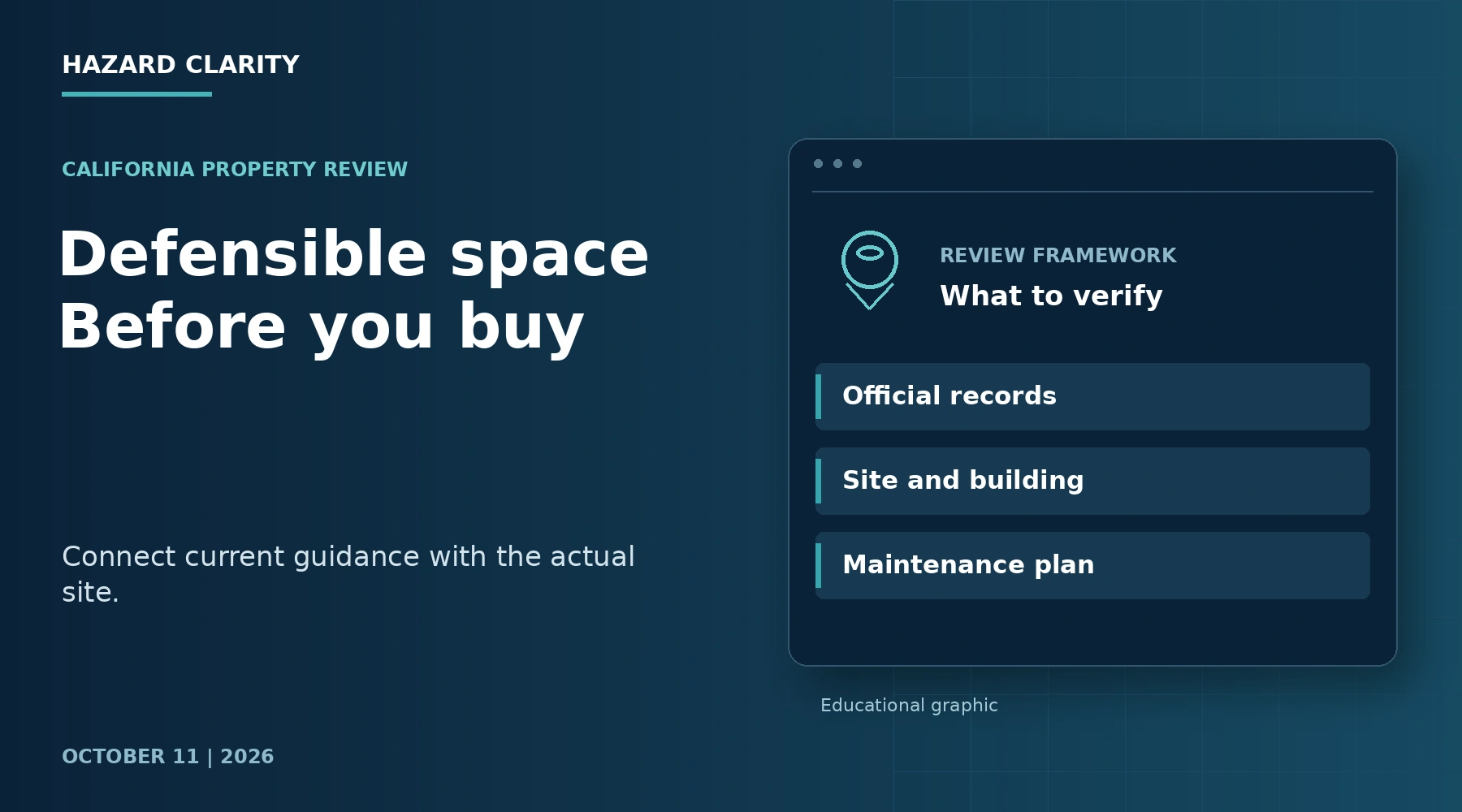
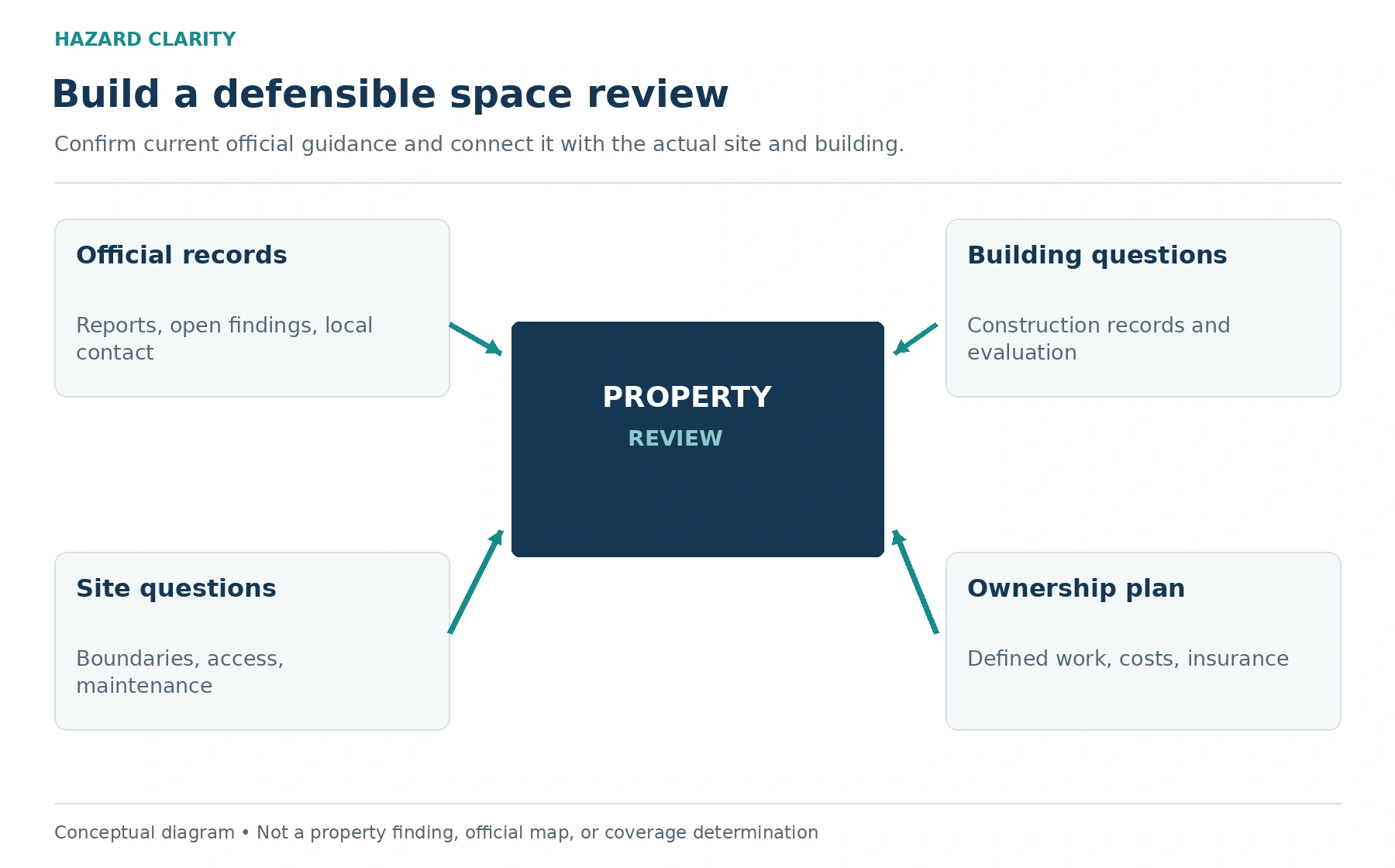
Defensible space belongs in a California homebuyer’s research before the moving truck arrives. The question is not simply whether the yard looks tidy. You need to understand the available records, the property’s maintenance needs, the authority responsible for guidance, and the work you would take on as an owner.
CAL FIRE describes defensible space as part of wildfire preparation alongside home hardening and evacuation planning. These subjects work together, but they are distinct. Managing vegetation around a building does not establish the condition of the building itself, and neither provides a guarantee that a home will avoid wildfire damage.
Start with HC’s California property information. Then use this guide to prepare a documented review of the site, the building, applicable requirements, and the proposed insurance arrangement.
Identify the property and responsible authority
Confirm the address, parcel information, and jurisdiction before collecting advice. Ask which local fire agency or other authority can explain the requirements and available inspection process for the property. California properties do not all have identical administrative circumstances, so generic statewide advice needs a local check.
Keep the official source, contact, date, and scope of each response. If someone provides guidance about a nearby property, ask whether it also applies to the address you are buying. A general neighborhood description is useful context, but it is not a property-specific inspection or determination.
Ask your transaction professional which notices, records, or inspections should be requested under the actual purchase agreement and applicable process. This article is a preparation guide, not a complete statement of California disclosure or transfer law. Use qualified guidance for the transaction-specific obligations.
Request the records already available
Ask the seller for defensible-space inspection reports, notices, correspondence, maintenance invoices, and relevant work records. Request complete documents with dates rather than a statement that the property “passed.” You need to know what was inspected, what findings were recorded, and whether any work remained open.
If a report identifies corrective work, ask for the follow-up record. An invoice may show that a contractor was paid for a task, while an authority’s record may address a different question about inspection status. Keep both documents and ask which evidence is needed to resolve the concern.
Record missing information honestly. “No report provided” should not turn into “no issues found.” It means you still need to determine whether a relevant report exists, whether an inspection should be requested, and what you can learn before the purchase deadline.
Walk the site with questions rather than assumptions
During the property review, note the areas close to the building, decks, accessory structures, and other features that may deserve discussion. Ask an appropriate professional to explain the relevant maintenance priorities. Do not use a buyer’s casual walk-through as proof that the site meets an official standard.
Ask how the slope, lot configuration, access, and boundaries affect the work that can be performed. A broad recommendation to clear vegetation may require clarification about ownership, permission, protected resources, or other site restrictions. Identify those constraints before budgeting for a major landscape change.
Photographs can help document questions and planned work. Label their locations and dates so a professional can understand what you are asking about. Keep the images as records of observed conditions, not as a self-issued compliance certificate.
Keep guidance and enforceable requirements distinct
Official educational guidance can explain mitigation priorities. The requirements applicable to the property need confirmation from the relevant authority. Ask which rule or process applies, what work is expected, and how completion is evaluated. That makes the response more usable than a general reassurance.
California’s Board of Forestry and Fire Protection publishes Zone 0 guidance and regulatory updates. As of the October 2, 2026 review for this draft, its page described final regulatory review as ongoing. Buyers should verify current status and property applicability rather than rely on an assumed statewide implementation date.
Save the guidance used for your decision and check it again before publication, closing, or starting work if time has passed. If a requirement changes, ask the authority how the change affects your property and planned work. Avoid treating an older article as the final legal answer.
Ask what maintenance will look like after closing
Request an explanation of routine tasks, seasonal needs, and work requiring specialized equipment or expertise. Ask how access is obtained and who performs the work. A property can involve recurring obligations that are easy to overlook when attention is focused on the purchase price.
Separate an initial cleanup estimate from an ongoing maintenance plan. Ask the contractor to identify the scope, exclusions, disposal, and anticipated follow-up. If the seller recently completed work, ask what still needs monitoring and how quickly conditions may require another visit.
Build a realistic ownership budget using property-specific estimates. Do not assume a small yard means low maintenance or a large lot means unaffordable work. The actual site, access, requirements, and chosen services determine what you need to plan for.
Review the building as well as the surroundings
Ask about available documentation of roof materials, openings, vents, attachments, and completed improvements relevant to wildfire preparation. Have the home inspector explain what is included in the inspection and whether specialist review is appropriate. Concealed construction may require records or additional investigation.
CAL FIRE treats home hardening and defensible space as related parts of preparation. A vegetation assessment does not answer every building question. Keep separate notes for the site and structure so an improvement in one area does not erase uncertainty in the other.
If a seller describes the home as hardened, ask for the basis of that claim. An invoice, permit, product specification, and inspection finding provide different kinds of information. Ask the qualified evaluator what those records establish and which parts of the building remain unverified.
Clarify shared boundaries and responsibilities
Ask who owns and maintains the land around the structures. Review association documents, easements, and other relevant records with the appropriate transaction professional. If maintenance depends on a neighbor or shared area, identify the actual arrangement rather than assuming the seller’s informal practice will continue.
Do not plan work beyond the property boundary without confirming permission and applicable requirements. Ask how unresolved conditions on adjacent land should be handled through the responsible authority or agreement. A buyer’s desire to improve the surroundings does not create a right to alter someone else’s land.
If the property is part of an association, request current records of relevant work and responsibility. Ask what owners must do themselves and what the association handles. Include anticipated assessments or shared costs in the budget when the documents establish them.
Discuss insurance with accurate information
Request insurance proposals early and provide accurate property records. Ask which mitigation documents the insurer considers, what requirements remain outstanding, and whether an inspection or completed work is needed. A property’s advertised features do not guarantee coverage availability or price.
Read HC’s article on wildfire and homeowners insurance for background. Then ask the licensed agent to explain the actual proposal, including limits, deductibles, exclusions, conditions, and effective date. Keep the response tied to the quoted policy.
If someone predicts a discount, ask the insurer which evidence it requires and whether the quoted premium already reflects it. Avoid counting a possible future adjustment as money you have already saved. Your purchase budget should use documented terms and clearly label unresolved items.
Put the purchase deadlines around the work
Schedule record requests and any recommended inspection early enough to review the results. The Consumer Financial Protection Bureau encourages prompt inspection arrangements. Your purchase agreement governs the actual deadlines and available choices, so have your real estate professional explain how the timing works.
If corrective work is proposed, ask whether it can be completed before the relevant deadline and how completion will be documented. Ask who is responsible for access, payment, permits where relevant, and follow-up. A vague promise to “take care of the yard” may not describe the work needed.
If work remains for you after closing, obtain a defined scope and estimate. Consider whether the expense, timing, and remaining uncertainty fit your plans. The decision should reflect the actual property and agreement rather than a universal rule to accept or reject homes in a particular area.
A hypothetical review produces a practical plan
Imagine a buyer reviewing a hillside California home. The seller provides a recent landscape invoice and an older inspection notice. The invoice does not clearly identify every item in the notice. The buyer also plans to replace a deck after moving in.
The buyer requests the complete records, asks the responsible authority about the inspection status and current guidance, and has the planned deck work reviewed through the appropriate process. A contractor then provides a defined maintenance scope. The insurance agent reviews the accurate property information and explains the proposed terms.
This illustrative process may leave some questions open, but it identifies them before they become assumptions in the purchase budget. It is not a claim about a real property, a compliance finding, or an insurance outcome.
Keep a record you can maintain
After closing, retain official reports, maintenance invoices, before-and-after photographs, relevant permits, and insurance correspondence. Record completed tasks separately from planned work. Set a review routine that follows current official guidance and the property’s actual maintenance needs.
Emergency planning deserves its own attention through local official resources. Know where to obtain current instructions and how to keep household plans updated. A property research report can support awareness, but it cannot replace live emergency information.
For your next step, ask for the property’s existing defensible-space records and identify the responsible local contact. See how Hazard Clarity works to organize location context, then connect that information with the site review, building evaluation, maintenance budget, and actual insurance proposal.
Sources and reference material
CAL FIRE — Defensible space • Reviewed October 2, 2026
California Board of Forestry and Fire Protection — Defensible space zones and regulatory updates • Reviewed October 2, 2026
CAL FIRE — Get ready for wildfire • Reviewed October 2, 2026
Consumer Financial Protection Bureau — Schedule a home inspection • Reviewed October 2, 2026
Sources support the article’s factual foundations; the research workflow, worksheets, and hypothetical examples are original editorial guidance. Confirm current requirements and policy terms for the actual property before relying on a transaction-specific conclusion.
See this property’s own hazard picture.
Check an address